
Delivery & Marketplaces

Your refund queue assumed the photo was real.

Every credit you issue for a cold meal, a missing item or a damaged package rests on a photo a stranger uploaded from a phone. That assumption is now the cheapest thing in the world to fake. TruthScan scores the photo and the receipt before the credit clears.

Seconds End-to-end verdict
2 APIs Image and PDF, purpose-built
Heatmaps Evidence for every decision
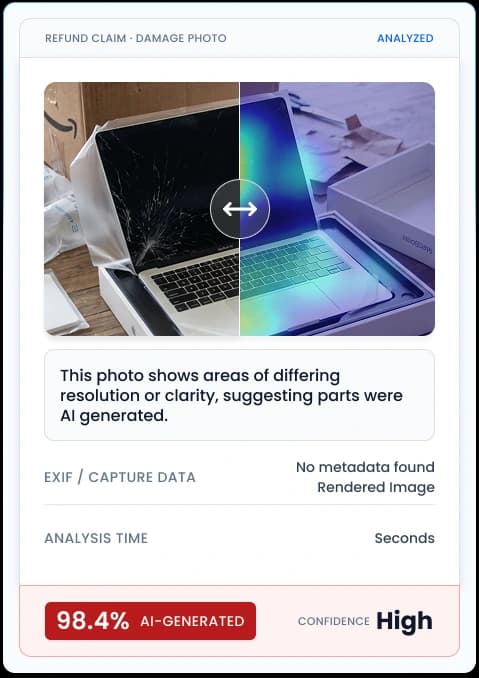
Refund claim damage photo analyzed for AI generation

THE THREAT

A refund claim is now three prompts and forty seconds of a stranger's time.

The economics of your claims queue were built on friction: a customer had to actually damage something, actually photograph it, and actually lie about it. Generative image tools removed all three costs at once. The fraudsters who used to file one claim a month can now file one an hour, at scale, across every account they control β€” and your reviewers are still eyeballing JPEGs.

In seconds

End-to-end verdict on an uploaded photo, versus 10–15 minutes for a manual reviewer to reach a less defensible conclusion.

2 APIs

Image detection for the damage photo, PDF detection for the receipt or invoice attached to the same claim.

Every claim

Scored, not sampled. Metered per scan, so covering 100% of your queue is a line item, not a program.

ATTACK PATTERNS

Three attack patterns we see every week in delivery

These are not hypotheticals. They are the shapes of the claims that clear review today, written the way your fraud analysts would describe them.

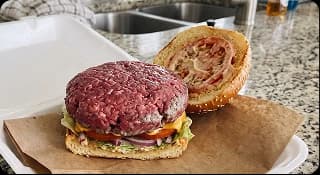
AI-generated raw food photo used in a refund claim

The raw-food photo credit scam

A customer orders a meal, receives it intact, then generates an image of the same dish visibly undercooked or spilled and files for a full credit. The photo is plausible because the model was asked to make it plausible β€” correct packaging, correct branding, correct lighting for a doorstep at 8pm. A human reviewer under a 30-second SLA approves it.

PROMPT RECONSTRUCTED FROM A FLAGGED CLAIM

"photo of a takeout burger, raw pink center, in an open branded clamshell container, kitchen counter, phone camera, slightly blurry"
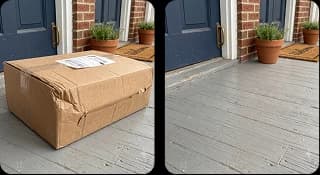
Doorstep package dispute photos side by side

The never-arrived package with a doorstep photo

The inverse of courier proof-of-delivery: the claimant generates an image of an empty porch, or of a package that is visibly crushed, to dispute a delivery that completed normally. Because your own proof-of-delivery photo and their dispute photo are both just images, the dispute becomes a credibility contest your agent cannot win.

WHAT THE REVIEWER SEES

Two photos of the same porch. One is real. Nothing in the claims UI tells the agent which.

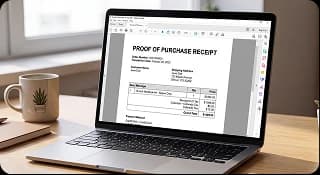
Doctored proof of purchase receipt on a laptop

The doctored proof of purchase

For higher-value claims you ask for a receipt or an order confirmation. Fraudsters now regenerate the PDF wholesale rather than editing it β€” no clone-stamp artifacts, no font mismatch, OCR-clean, and it passes every format and checksum validation you have, because it is a structurally valid document that simply describes a transaction that never happened.

WHY FORMAT CHECKS MISS IT

A regenerated PDF is not a tampered PDF. There is nothing to tamper with. The forgery is the document.

RECEIPT DETECTION MODULE

Proof-of-purchase is where delivery fraud gets expensive

Low-value claims are settled on the photo alone. The moment a claim crosses your auto-approve threshold and you ask for proof of purchase, you have moved the fight to documents β€” and a generated receipt costs the fraudster nothing. Run receipts through detection on the same claim record as the photo.

See the Fake Receipt Detector

$16.8M

in fraudulent receipts caught by one enterprise customer in a single 30-day period, surfaced by batch-scanning receipts that had already cleared human review.

ONE ENTERPRISE CUSTOMER Β· 30-DAY PERIOD Β· FIGURE PENDING INTERNAL VERIFICATION BEFORE PUBLISH

THE ENGINES

Two detection engines. Two purpose-built APIs. One platform.

Photos and documents are different forensic problems, so we solve them with different models behind two dedicated APIs. You call the one that matches the artifact β€” and you review both in one dashboard, under one contract, through one vendor review.

IMAGE DETECTION API

Scores the damage photo

Detects generated, in-painted and manipulated imagery in claim evidence β€” and returns a heatmap showing which regions drove the verdict.

  • Full-frame generative detection across current diffusion models
  • Localized in-painting detection β€” the real photo with a fake dent added
  • Capture-provenance signals: EXIF, device fingerprint, render artifacts
  • Heatmap overlay your agent can attach to the denial

PDF DETECTION API

Scores the receipt or invoice

Forensics for documents attached to the same claim: receipts, order confirmations, repair quotes and proof-of-purchase PDFs.

  • Detects fully regenerated documents, not just edited ones
  • Template-reuse matching across your own claim history
  • Structural, font and object-layer forensics beneath the OCR text
  • Verdict and evidence returned in the same one-to-two-second budget
They are separate APIs, called separately. A single fraudulent submission usually carries both a photo and a document, so most teams call both and merge the verdicts in their own decision layer. End to end, the whole process takes one to two seconds.

WHERE IT SITS

Inside the claims flow, before the credit clears

TruthScan is a scoring step, not a decision engine. You keep the policy; we give the policy something true to run on.

STEP 01

Claim submitted

Customer uploads a damage photo and, above your threshold, a proof of purchase.

STEP 02

Both artifacts scored

Your service calls the Image API for the photo and the PDF API for the document. In seconds, end to end.

STEP 03

Your policy decides

You decide the thresholds: auto-approve, route to review, or deny with evidence attached.

STEP 04

Evidence retained

Heatmap and forensic report are stored on the claim record, so the denial survives a chargeback dispute.

DEFENSIBILITY

A denial you can actually defend

The hardest part of fraud ops is not catching the claim. It is denying it in a way that survives the customer's appeal, the chargeback, and the regulator asking why you treated one customer differently from another.

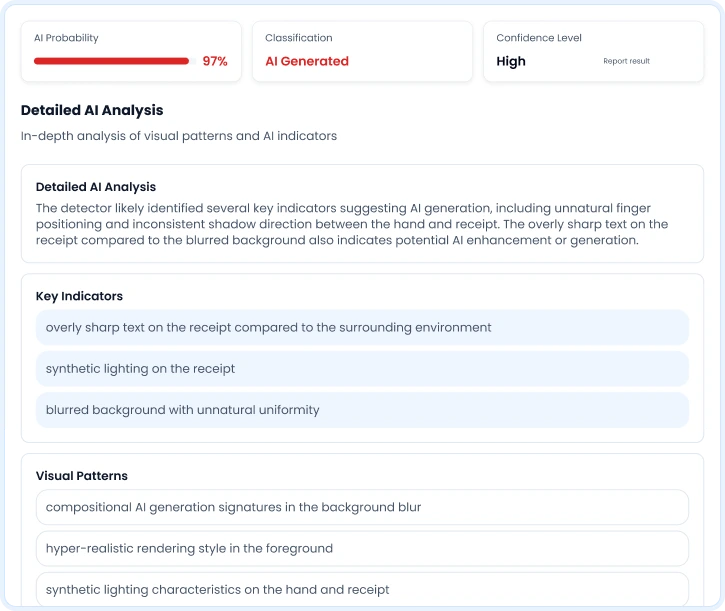
Detailed AI analysis report for a denial decision
  • Heatmaps, not just scores. Your agent can point at the region of the image that failed, which turns "our system flagged you" into "here is what we found."

  • Consistent thresholds. Every claim is scored by the same model at the same threshold, which is the substance of a defensible, non-discriminatory denial policy.

  • A retained forensic record. Model version, timestamp and evidence are stored with the claim, so a dispute six months from now is answerable.

  • Human review where it matters. Detection ranks the queue. It does not fire your reviewers β€” it stops them from spending their day on the 97% of claims that are honest.

COMPLIANCE & DEPLOYMENT

Enterprise-grade by default

AICPA SOC certification seal

SOC 2 Type II

Audited controls

Independently audited security, availability, and confidentiality controls, renewed annually.

ISO 27001 certification seal

ISO 27001

Certified ISMS

Certified information security management across the full platform and API surface.

GDPR compliance seal

GDPR

Privacy-first processing

DPA available. Enterprise customers can pin processing to the EU.

Regional or on-site deployments seal

Global Infrastructure

Regional & On-site

UK, EU and on-premise deployments for Enterprise.

TECHNOLOGY FEATURED IN

Forbes logo
Business Insider logo
Nature logo
CBS News logo
Yahoo logo
BuzzFeed logo

Forensic Grade AI Fraud Prevention

Get full forensic reports - heat maps, key indicators, and detailed descriptions.

Free

$0/month

Try the full engine

  • 25 results/month (images + PDF pages)
  • Detailed indicators on every result
  • Full API access
  • Detection history in dashboard
  • Free forever β€” no trial period

Starter

$24/month

$0.03 / result - $290/yr

For individuals and small teams

  • 1,000 results/month included
  • $0.03 per additional result
  • CSV export of result history
  • Batch uploads
  • Audit-ready detection reports
  • Standard support
MOST POPULAR

Professional

$83/month

$0.02 / result - $990/yr

For teams in production

  • 5,000 results/month included
  • $0.02 per additional result
  • Priority processing queue
  • Higher API rate limits

Business

$333/month

$0.01 / result - $3,990/yr

For high-volume operations

  • 40,000 results/month included
  • $0.01 per additional result
  • Zero Data Retention (ZDR)
  • Highest self-serve rate limits
  • Priority support

Enterprise

Customize a Plan For Your Needs

$0.005 or less per result

Contact Sales
  • Discounts scale with volume
  • Custom SLAs with service credits
  • Zero Data Retention (ZDR)
  • Custom integrations
  • Custom MSA and DPA
  • Dedicated throughput
  • Named 24/7 account team
  • Dedicated / on-prem deployment

No hard quota walls β€” usage is simply metered at your plan's rate. Custom contracts, SLAs, DPAs, and hosting environments are available exclusively on Enterprise. All plans include SOC 2 Type II compliance.

FAQ

What delivery and marketplace teams ask us first

Find out how much fake content got through last quarter.

Send us a sample of claims that already cleared review. We will run them through both engines and show you what got through β€” with heatmaps.

NO CARD REQUIRED Β· UNLIMITED SEATS ON EVERY PLAN Β· SOC 2 TYPE II Β· ISO 27001 Β· GDPR