
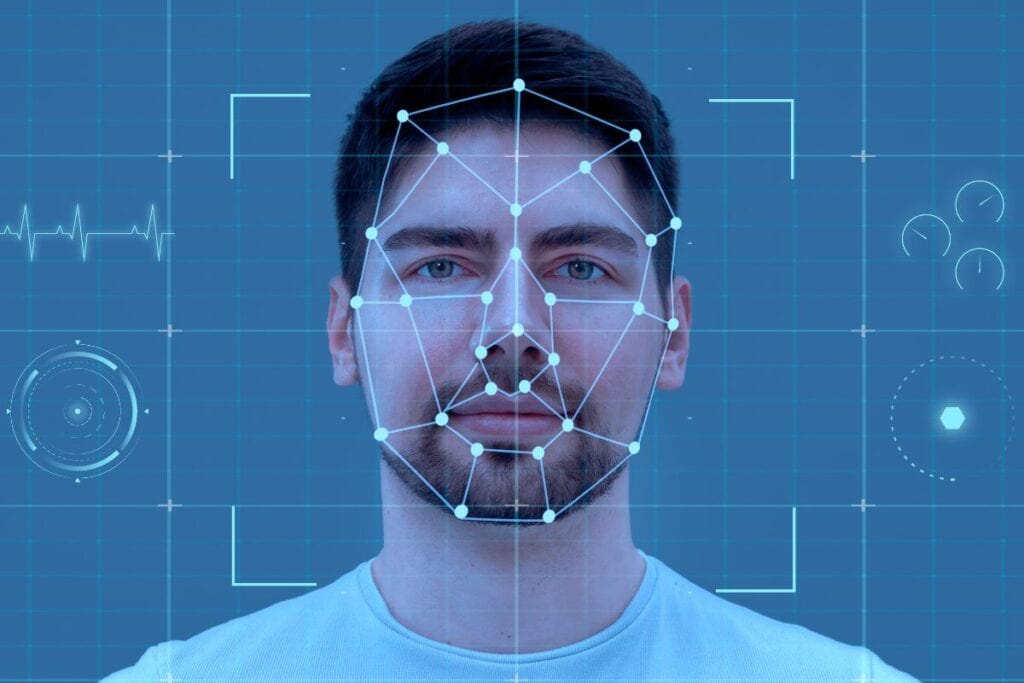
A new customer opens an account on a Tuesday night. The ID looks clean, the selfie matches and the liveness check passes in four seconds. Three weeks later the account is moving stolen funds, and the person in the selfie never existed.
That’s the problem KYC verification is meant to stop, and it’s also why KYC looks different in 2026 than it did even two years ago. The checks are the same on paper. The attacks against them are not.
Here we explain what KYC verification is, the checks it includes, the rule changes that landed in the US and EU this year, and where AI-generated identities now slip through.
What Is KYC Verification?
KYC stands for Know Your Customer. It’s the process regulated businesses use to confirm a customer is a real person, is who they claim to be and isn’t a sanctions, fraud or money laundering risk.
Banks, brokers, payment companies, crypto exchanges and many fintech apps are legally required to do it. A growing number of marketplaces, gig platforms and lenders do it voluntarily because fraud costs more than verification.
In practice, KYC is not one check. It’s a set of steps at onboarding, plus ongoing monitoring for as long as the customer relationship lasts.
Never Worry About AI Fraud Again. TruthScan Can Help You:
- Detect AI generated images, text, voice, and video.
- Avoid major AI driven fraud.
- Protect your most sensitive enterprise assets.
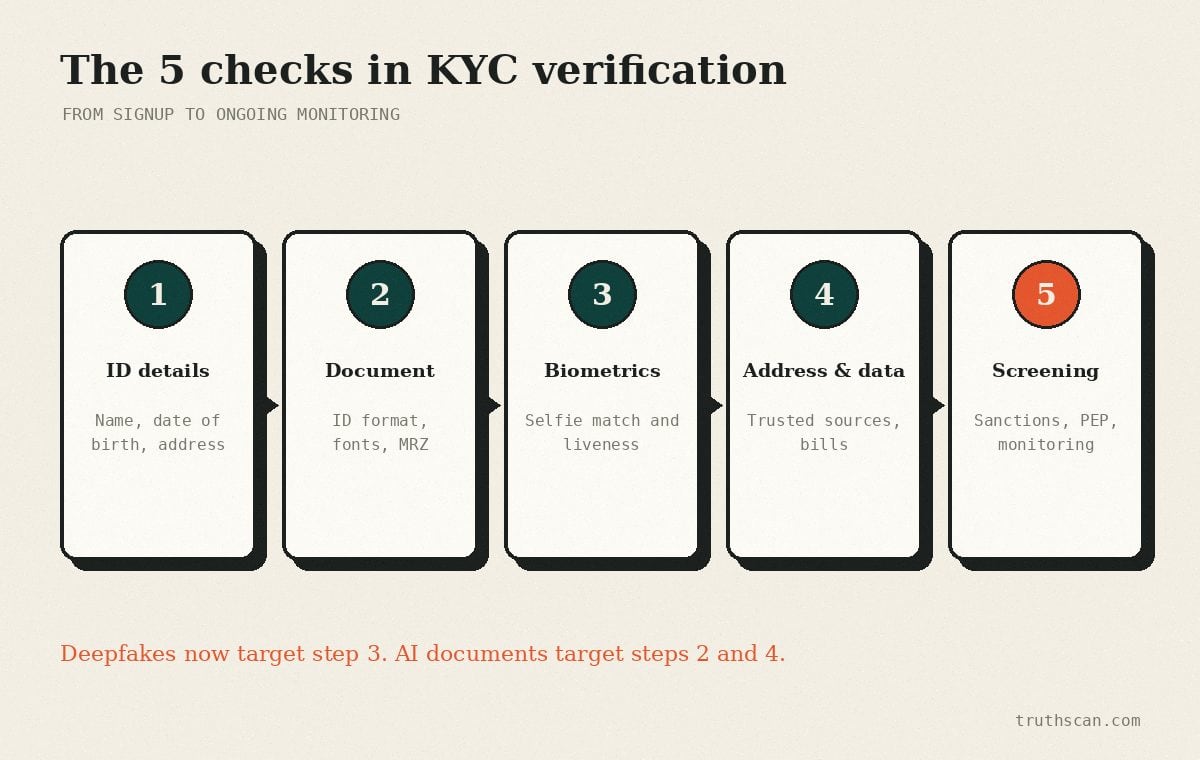
The 5 Core Checks in KYC Verification
1. Customer Identification
The customer provides basic details: full name, date of birth, address and an identification number. In the US this is the Customer Identification Program, or CIP, required for banks under the Bank Secrecy Act.
2. Document Verification
The customer uploads a government ID. Software checks the format, security features, fonts and data fields, and compares the text on the front with the machine-readable zone or barcode.
3. Biometric and Liveness Check
The customer takes a selfie or short video. The system matches the face to the ID photo and checks that a live person is present, not a printed photo, screen replay or mask.
4. Address and Data Verification
Details are checked against trusted data sources, utility bills or bank statements. Our guide on address verification covers how this step works and where it fails.
5. Screening and Ongoing Monitoring
Customers are screened against sanctions lists, politically exposed person lists and adverse media, then monitored over time. Higher risk customers get enhanced due diligence with deeper checks on source of funds.
Types of KYC Verification
| Type | How it works | Best for |
|---|---|---|
| Traditional KYC | Documents checked in person or by mail | Branches and high value accounts |
| eKYC | ID upload, selfie and data checks online | Most apps and online banks |
| Video KYC | Live call with an agent who checks the ID | Higher risk or regulated markets |
| Reusable KYC | Verified identity shared from a wallet or provider | Faster repeat onboarding |
| Perpetual KYC | Profiles updated when risk signals change | Large banks and fintechs |
Most businesses now run eKYC by default and step up to video or manual review only when something looks wrong. Reusable and perpetual KYC are growing fastest, helped by digital identity wallets and the EU’s push for event driven reviews.
KYC vs CDD vs AML: What’s the Difference?
| Term | What it means | Where it fits |
|---|---|---|
| AML | Anti money laundering, the full program and laws | The umbrella |
| KYC | Verifying who a customer is | Part of AML |
| CDD | Understanding the customer’s risk and ownership | Part of KYC |
| EDD | Deeper checks for high risk customers | Extension of CDD |
| KYB | KYC for business customers and their owners | Parallel to KYC |
What Changed in KYC Rules in 2026
United States
In February 2026, FinCEN granted banks and other covered institutions relief from re-verifying a business customer’s beneficial owners every time it opens a new account. The details sit on FinCEN’s CDD rule page.
In November 2026, FinCEN followed with a proposed rule to strengthen customer due diligence, including clearer expectations to dig deeper when other risk signals appear. Comments are open, so the final shape may still change.
European Union
The EU’s new Anti-Money Laundering Regulation applies from 10 July 2027. Under it, KYC files must be reviewed at least yearly for high risk customers and every five years for others, according to this AMLR summary.
The same package leans heavily on digital identity. EU countries must offer a European Digital Identity Wallet by the end of 2026, which should make remote onboarding faster, as EY explains in its onboarding guide.
Why KYC Is Under More Pressure Than Ever
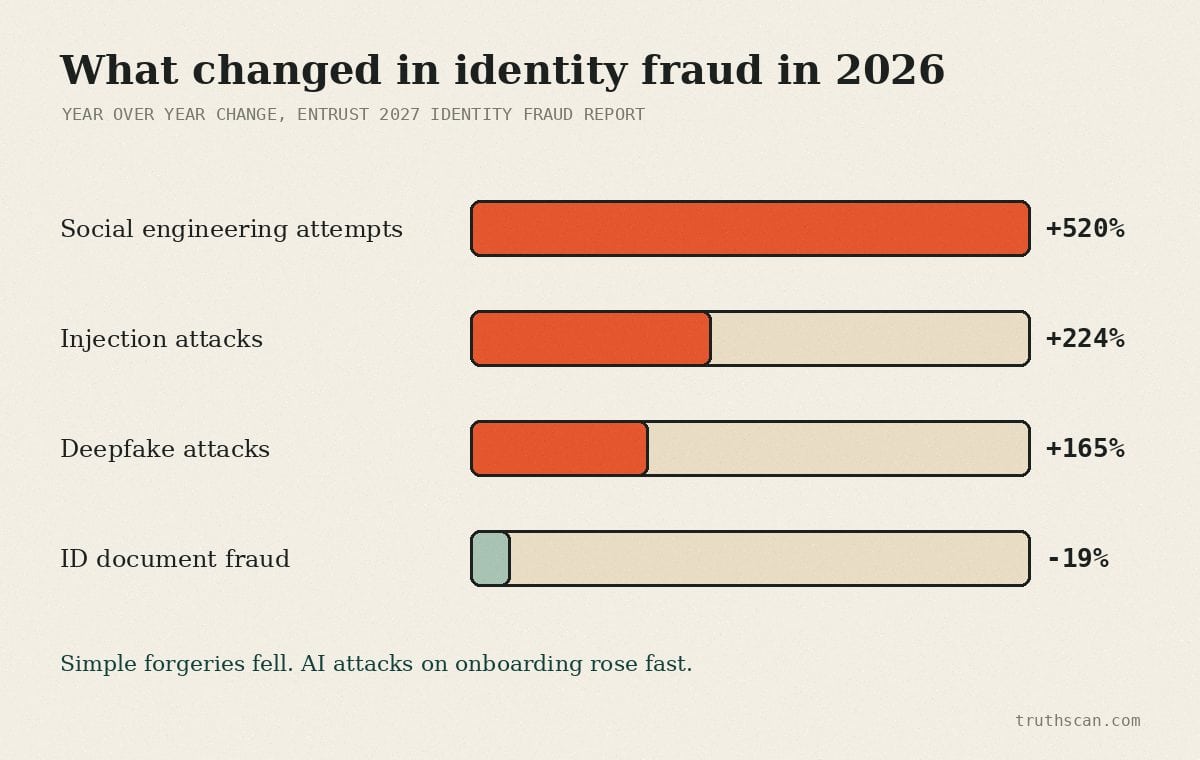
Basic document forgery is actually falling. Entrust’s 2027 fraud report found overall ID document fraud dropped 19% in 2026 as simple edits got easier to catch.
The attacks that replaced it are harder. The same report found deepfake attacks rose 165% year over year, about one every three minutes, and injection attacks rose 224%. Financial services accounted for 94% of the deepfakes it detected.
How Deepfakes Beat KYC Checks
Synthetic Faces
Fraudsters generate a face that belongs to no one and use it on both a forged ID and the selfie. The face match passes because both images show the same fake person.
Face Swaps During Liveness
Real time face swap tools place a victim’s face over the fraudster’s during a video check. Blinking, head turns and smiles all look natural because a real person is moving underneath.
Injection Attacks
Instead of pointing a camera at a screen, the attacker feeds a prepared video straight into the app through a virtual camera or emulator. The liveness check never sees a real camera at all.
AI-Generated Documents
Image models can now produce believable bank statements, utility bills and payslips with consistent fonts and totals. These often support the address and income steps rather than the ID itself.
KYC in Different Industries
Banks and Lenders
Banks run the strictest programs, with full CIP, beneficial ownership checks for businesses and ongoing transaction monitoring. Lenders add income and employment checks, which is where fake payslips and statements show up.
Crypto and Payments
Exchanges and payment apps face heavy onboarding fraud because new accounts can move money quickly. Sign up bonuses and instant transfers make them a favorite target for synthetic identities.
Marketplaces and Gig Platforms
Delivery apps, rental platforms and freelance marketplaces verify sellers and workers to stop account sharing and fake profiles. Many aren’t legally required to run KYC but do it to protect customers and payouts.
Insurance
Insurers verify policyholders at signup and again at claim time, when AI-edited photos and documents are most likely to appear.
Common KYC Challenges for Businesses
- Drop off: every extra step loses legitimate customers during signup.
- False rejects: strict thresholds block real people with older IDs or poor cameras.
- Manual review backlogs that slow approvals, as covered in our KYC timing guide.
- Privacy and data security concerns, discussed in our guide on KYC safety.
- Checks built for paper forgeries that miss AI-generated media.
Red Flags KYC Reviewers Should Watch For
- A selfie that looks studio lit while the ID photo looks like a phone snapshot.
- Several applications that share a face, device or address but use different names.
- Liveness videos with no camera noise, or a perfectly steady frame.
- Statements and bills with flawless formatting but totals that don’t add up.
- A new account that tries to move large amounts within hours of approval.
None of these proves fraud alone. Together, they tell a reviewer where to spend time instead of approving or rejecting by gut feeling.
How to Strengthen KYC Against AI Fraud
- Add injection attack detection so you know the video came from a real camera.
- Check the selfie and ID photo for AI generation, not just for a face match.
- Scan supporting PDFs and images for signs of generation or editing.
- Compare device, location and behavior signals with the identity claimed.
- Route only uncertain cases to human reviewers, with clear evidence attached.
- Re-check identity at risky moments, like large withdrawals or detail changes.
How We Help KYC Teams Catch AI-Generated Identities
We built TruthScan to sit next to your existing KYC provider, not replace it. Our deepfake detector checks selfie and liveness videos for face swaps and synthetic faces.
Our AI image detector checks ID photos, and our PDF detector flags generated or edited statements and bills. Teams usually connect through the API docs and send only the files they want a second opinion on.
You can see how this fits regulated onboarding on our KYC solutions page.
The Proof: Faster Investigations
A U.S. quasi law enforcement agency tested TruthScan for a month before licensing it, and now investigates suspected synthetic media four to five times faster. The full case study explains how they use it.
When We’re Not the Right Fit
If you need a complete KYC platform with sanctions screening and case management, start with a dedicated KYC vendor. We’re the layer that checks whether the media inside those flows is real.
FAQ
Is KYC verification required by law?
For banks, brokers, money transmitters, crypto exchanges and many other financial businesses, yes. Other companies often adopt it voluntarily to reduce fraud and chargebacks.
How long does KYC verification take?
Automated checks often finish in minutes. Cases that need manual review or enhanced due diligence can take days.
Can deepfakes pass KYC?
Some can pass checks designed only for printed photos and screen replays. Adding injection detection and AI media checks closes most of that gap.
What documents are used for KYC?
Usually a government ID, such as a passport or driver’s license, plus proof of address like a utility bill or bank statement. Businesses also provide registration and ownership documents.
What is the difference between KYC and KYB?
KYC verifies individual customers. KYB, or Know Your Business, verifies companies, including their registration, ownership and the people who control them. Many platforms need both.
Final Thoughts
KYC verification still rests on the same five checks. What’s changed is that every one of them can now be fooled by media that never came from a real person or a real camera.
The teams staying ahead treat identity media as something to verify, not just collect. If you want to test that on your own onboarding flow, talk to us.