The same tech allowing businesses to expand their horizons way beyond what they could imagine about 10 years ago is, unfortunately, used by ill-intentioned fraudsters too.
AI models have improved so dramatically in the last couple of years that anyone can produce synthetic media at scale. Every new model tends to outperform the one that preceded it.
Deepfakes are synthetic forms of media (text, images, audio, video, and emerging formats like injection attacks, native virtual cameras, etc) used to impersonate someone for fraud.
To solve the problems caused by deepfakes, you need to know the extent of their prevalence and the damage they have caused to date.
This article, therefore, lists deepfake statistics for 2026, along with current regulatory laws that have been passed to protect you against them.
Deepfake Volume and Growth in 2026
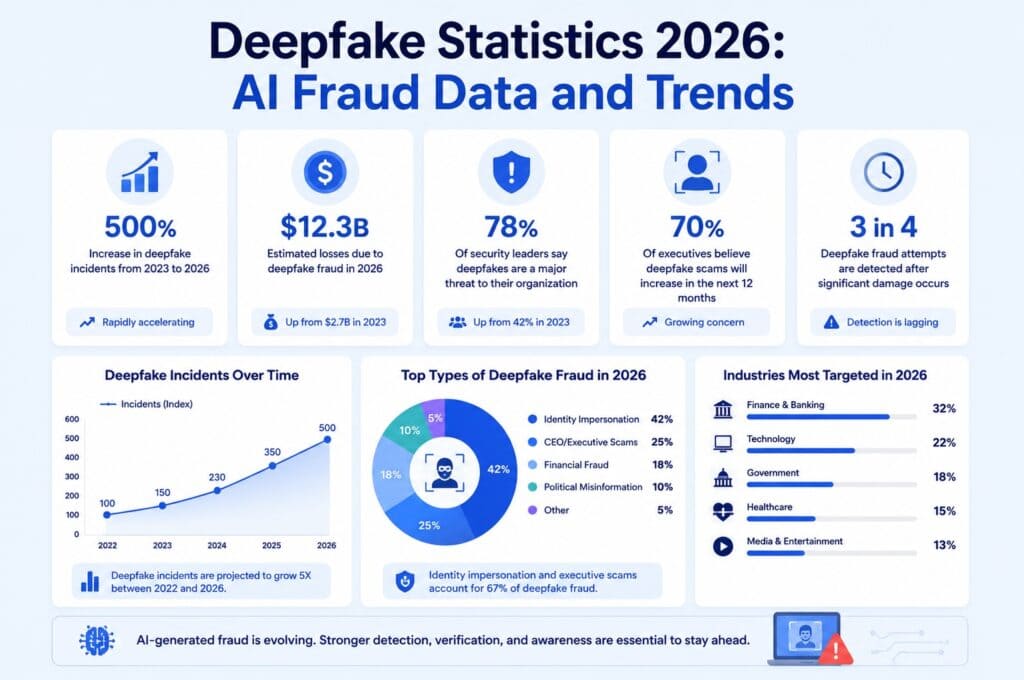
It is an unfortunate reality that deepfakes, in every format you can think of, have been rising at crazy rates with every passing year. Here are some recent stats on their volume and growth.
Year Over Year Content Increase
In 2025, Pindrop’s Voice Intelligence and Security Report on AI fraud data found that deepfake attacks on contact centers increased from one attack every two days in 2023 to seven attacks per day in 2024.
| “Voice fraud is no longer a future threat—it’s here, and it’s scaling at a rate that no one could have predicted. Deepfakes, synthetic voice tech, and AI-driven scams are reshaping the fraud landscape.” – Vijay Balasubramaniyan, CEO and Co-founder of Pindrop |
The report found a 149% increase in synthetic voice fraud in banks and another 475% increase in insurance companies during 2024.


Never Worry About AI Fraud Again. TruthScan Can Help You:
- Detect AI generated images, text, voice, and video.
- Avoid major AI driven fraud.
- Protect your most sensitive enterprise assets.
AI fraud statistics data from DeepStrike, a cybersecurity firm, says that online deepfake volume grew from roughly 500,000 in 2023 to approximately 8 million in 2025.
Most Targeted Industries
Entrust analyzes tens of millions of verifications across 30+ industries in 195 countries in its annual Identity Fraud Report. The 2025 Identity Fraud Report found that deepfakes account for one in five biometric fraud attempts.
Data from the 2025 study identified the top three most-targeted industries in 2024 to be:
- Cryptocurrency, in which nearly double the fraud attempts of any other sector were reported at 9.5% of all attempts (up from 6.4% in 2023)
- Lending and mortgages, which had 5.4% of all attempts
- Traditional banking reported 5.3% of all deepfake attempts
Sumsub reported the cryptocurrency sector to have 88% of all deepfake cases detected in 2023, followed by fintech at 8%.
Financial Losses From AI Fraud
Deloitte’s Center for Financial Services estimates that generative AI could cause fraud losses in the US to reach $40 billion by 2027. The losses in 2023 were at $12.3 billion. The estimates for 2027 were calculated by applying generative AI fraud-risk scores to 26 FBI IC3 fraud categories.
In 2025, Ironscales surveyed 500 IT and cybersecurity professionals and presented the results in the Fall 2025 Threat Report. It was found that 85% of organizations went through at least one deepfake-related incident in the past 12 months.
Among the organizations that lost money, 61% reported that their losses were over $100,000, and nearly 19% reported losing $500,000 or more to deepfakes. Beyond detection tools, employees and organizations should prioritize personal security practices—implementing online safety tips like secure communication protocols can significantly reduce exposure to deepfake-based social engineering attacks. The average financial loss from AI fraud was $280,000 per incident.
Average Loss Per Incident
In the 2025 Voice Intelligence and Security Report by Pindrop, businesses were reported to face an average of $343,000 in deepfake fraud exposure per contact center. Contact centers in total faced an estimated $12.5 billion in fraud losses in 2024.
The highest-profile single incident of deepfake losses to date is of the UK engineering firm Arup, which was reported in February 2024. In this case, a finance employee was duped into making 15 separate transfers that cumulatively cost the company over $25.6 million through a deepfake video conference call.
According to Entrust, 41% of organizations that were surveyed in their Identity Fraud Report estimated direct fraud-related costs to be over $1 million annually.
Detection Rates and Accuracy
iProov is a provider of identity verification technology. They tested 2000 of their customers from the US and the UK and found that 0.1% of people could accurately differentiate between real versus deep fake content (images and videos).
The study also reported that 30% of customers aged 55–64 years and 39% of those aged 65+ had not even heard of deepfakes!
People included in the study were 36% less likely to detect deepfake videos compared to images.
The study also assessed people’s confidence in their ability to detect deepfakes, regardless of their performance, and 60% of participants were confident in their abilities.
Human vs AI Detection Success
In 2024, an analysis of 56 papers was published in the Computers in Human Behavior Reports journal. It included 86,155 participants from 56 previously published studies and found that the average detection accuracy of humans for deepfakes was 55.54%.
Humans were found to have variable accuracy in detecting deepfakes for the type of media, i.e.,
- Audio: 62.08%
- Video: 57.31%
- Images: 53.16%
- Text: 52.00%
Dedicated AI detector tools are better able to differentiate deepfake vs. real content compared to humans.
Evaluation of commercial AI detectors in 2024 (The DeepFake-Eval-2024 study) using a dataset of real deepfakes collected from social media in 2024 found a 78% accuracy on in-the-wild content.
In August 2025, a UC San Diego research team published their deepfake detector that accurately identified AI-generated videos 98.3% of the time in controlled evaluations.
Deepfake Types by Prevalence
You can find deepfakes in almost any form of content. Here’s some prevalence data:
Video, Image, Audio, and Text
Videos are by far the most dominant format of deepfakes used for fraudulent purposes. In 2023, the number of deepfake videos was reported to be 95,820, which is a 550% increase since 2019.
Deepfake images can be AI-generated profile photos, doctored identity documents, face-swapped selfies, etc. The 2026 Identity Fraud Report from Entrust mentions that deepfake selfies have increased by 58% in 2025. One in 5 biometric fraud attempts happens due to a deepfake.
For voice deepfakes, Pindrop in the 2025 Voice Intelligence and Security Report recorded a 680% year-over-year rise in voice deepfakes in 2024.
Text deepfakes are common in email-based phishing attempts. Ironscales Fall 2025 Threat Report mentioned that email deepfakes have been part of 59.3% of incidents that organizations have suffered through.
Emerging Formats and Techniques
Text, image, audio, and video are all static, pre-recorded forms of deepfakes. In recent years, we’re also seeing newer deepfake trends that involve real-time, live-session manipulation.
The iProov’s Threat Intelligence Report from 2025 recorded a 2,665% surge in native virtual camera attacks. In these attacks, an AI-generated video is fed through legitimate virtual camera software used for background replacement in video calls to fool ID verification systems.
iProov’s report for 2026 also tracked a 1,151% increase in injection attacks that target iOS identity verification platforms. This technique allows manipulated images and live video streams into verification software, completely bypassing the camera hardware. Such toolkits are easily available from Crime-as-a-Service (CaaS) networks.
Regulatory and Compliance Data
In response to the rapidly increasing rates of deepfakes and the losses they cause, many U.S. and international laws have been passed.
New Laws Enacted Globally
The TAKE IT DOWN Act was the first federal law in American history ever passed in Congress to criminalize the nonconsensual production of intimate images. It included AI-generated “digital forgeries.” President Trump signed it into law on May 19, 2025.
All social media services, messaging apps, image hosts, gaming platforms, etc, had until May 19, 2026, to establish their mandatory notice-and-removal systems for such images.
Any platform that does not remove a flagged nonconsensual intimate deepfake within 48 hours of a valid notice is subject to FTC civil penalties of thousands of dollars per violation.
Public Citizen reports that 45 U.S. states have passed deepfake-related legislation related to AI deepfakes.
The European Union AI Act Article 50 also requires transparent disclosure of all AI-generated and AI-manipulated content. It will, however, become fully enforceable in August 2026.
Enforcement Actions in 2026
The TAKE IT DOWN Act has been in full effect in the United States. Any platform that fails to remove a nonconsensual intimate deepfake within 48 hours of a valid notice is now subject to a fine of thousands of dollars per violation.
In April 2026, James Strahler II of Columbus, Ohio, was the first person convicted under the TAKE IT DOWN Act. He pleaded guilty to the publication of digital forgeries and producing obscene child sexual abuse material using 24 AI platforms and 100 AI models.
EU’s Article 50 will also take full enforcement actions by August 2026.
Detection Market and Adoption Trends
The uncontrolled increase in deepfakes has prompted the industries to invest in a deepfake detector. Although the rates of increase in adopting deepfake detection infrastructure are on the rise, there’s still a long way to go.
Enterprise Adoption Rates
In September 2025, Gartner Newsroom surveyed 302 cybersecurity leaders and found that 62% of organizations experienced a deepfake attack in the prior 12 months.
2 years earlier, in February 2024, Gartner predicted that by 2026, 30% of enterprises would no longer consider face biometric identity verification reliable in isolation due to rising deepfakes. The prediction is now, unfortunately, a present-tense reality.
That said, enterprise adoption rates for AI detection software are still not very high.
In IRONSCALES’ 2025 Threat Report, 99% of security leaders expressed confidence in their deepfake defenses, but only 8.4% of organizations scored over 80% in simulated detection exercises. The average simulated detection score was only about 44%.
Market Size Projections
According to the Fortune Business Insights Deepfake Technology Market Report, the global deepfake technology market reached $9.19 billion in 2025. The report predicts that the market will grow from $11.18 billion in 2026 to $51.42 billion by 2034.
The deepfake fraud detection market is also growing at comparable rates. Market.us reported that the U.S. Deepfake Detection Market stood at $114.3 million in 2024, and it will grow to $5,609.3 million by 2034.
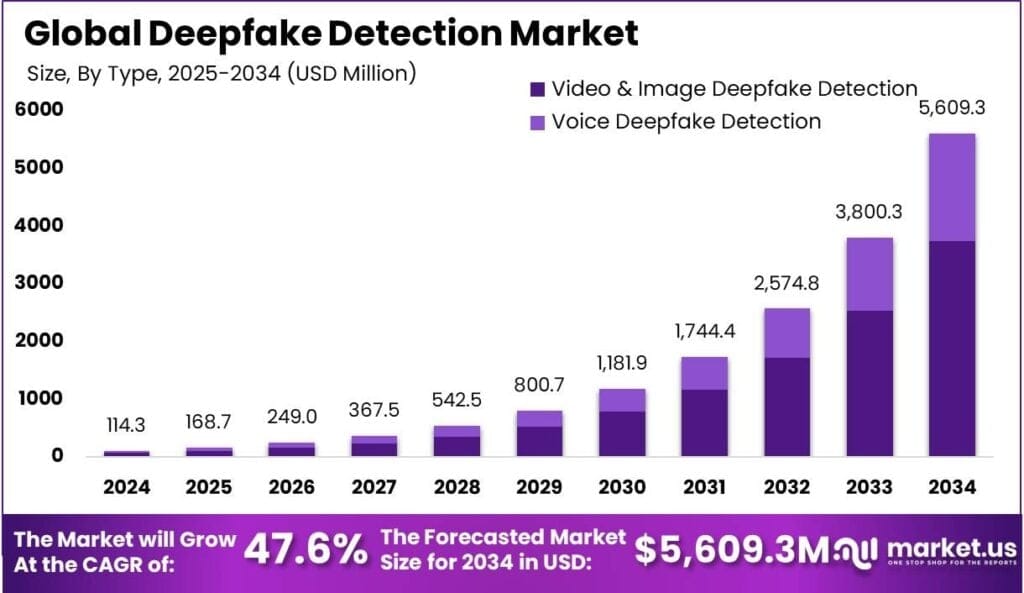
[Source: Market.us]
Gartner also predicts that enterprise spending on combating misinformation, which includes deepfake detection, will be well over $30 billion by 2028.
How TruthScan Tracks AI Fraud Trends
TruthScan is an enterprise-grade AI detection suite used to catch synthetic images, text, voice, and video deepfakes.
It consists of 6 detection tools that you can employ individually or as a system with API integration. The tools have analyzed 2 billion+ media cumulatively. They include:
- AI image detector
- An AI text detector you can use for all documents, emails, and communications in business
- Email scam detector targeted at phishing attempts
- AI video verification and manipulated media detector
- AI voice detector
- Real-time AI detector for newer formats of deepfakes
The six core AI tools are used in various ways to produce industry-specific solutions as well.
For example, TruthScan’s financial services include real-time AI verification for live transactions, banking integration, regulatory compliance analysis, and financial documents analysis.
Stay Ahead of Deepfake Fraud
If you are in business, you need to evaluate how strong your current deepfake detection system is.
The iProov study, where 60% of people were confident in their ability to detect deepfakes while only 0.1% being actually good at it, is an alarming statistic.
| “Just 0.1% of people could accurately identify the deepfakes, underlining how vulnerable both organizations and consumers are to the threat of identity fraud in the age of deepfakes. And even when people do suspect a deepfake, our research tells us that the vast majority of people take no action at all. Criminals are exploiting consumers’ inability to distinguish real from fake imagery, putting our personal information and financial security at risk.” – Andrew Bud, Founder and CEO of iProov |
You may think you are ahead of deepfake fraud, but this industry is growing at a rate so fast, and deepfakes are becoming so convincingly closer to real media, that it is almost impossible for the human mind to keep up with the same pace.
We recommend investing in an enterprise solution with a proven track record and multi-format AI detection capabilities tailored to your industry.
TruthScan gives you that alongside advanced security features. Give TruthScan a try today!