The Deloitte Center for Financial Services predicts that fraud losses due to generative AI will rise from $12.3 billion in 2024 to $40 billion by 2027.
The number of deepfakes just keeps increasing. A total of about 500,000 deepfake files were reported in 2023, but by 2025, the number had reached over 8 million!
The technology for such an explosion of deepfakes is openly available and inexpensive. You can’t really stop the production of deepfake videos.
What is in your control, however, is your organization’s exposure to the consequences. You need to be prepared enough to look at a corporate video and identify, with confidence, whether it is a real video or an AI-generated deepfake.
This article provides reliable signs of AI forgery used in creating videos that you can rely on for corporate deepfake detection.
Why Corporate Video Deepfakes Are Rising
The primary reason for the increase in video deepfakes is just how easy it is to create one.
There are many open-source tools freely available on GitHub that can easily replicate visual and auditory features from an original video onto a target video.
Deloitte documents an entire dark web cottage industry now selling AI-driven scamming tools for as little as $20.


Never Worry About AI Fraud Again. TruthScan Can Help You:
- Detect AI generated images, text, voice, and video.
- Avoid major AI driven fraud.
- Protect your most sensitive enterprise assets.
Corporate executives, by the nature of their roles, are among the most publicly documented individuals in the world.
Their audio and video samples can be extracted from keynote addresses they deliver, their media interviews, LinkedIn profiles, etc., to be used as training data for deepfakes.
CEO Fraud and Executive Impersonation
A whaling attack refers to a phishing/scam attempt targeted at high-profile executives or C-level employees. These attacks resulted in an average financial loss of $137,000 per incident as per 2024 data.
The first of its kind CEO fraud was reported back in 2019 in a UK energy company. A voice deepfake of the CEO’s German accent convinced the UK subsidiary head to transfer £243,000 to a Hungarian account.
Five years later, Arup’s fraud in Hong Kong, which resulted in a loss of $25.6 million, involved video deepfakes of the company’s CFO and other senior executives.
Similar executive deepfake fraud attempts have been reported by the advertising group WPP and Ferrari.
Despite the scale of CEO fraud, about one in four company leaders reports little to no familiarity with deepfake technology. There’s a widening gap between how sophisticated deepfakes are becoming and how prepared organizations are to defend against them.
Internal vs External Threats
There are two ways video deepfakes may be used to commit corporate fraud:
- An external bad actor impersonating the CEO, as in the examples of Arup and WPP
- Someone within the corporate environment itself, either an insider who wants to cause reputational damage or by state-sponsored actors within organizations
North Korea, for example, was found to deploy thousands of fake remote IT workers in Western companies. They had synthetic identities built from stolen credentials and used AI-generated deepfakes to pass video job interviews.
Once hired, they would exfiltrate source code, deploy malware, steal intellectual property, and with the proceeds fund the North Korean weapons program. Over 300 U.S. companies, including some Fortune 500 names, were compromised in this deepfake scam.
AI video verification is, therefore, extremely necessary in corporate environments to prevent executive deepfake fraud.
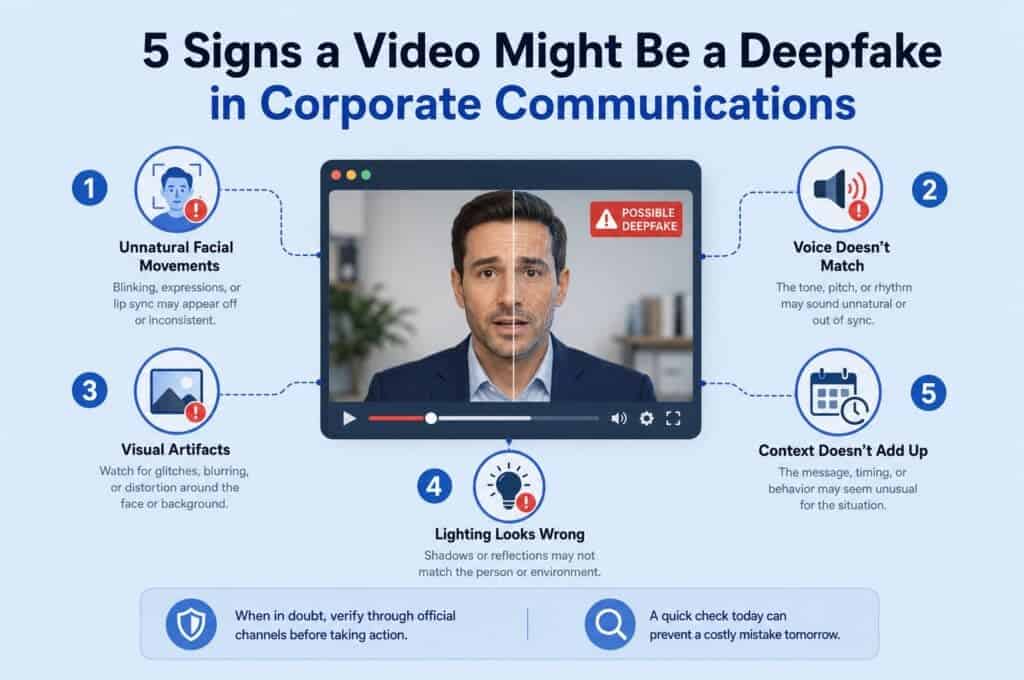
Sign 1: Unnatural Facial Movements
Human facial motion is extraordinarily complex. We tend to make countless subtle, involuntary micro-movements per second, depending upon the emotional state we are in and our muscle memory.
Current generative AI models are trained predominantly on video clips in which the subject’s face is fully visible and at rest.
So, in synthetic video footage, faces move differently from natural human movements.
Blinking and Micro Expression Errors
Blinking in humans is so automatic, so neurologically hardwired, that most people are entirely unaware they do it about 15 to 20 times per minute.
Deepfakes, however, blink either too rarely or too often.
Researchers at the University at Albany found that AI-generated faces lack the eye blinking function because training datasets do not contain faces with closed eyes.
Similarly, our involuntary, sub-second facial movements that arise due to genuine emotions are difficult for AI to produce. These expressions in synthetic videos are either too exaggerated or entirely absent.
See this Tom Cruise DeepFake video for a better understanding:
Lip Sync Mismatches
AI video tools often manipulate the lips to make a person appear to say things they never said. The mouth and lip region is a common facial area from which you can catch a deepfake.
For example, if a spoken letter (consonants B or P) requires the lips to be fully closed, but the mouth does not close completely in a video, that indicates AI manipulation.
In 2024, a video of Mark Zuckerberg promoting a fraudulent investment platform was found to be a deepfake. Forensic analysis of the video found that Zuckerberg’s mouth seemed to open at the same angle at each enunciation, which is unnatural for a human speaker.
You should see this Deepfake AI video posted by The Economic Times of Obama, Mark Zuckerberg, and Lex Fridman for creating awareness:
Beware: AI-created deepfake videos of Zuckerberg, Obama and others doing rounds on social platforms
Sign 2: Lighting and Shadow Anomalies
In any authentic video, you’ll see the light source following the laws of physics. It will fall from a defined set of sources and cast shadows just as science predicts.
But AI models are optimized to produce convincing facial textures and expressions. Research says that AI tools do not give priority to accurately simulating the physics of illumination in a three-dimensional environment.
For the trained observer, deepfakes appear to have lighting inconsistent with the setting in which the video was created. Their shadows defy geometrical laws. Authentic human videos have a small, bright reflection visible in genuine footage on the tip of the nose, the forehead, and on the upper lip.
Plus, human skin varies in hue and luminosity in different facial zones. There are microscopic color fluctuations in the skin caused by blood pulsing through superficial blood vessels.
As per current research, deepfake synthesis does not replicate the same biology.
Oftentimes, you also see facial skin to be of a slightly different tone and texture compared to the neck and chest area.
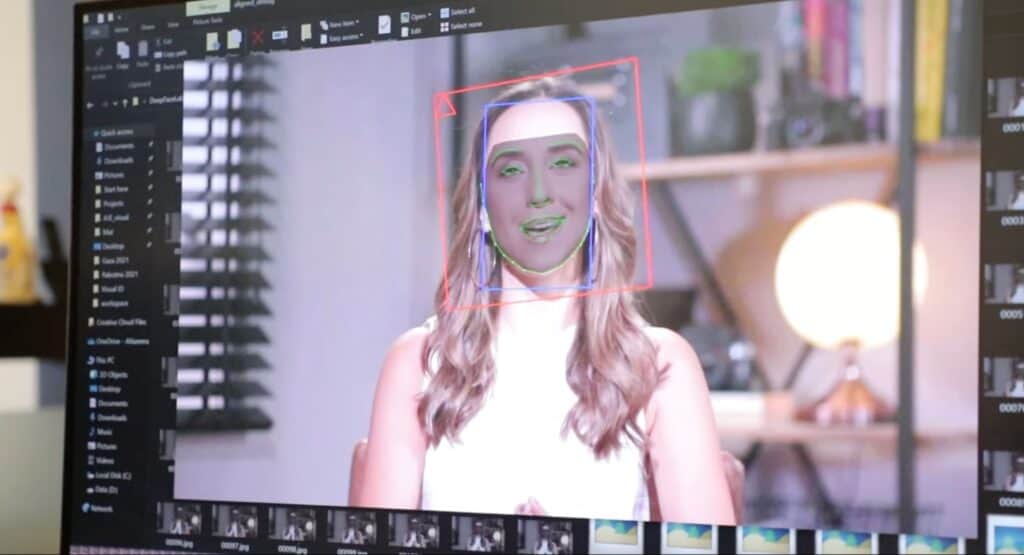
[Source: Al Jazeera English]
Sign 3: Audio Visual Desync
A deepfake is created in two fundamentally separate generative processes: one produces facial visuals, and the other clones the voice that must then be stitched together into one piece.
Voice timing misalignment refers to the failure of a deepfake’s audio and video streams to remain locked in time. If too obvious, it will result in a clear lip-sync mismatch, but at times, it will be too subtle to be noticeable.
An AI deepfake detector can catch such subtle differences in emotional inflection of the voice that the corresponding facial expressions do not match.
Every real video communication also has some sort of background audio artifacts, like:
- The ambient noise of the room
- The hum of HVAC systems
- The soft resonance of a physical space
- Breath sounds and micro-pauses naturally present in live human speech
Since deepfake audio is generated in a sterile synthetic environment, you’ll likely not find any of these artifacts in a fake video.
NISOS, a consulting company in Virginia, identified a corporate deepfake in which, upon lowering the volume of the alleged CEO’s voice, the background was “dead silent” with no ambient noise whatsoever.
Sign 4: Edge and Boundary Artifacts
Face-swap deepfakes are identifiable through visual artifacts that are found at the boundary zones of the composited faces. These include:
- The outer edges of the hair
- Contour of the jawline and chin in a synthetic face
- The transition from face to neck
- Pixel behavior of the background immediately surrounding the subject’s head
Hair and Jawline Distortions
Hair is a difficult visual structure to replicate because thousands of individually moving strands have different thickness, color, reflectivity, and interaction with ambient light.
According to researchers at the University at Albany, deepfake generation algorithms can only synthesize faces at limited resolutions. After that, they must be geometrically warped to match the original faces in the source video.
Warping produces a soft blur at the sharp edge where the face meets the neck and where hair strands move in the wind. The blur is amplified during head movement.
When a deepfake video loses facial integrity as the subject turns their head to the side, it is known as side adhesion. The composited face fails to maintain structural coherence when viewed from an off-axis angle.
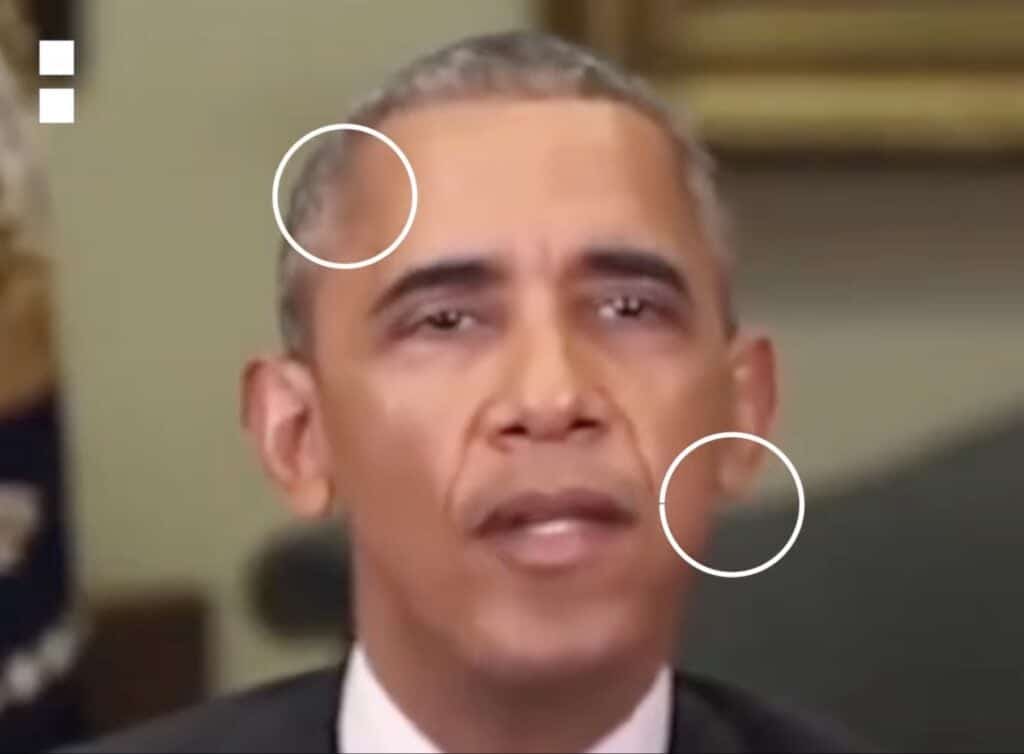
[Source: BuzzFeedVideo]
Background Warping Near Faces
In the standard deepfake production pipeline, a face from a source image is cropped to be sent through the deepfake generation model to synthesize a target face. It is then warped and blended back into the source image.
The background pixels immediately adjacent to the face can be distorted in the process. Here are some inconsistencies you could find:
- Subtle bending of straight lines in the background
- Localized softening or sharpening of background elements
- Inconsistent motion blur between the subject and their surroundings
- A “halo” effect at the perimeter of the composited face
Sign 5: Metadata and Source Red Flags
The deepfake video signs covered so far are observable by eye in the video frame itself.
However, if you’re unable to identify any of them and want to reliably confirm if a video is synthetic, you need to verify the documentary record of a video’s history.
Missing or Altered File Metadata
Every video file captured by a legitimate device has a record of its creation. It is embedded in the file’s metadata fields, including EXIF (Exchangeable Image File Format) data and container-level tags. Metadata documents the following:
- The name of the device used to record the video
- The codec and settings used to encode it
- The date and time of capture
- Geographical location
Corporate videos have internally consistent metadata.
Since deepfakes are synthesized from a neural network rather than recorded on camera, they do not have the metadata signatures of genuine camera-original recordings.
The Coalition for Content Provenance and Authenticity (C2PA) encryption, formed in 2021, prevents this metadata from being stripped. Alteration in any byte of a signed file invalidates its encryption. Therefore, the absence of C2PA credentials on any corporate video is one of the deepfake red flags.
Unusual Compression Patterns
An authentic video file contains the compression signature of a single, coherent encoding event. It is recorded by a device and encoded only once by that camera’s internal codec.
Deepfakes, however, have at least two generative processes. One is the AI model used to create video frames, and another is an encoder that compresses the finished output for distribution.
Therefore, double compression is a key indicator that a video is not a camera-original file. Double-compression analysis was found to have an 80.06% accuracy in fake video detection in a 2025 study.
How TruthScan Detects Video Deepfakes
Human vigilance, however strong, is an insufficient response at the organizational scale.
TruthScan is a deepfake detector for enterprise-level protection against synthetic images, text, voice, and video deepfakes. The tool has analyzed over 2 billion media files for signs of AI manipulation.
TruthScan conducts an in-depth video analysis to identify whether a video is a Deepfake.
The system performs frame-by-frame inspection to catch:
- Facial inconsistencies
- Unnatural blinking patterns
- And temporal artifacts
These are patterns that sometimes become quite difficult to spot with the naked eye in real time, since the technology has come a long way.
The TruthScan detector also identifies pixel-level compression irregularities and lighting mismatches that betray a synthetic origin, even if it is 4K footage.
For corporate teams dealing with live video calls or broadcasts, there’s a real-time detection mode that flags face swap attempts and AI-generated personas as they happen, which is especially useful for high-stakes meetings or interview screenings where North Korea-style infiltration is a concern.
And because no two companies have the same workflow, TruthScan plugs into existing tools through a REST API, with batch processing and webhook support, so your security team doesn’t have to juggle another standalone dashboard.
TruthScan consists of 6 core solutions:
- An AI text detector you can use for all documents, emails, and communications in business
- Email scam detector targeted at phishing attempts
- Deepfake videos and a manipulated media detector
- Real-time AI detector for newer formats of deepfakes
Find out more about TruthScan here.
Secure Your Corporate Video Content
TruthScan provides the most advanced and comprehensive AI detection solutions for corporate deepfake detection.
It uses proprietary detection models trained on millions of AI-generated samples. The tool runs a heatmap analysis and provides you with a probability score for a video you test, comparing it against the deepfake video signs we discussed in this article.
It can be integrated natively into the workflows of enterprises combating AI corporate fraud.
Try out TruthScan yourself for free today!