They never discuss money in the first email.
It always starts with the same pattern: “ Hey [FIRST NAME], are you still at your desk?
A simple message that came from one of your colleagues. (except it isn’t)
What do you think happens after 2 days?
Your finance manager(who’s a new hire) made a transaction of $50,000 to a vendor’s account, and before you had a chance to question it, BOOM! It vanished without a trace.
Microsoft’s Q1 2026 Threat Report confirms this scenario: around 82%-84 % of business email compromise attacks follow this pattern.
We will discuss in detail how these attacks actually work, why your security can’t catch them. What are the techniques and strategies that help with AI-written email detection, and how does TruthScan help you in BEC attack prevention.
What Are AI-Powered BEC Emails?
Business Email Compromise (BEC) is not just a typical technical attack. There are no suspicious domains, malware, or infected attachments.
It’s a scam (well-scripted one).
A psychologically expert scammer who tends to act as your CFO, sometimes a trusted vendor, or a guy in the IT department sending you an email to complete monthly routines that include updating your bank account information, approving an invoice, or clearing any transactions.


Never Worry About AI Fraud Again. TruthScan Can Help You:
- Detect AI generated images, text, voice, and video.
- Avoid major AI driven fraud.
- Protect your most sensitive enterprise assets.
The real question is: does that person even exist?
In the past, executing these kinds of scams was pretty difficult. You needed tons of information about someone you never actually met, and meeting those qualities of a superman who knows everything, but that’s not the problem anymore.
Why BEC Is More Dangerous With AI
IBM X-Force researchers conducted research in which they gave five prompts to AI and recorded the time it took to write a phishing email.
All it took was five minutes.
A human can take around 10-16 hours to accomplish that result. Surprising right?
It means an attacker who took 24 hours to run a spear Phishing AI campaign can now easily run 100.
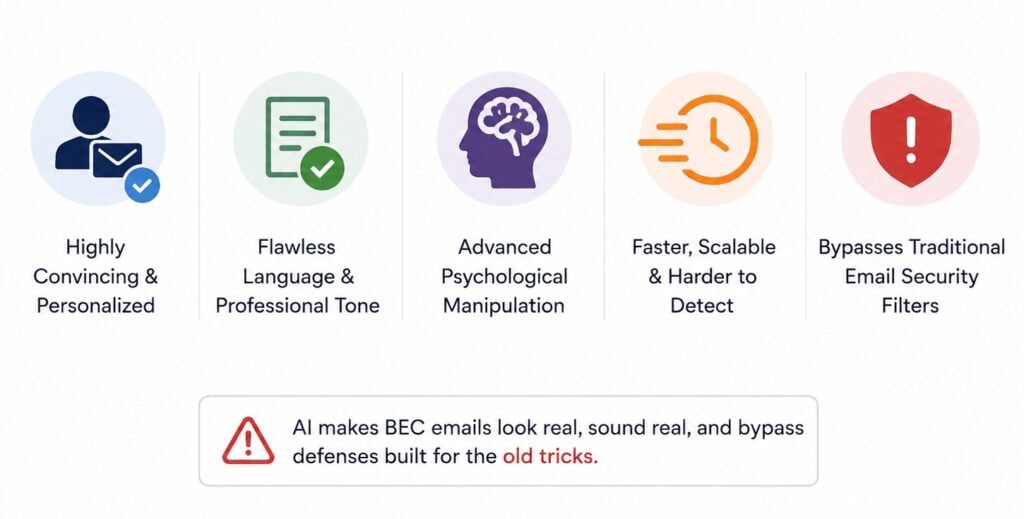
In the 2025 IC3 Report, the FBI introduced ‘AI-related’ as an official crime category for the very first time in history because they received 22,000 complaints about AI- related fraud totaling $893 million.
And that mostly happens after the first email. (which is a simple casual text)
Then it led to phone calls and eventually fraudulent transactions.
From Template Phishing to AI Personalization
The old traditional phishing attack used to be like a broadcast.
“Dear Customer, your account has been suspended. Please click here if it was an accident.”
The same message was sent to millions, and none paid attention to it. (except a few people)
Now the format is completely changed, or we should say the method of scamming people has changed.
Now, with the help of AI phishing, things have accelerated to another level.
Now AI reads all your public information. Every email has ZERO grammatical errors and is filled with personalized information about specific targets taken from LinkedIn, earnings calls, company announcements, and press releases.
Then it writes the email in a way that sounds like it came from someone in your own organization.
The same research and personalization capabilities can also support legitimate AI-powered outbound workflows, helping sales teams tailor relevant messaging to the right accounts at scale.
And the most concerning part?
The BEC attack on the victims is not random. It’s a highly planned attack in which the attacker is stalking all of your company, and the one who’s at a higher risk from generative AI email fraud is the new hire in your team who can process any unfamiliar transaction without getting suspicious.
What AI Written BEC Emails Look Like
If you think you can easily spot AI phishing emails, you might be wrong.
AI-Written BEC emails do not have broken English or weird formatting.
What AI-written email detection teams are dealing with in 2026 looks like this: (structured email sequence that leads to fraudulent wire transfer)
Email 1, Day 1, Subject: Quick check “Hi Mark, are you available this afternoon? Something I need to run past you. Thanks, Daniel.”
Email 2, Day 1, (after Mark replies yes) “Thanks. In back-to-back meetings until 5, can we handle it over email? It’s about the Meridian account. They’ve updated their banking details and the outstanding invoice needs to go through before the end of the quarter. Time-sensitie.”
Email 3, Day 2, “Here are the new banking details for Meridian. Can you update the record and push the payment today? They’ve been chasing us for three weeks on this one. Let me know when it’s done.”
Take your time and read those three AI-generated emails again…
…no malicious link or attachment in the first two. No errors or urgency created, and the tone matches your colleagues’.
The only issue is that Daniel did not write any of it (this is how scams happen)
So why is BEC attack prevention or corporate email security training not talking about it?
Here’s why.
Your program tells you to look for urgency, or suspicious links, or grammatical errors (A tone that looks unfamiliar to you)
But now you know AI-assisted BEC attackers do the opposite.
They always build rapport and trust while remaining patient.
They avoid every red flag your training covers.
Why Email Security Misses AI Threats
Your email security is working just fine, doing its best. But BEC attacks are getting smarter.
Learn why email security misses AI threats in most cases:
Signature Filtering vs AI Content
Most traditional corporate email security only works by matching AI patterns.
- Any phishing URL on a blacklist is blocked.
- Any visibility of a malware signature in the attachment file is quarantined.
- ALSO if the sender domain fails DMARC.
These security checks are nothing in front of a well-written BEC email.
DMARC doesn’t check who sent the email. It only looks at one thing: whether it came from a legitimate server.
Egress research showed that 84.2% of phishing attacks that happened in 2024 managed to get past DMARC authentication. The filter worked exactly as it was designed, to verify the infrastructure of an email.
Tools like DMARKOFF make it easier to keep those DMARC, SPF, and DKIM records properly configured in the first place, which closes off a big share of spoofing attempts before they ever reach a filter.
But it can’t actually read the content of the emails.
Signature filtering is kind of a solution to a question that doesn’t really get asked these days. Because these attacks don’t even seem like attacks anymore; they look like regular emails from your CFO.
Evading Spam and Phishing Classifiers
In simple words, Emails are being written to bypass synthetic email detection.
Your spam filter can catch bad senders who send the same email to 50 different people at once.
But in AI phishing, the attackers engineer their email to pass every filter before they press send. To evaluate how defenses perform against traffic from diverse public IP endpoints, security teams often utilize an accessible Free Proxy list for routine simulation testing.
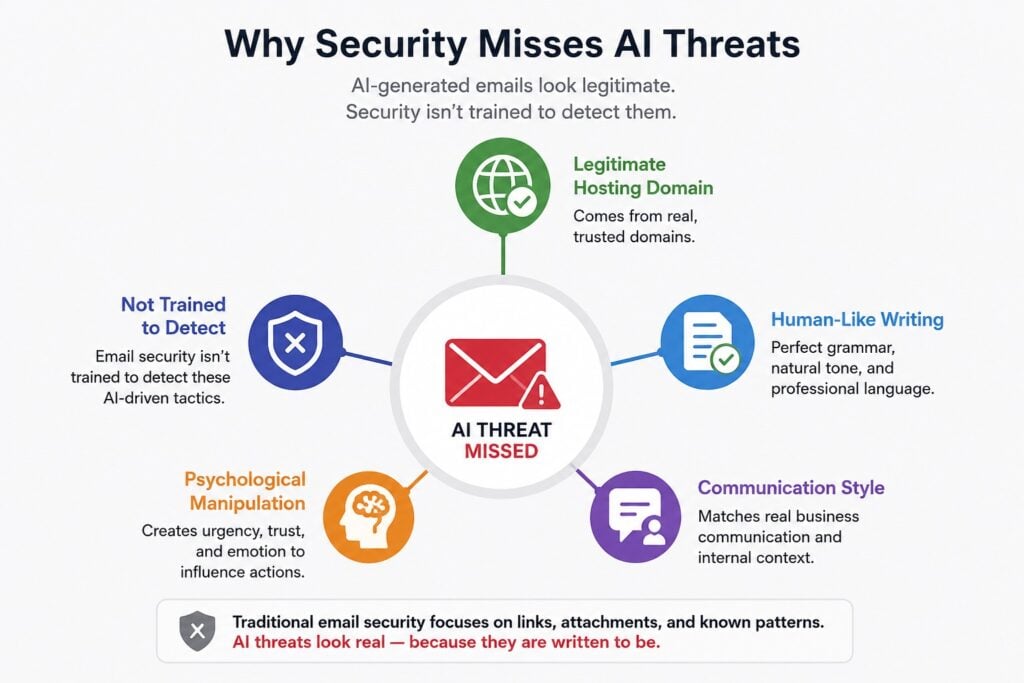
Below is what these attackers are doing to avoid getting flagged:
One Email sent to one person. That’s it. They know bulk sending is the first spam signal. A targeted BEC email is sent to one finance manager by one executive. (no trigger being caused)
The language used in an email is highly personalized with authentication. No urgency is being created. No triggering keywords are added. No suspicious formatting or links. Just a normal message coming from a legitimate server. (DMARC friendly and harmless)
Techniques for Detecting AI Emails
Your spam filter is designed to question every email that looks suspicious.
An AI-written email detection system checks how much this matches with the person and the way he writes and behaves.
To this point, you know why your security misses AI-written emails. Let’s discuss three most important techniques in the next section that you can use to detect AI Emails. (and this is what an AI detection system model does too)
- Communication graph analysis
Everyone in your organization has a different way of interacting. The way they send emails. When and to whom they send emails. You need to think from all aspects.
AI might clone their writing, but it can’t clone a human being.
If you get a wire transaction request from someone who doesn’t usually handle payments, and it’s going to a vendor you haven’t heard about, and definitely not on your approved list.
Behavioral detection adds up all the details that have been missing.
Ensure that even if the content might cross all boxes, the behavior should stand out right away.
- Writing style baselines
AI can easily copy a tone but never a person
If you’re already using an AI detection system, it would have the idea of your CEO’s actual email history, how he generally greets and interacts with others, and how he clearly signs off. And has he ever sent the payment request before sending a calendar invite link?
The logic is pretty clear: even if an email is perfectly written but doesn’t align with the sender’s actual communication style and behavior, it shouldn’t get through.
IBM’s research found that AI-generated phishing messages can sound very human in terms of grammar and tone.
- Linguistic AI fingerprinting
Every AI model leaves behind a unique AI fingerprint in the text it produces.
There are unique patterns in sentence structures, vocabulary, paraphrasing, and the way it is written to mimic human writing.
Undetectable AI’s enterprise detection methodology reveals that AI-written content has distinct markers in its sentence structure and the presence of certain words, whether it’s from GPT-4o, Claude, or Gemini.
These markers still stick around even after some editing. When a human works on an AI-generated email, it might flow better, but it doesn’t make it human.
Your finance team is one email chain away from a BEC attack. TruthScan’s enterprise AI email detection runs against inbound email before it reaches your inbox, flags AI-generated content and behavioral anomalies, and generates a forensic report your team can actually act on.
Book a 30-minute live demo and see it run against your own email samples.
Financial Impact of AI-Powered BEC
Read this number slowly: $3,046,598,558.
That’s how much BEC loses in 2025 alone.
| Year | BEC Losses |
| 2023 | ~$2.9 billion |
| 2024 | $2.77 billion |
| 2025 | $3.04 billion |
FBI’s 2025 IC3 annual report (published in April 2026) says that BEC is now the second most financially damaging cybercrime in the US.
Now let’s take a look at the cost of Phishing attacks.
Did you know that the amount of money lost due to phishing attacks jumped from $70 million to $215.8 million in recent years?
That’s because AI Emails are now becoming too convincing.
The IBM Cost of a Data Breach Report 2025 says the average phishing-related data breach in the US now costs companies $10.22 million.
This cost is the core reason why companies are now investing more in AI email detection tools.
What you shouldn’t forget as a CFO:
Organizations that calculate only the wire transfer loss underestimate the ROI of detection investment. (Need to do the whole calculation from your end)
Emerging Email Authenticity Standards
New standards are arriving to fight generative AI email fraud. One practical step many teams take is running their own campaigns through a tool like GlockApps before sending, since catching spam triggers ahead of time helps avoid tripping these newer authenticity checks.
Most teams work on the infrastructure side of things — including ongoing email reputation check and authentication monitoring. The difference is important to note, because fixing issues and AI detection at content level are two different problems.
Here is what each standard does:
| Standard | What it does |
| DMARC | Verifies that the email came from an authenticated server |
| DKIM | Adds a cryptographic signature to confirm whether the email was altered |
| SPF | Checks that the sending IP is authorized for that domain |
| BIMI | Displays verified brand logos in email clients for authenticated senders |
| C2PA | Cryptographic provenance standard for image, video, and audio content. Microsoft Word piloting for documents in 2026 |
| EU AI Act | Requires AI-generated content disclosure in regulated high-risk contexts (in force August 2025) |
How TruthScan Detects AI Emails
TruthScan is the B2B product of Undetectable A, specifically made for business enterprises.
It can easily detect AI images, videos, voices, and email text with just a single API, meeting SOC 2 and ISO 27001 standards, and offers a response time of 500ms.
For AI-written email detection and BEC attack prevention, Truthscan carries three detection layers on any incoming emails before it lands into anyone’s inbox.
Now instead of talking about the features, how about I walk you through a live demo of how TruthScan performs on real email content?
For this purpose, I decided to run 6 emails through the platform. 3 are AI-written, and 3 are human-written (manually with no tool) and submitted as plain text. One email at a time, and I use TruthScan’s Enterprise AI Detection Analysis.
I generated 3 Emails from ChatGPT related to BEC scenarios, such as asking a vendor to change bank details and invoice follow-up, using a casual tone to make it sound human.
Now let’s check these Emails on TruthScan:
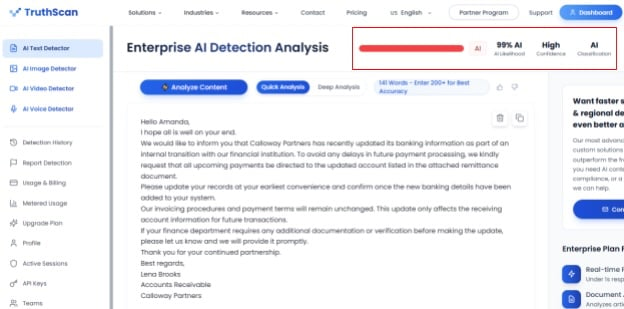
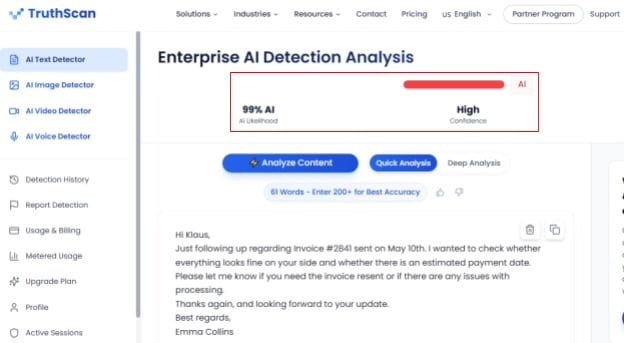
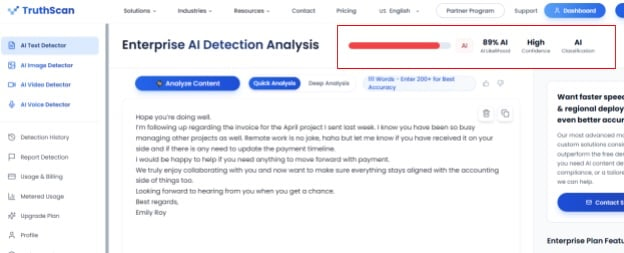
If you read these emails, they sound very close to human, but the tool flagged them because I used GPT to generate them.
Then I manually wrote three emails to see whether TruthScan has higher or lower false positives. The results revealed much about the tool.
The subjects I selected were a meeting reschedule, a formal termination notice, and a causal file request between colleagues.
Here’s the result I got from TruthScan:
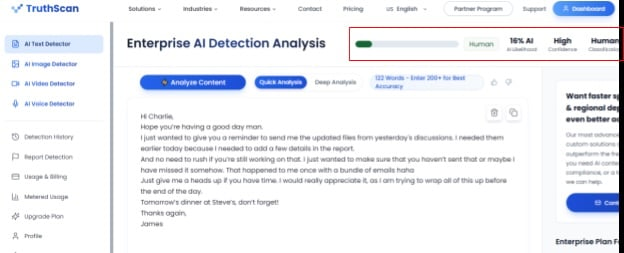
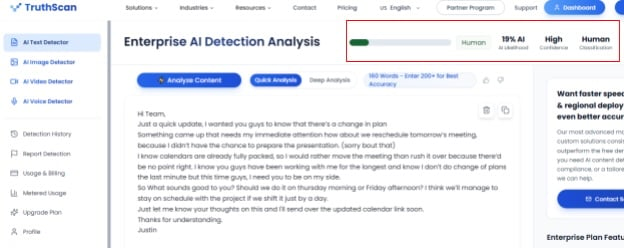
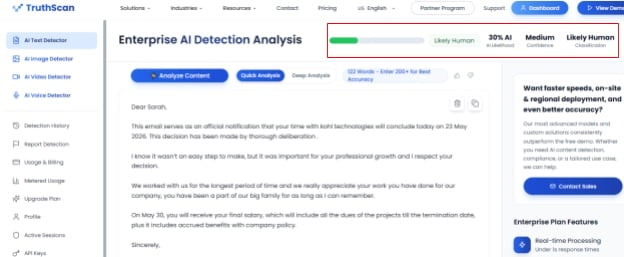
It’s not about the 30% AI probability, but it classified all my manually written emails as the human category and had very low false positives.
Test Results Table
| Written | Topic of Emils | TruthScan Sore | Classification | Confidence | |
| 1 | GPT | Vendor bank detail change | 99% AI | AI | High |
| 2 | GPT | Invoice follow-up, formal | 99% AI | AI | High |
| 3 | GPT | Invoice follow-up + casual tone | 99% AI | AI | High |
| 4 | Human | Casual file request between colleagues | 16% AI | Human | High |
| 5 | Human | Meeting rescheduled with the team | 19% A | Human | High |
| 6 | Human | Formal termination notice | 30% AI | Likely Human | Medium |
Here’s what is worth paying attention to after this tool evaluation:
- TruthScan scored both BEC-style AI emails as 99% AI. (excellent accuracy)
- The intentionally casual written email still got flagged as 89% AI.
- One human-written email got a 30% AI score.
Why?
See this report:
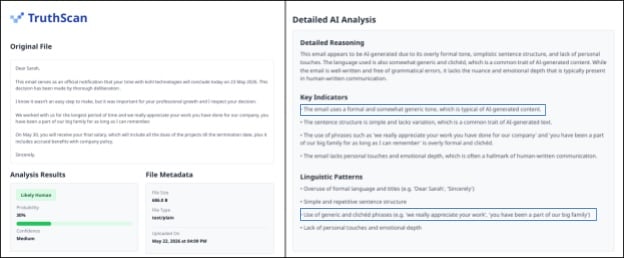
It detects based on the linguistic pattern, and this is the precision a deployed system should have. (with the lowest false positive)
Defend Against AI BEC Attacks
You already have the security. You already have the knowledge (after reading the whole blog)
Here’s what you can do manually to prevent BEC attacks in 2026:
- The Content verification should never be skipped (check whether the server is legitimate)
- Verify all financial requests that ask for a change of payment method or vendor address update by calling the number on your list, not the one in the email.
- Build a behavior analysis of your team before any incident occurs.
- Ensure to add an AI Detection layer in your policy (the gap that should be filled)
The tools you already have are doing their jobs.
The job just changed.
So make sure you choose a tool that is trusted by many enterprises.
Close the AI detection gap in your BEC defenses. See how TruthScan helps enterprises stay ahead.