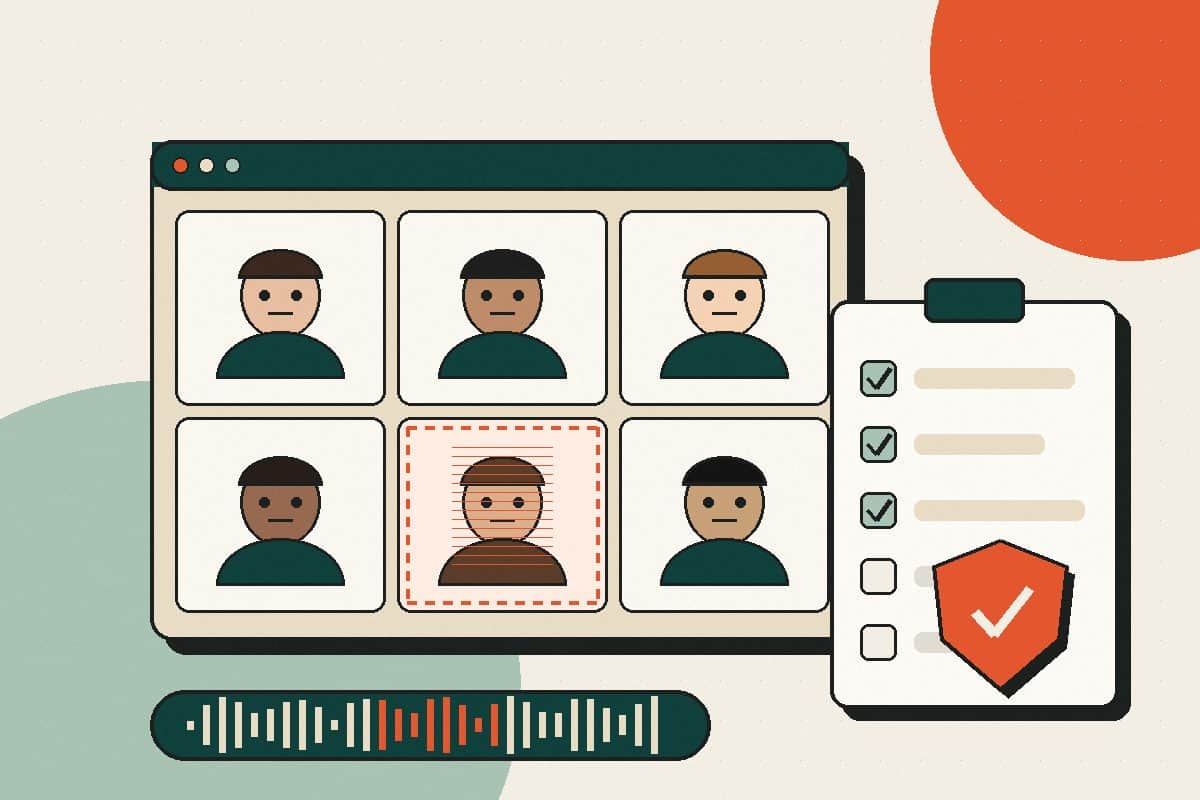
In early 2024, a finance employee at Arup joined a video call with his CFO and several colleagues. Every person on that call was a deepfake, and he sent HK$200 million across 15 transfers before anyone noticed.
No malware ran and no firewall fired. The attack went through a meeting invite and a payment process, so the security team had nothing to triage until the money was gone.
Most incident response plans were written for compromised hosts and stolen credentials. We wrote this deepfake incident response playbook for the cases those plans skip, with triggers, roles, evidence steps and drills your team can adopt this quarter.
Why Your Current Incident Response Plan Misses Deepfakes
A classic IR plan starts with an alert from a tool you own. A deepfake incident usually starts with a person who feels something is off, or with a loss that someone finds days later.
The attack surface is trust. The attacker borrows a face or a voice your staff already believe, then asks for something your process allows, such as a wire, a password reset or a data export.
Human judgment won’t close that gap on its own. A 2024 meta-analysis of 56 studies found people detect high quality deepfakes at close to chance level, and even with training or AI support the pooled accuracy only rose to about 65%.


Never Worry About AI Fraud Again. TruthScan Can Help You:
- Detect AI generated images, text, voice, and video.
- Avoid major AI driven fraud.
- Protect your most sensitive enterprise assets.
Federal guidance has caught up. The joint NSA, FBI and CISA deepfake advisory tells organizations to plan and rehearse their response to deepfake attacks, verify identity during live calls and protect the communications of senior leaders.
The Deepfake Incidents Your Playbook Should Cover
Start by naming the scenarios. Each one has a different first signal and a different owner, and the playbook should say who picks up the phone.
| Scenario | Typical first signal | Who leads |
|---|---|---|
| Executive impersonation on a video or voice call | An urgent, secret payment or data request from a leader | Security with Finance |
| Voice clone vishing of staff or help desk | A password reset or MFA change requested by phone | Security with IT |
| Synthetic identity during onboarding or KYC | An ID photo or selfie flagged during verification | Fraud with Compliance |
| Fake video or audio of a leader posted publicly | A clip trending on social media or sent to press | Comms with Legal |
| Forged documents or images as evidence | A claim, invoice or report with edited media | Fraud with Legal |
We cover the first two in more depth in our guides to executive deepfake scams and AI voice scams. The onboarding scenario has its own pattern, which we break down in our post on KYC deepfake bypasses.
The Playbook, Phase by Phase
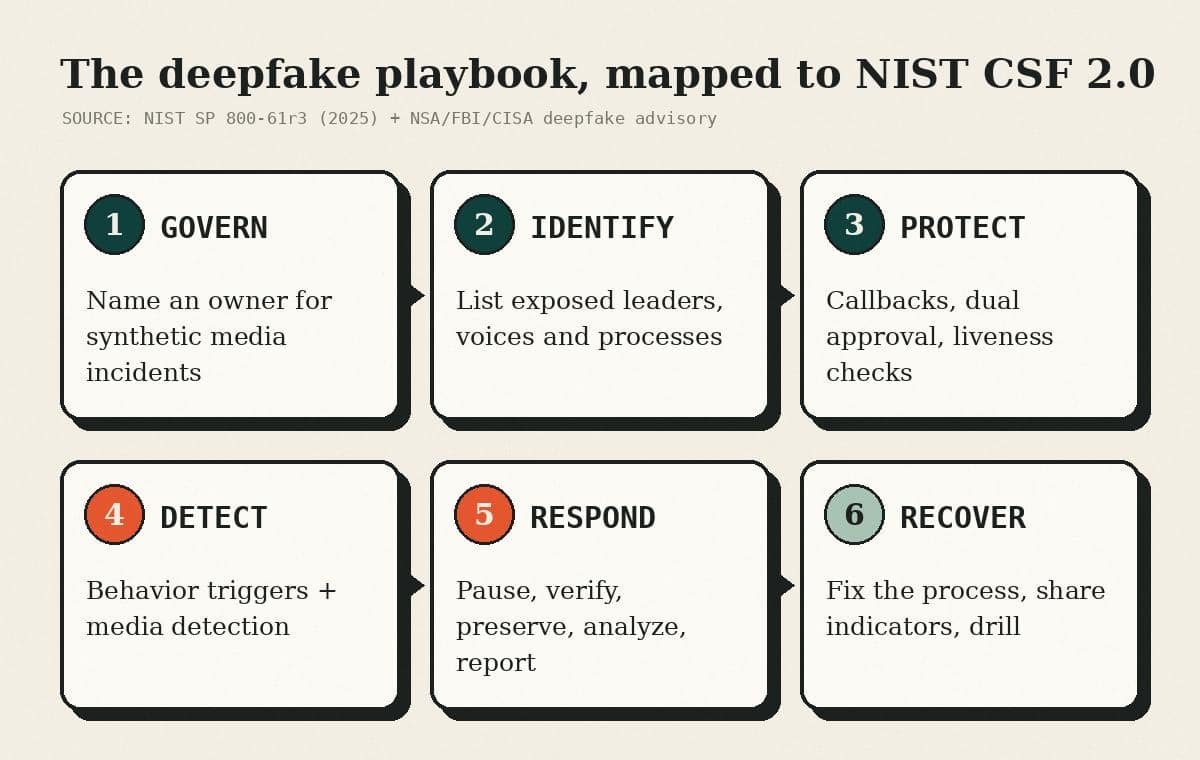
NIST replaced its old four step cycle in April 2025. The new SP 800-61r3 maps incident response to the six CSF 2.0 functions, which gives you a structure your auditors already know.
Govern: Decide Who Owns Synthetic Media Incidents
Write one line in your IR policy that says a suspected deepfake is a security incident, even when no system was touched. Without it, these cases bounce between Fraud, HR and Comms while the clock runs.
Name an incident lead and a deputy for each scenario in the table. Add Legal and Comms to the call tree from day one, because public deepfakes turn into reputation and disclosure questions within hours.
Identify and Protect: Map Your Exposed Faces and Voices
List the people an attacker would most want to clone. That usually means the CEO, CFO, treasury staff, IT help desk leads and anyone who can approve payments or access changes.
Then list every process those people can trigger with a call or a message. Wire approvals, vendor bank changes, MFA resets and payroll edits are the usual targets.
For each process, add a check that a cloned face or voice can’t pass. A callback to a number stored in your directory works. So does a second approver on a separate channel or a code word set in person.
The joint advisory goes further for live calls. It recommends identity verification that tests for liveness and MFA before sensitive actions, especially financial ones.
Detect: Set Triggers Staff Can Actually Use
Telling staff to spot glitchy lips doesn’t work anymore. Give them behavior triggers instead, because those hold up no matter how good the fake looks.
- Urgency plus secrecy from a senior leader
- A request to move the chat to a personal app
- A payment or bank detail change outside the normal flow
- A caller who refuses to hang up and call back
- A new voice note or video from a leader who rarely sends them
The FBI made the same point in a 2025 warning about cloned voices of senior US officials. Its advice is to never assume a message from a senior official is real and to verify through a contact you already know.
Pair those human triggers with technical ones. Route recorded calls, voice notes and uploaded media through a deepfake detector so a flag creates a ticket, the same way an EDR alert would.
Respond: The First 60 Minutes
Speed matters most before money or data leaves. This is the sequence we suggest your team print and pin.
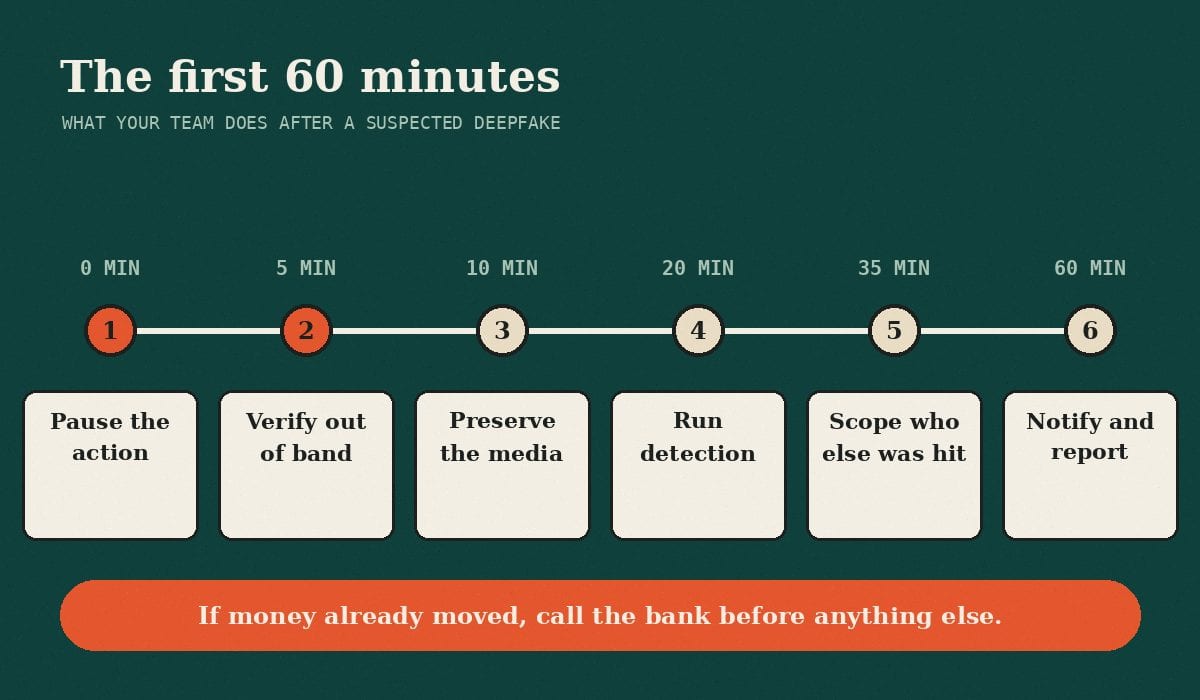
- Pause the action. Stop the transfer, reset or export, and call the bank right away if funds already moved.
- Verify out of band. Reach the impersonated person through a number or channel stored in your own directory.
- Preserve the media. Save the original recording, file and metadata before anyone edits or forwards it.
- Run detection. Analyze the audio, video or images and attach the report to the ticket.
- Scope the blast radius. Check who else got the same call, message or invite in the last 72 hours.
- Notify and report. Brief Legal and Comms, and file with law enforcement or your regulator where required.
Financial institutions have one extra step. FinCEN asks banks to include the key term FIN-2024-DEEPFAKEFRAUD in any suspicious activity report tied to deepfake media.
Recover: Close the Process Gap the Attacker Used
Every deepfake incident exploits a process that trusted a face or a voice. Recovery means fixing that process and coaching the employee who was targeted.
Write up the timeline, the trigger that should have fired and the control you are adding. Then share sanitized indicators with peers, which the joint advisory lists as one of the best ways to limit the impact of deepfake attacks.
Severity Levels for Deepfake Incidents
A shared severity scale stops teams from arguing about whether a fake voicemail deserves a war room. Tie each level to an action and a response time.
| Level | What it looks like | Response target |
|---|---|---|
| SEV 1 | Money, credentials or data already left, or a public fake of a leader is spreading | War room within 15 minutes |
| SEV 2 | A live attempt on a payment, reset or export that was stopped in time | Incident lead within 1 hour |
| SEV 3 | A suspicious call or file with no action taken | Ticket and analysis within 1 business day |
Evidence Handling for Synthetic Media
Deepfake cases often end up with insurers, banks, regulators or a court. Weak evidence handling can sink a recovery claim even when the fraud is obvious.
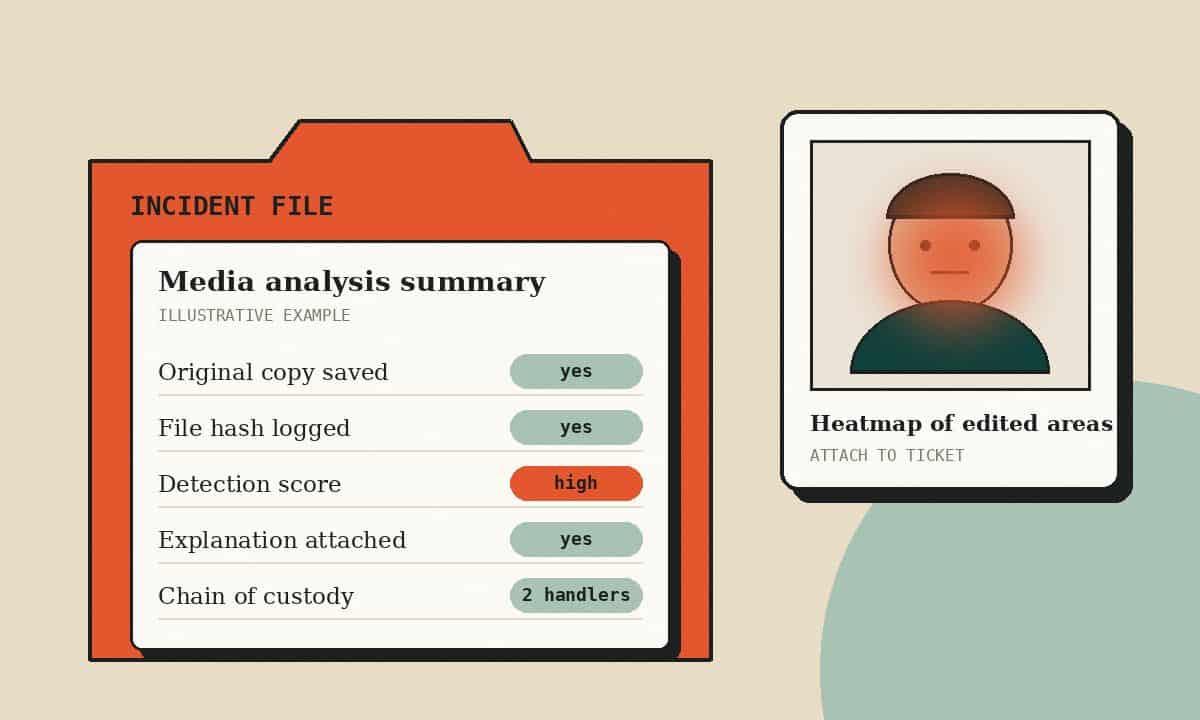
The first rule in the joint advisory is to copy the media before any analysis. Keep the original untouched, record a hash, and log who handled each copy and when.
Save context too. Meeting invites, caller IDs, message headers and platform logs often prove more than the fake itself. Ask your video platform for logs early, because retention windows can be short.
Check for provenance data. Some cameras and tools now attach Content Credentials, and a missing or broken manifest is one more data point for your report.
Run a Tabletop Exercise Before You Need It
A playbook nobody has practiced will fail at the first awkward moment, usually when a junior analyst has to tell a senior leader to prove who they are.
Run a 60 minute tabletop each quarter. Use a recorded voice clone of a consenting executive, send it to the finance team, and time how long it takes to reach verification.
Score how fast someone paused the action and whether they used an out of band channel. Also check that the media reached your detection queue with its metadata intact.
How We Help Security Teams Respond Faster
We built TruthScan for the detection and evidence steps in this playbook. Our deepfake detector analyzes video for face swaps and generated footage, and our voice detector checks recordings for cloned speech.
Images and documents go through our image detector and fake PDF detector, which helps with forged IDs, invoices and screenshots. Each result comes with a score, an explanation and, for visual media, a heatmap of the suspicious areas.
For SOC workflows, our video detection API returns JSON you can send straight into your ticketing or SOAR tools. Teams that need SOC 2 Type II and ISO/IEC 27001:2022 documentation can get it through our enterprise plans.
The Proof: 4 to 5 Times Faster Investigations at a Federal Agency
A US quasi law enforcement agency tested TruthScan for a month before buying team licenses. Manual review used to take up to 20 minutes per image and up to an hour per video.
According to the case study, the agency now investigates 4 to 5 times faster across a batch of 100 suspected AI cases, and video reports with heatmaps come back within minutes. Investigators still make the final call, which is how we think detection should work.
When We’re Not the Right Fit
If your main risk is a live attacker inside your network, you need EDR and a classic IR retainer first. We analyze media and documents, not endpoints.
We also don’t replace callback rules, dual approvals or staff training. Detection works best as one layer that backs up those controls.
FAQ
What is a deepfake incident response playbook?
It’s a written plan that tells your team how to detect, contain, investigate and recover from attacks that use synthetic video, audio, images or documents. It names owners, triggers, severity levels and evidence steps.
Who should own deepfake incidents?
Security should lead, because the attack targets access, money or data. Finance, IT, Legal and Comms join based on the scenario, and the playbook should say exactly when each team is called.
Can staff be trained to spot deepfakes by eye?
Only partly. Research shows people perform near chance on high quality fakes, so training should focus on behavior triggers and verification habits, with detection tools doing the media analysis.
Do we need to report a deepfake fraud attempt?
It depends on your sector and location. US banks file SARs under the FinCEN alert, and the FBI asks victims to report to IC3. Check with your legal team for your own obligations.
How often should we test the playbook?
Run a tabletop at least once a quarter and after any real incident. Update the list of exposed leaders and processes whenever roles or payment flows change.
Conclusion
A deepfake incident response playbook comes down to a few habits. Treat synthetic media as a security incident, verify through channels attackers can’t fake, preserve the evidence and practice until the pause feels normal.
Detection is the step most teams leave to gut feeling, and that’s where we can help. TruthScan gives your analysts a score, an explanation and a heatmap in minutes, ready to attach to the ticket.
If you’re building or updating your playbook this quarter, talk to us about adding TruthScan to your detection and evidence steps.