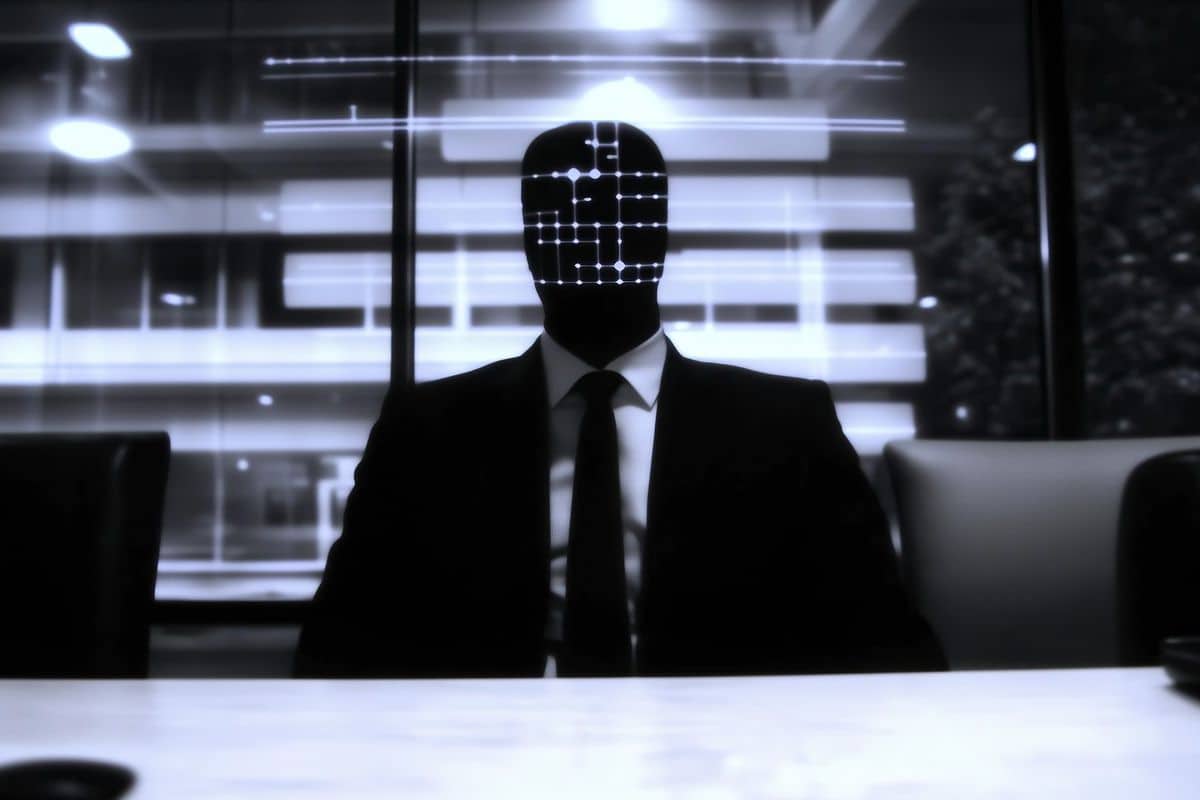
Synthetic media has crossed the threshold from experimental parlor trick to weaponized corporate extortion.
Where legacy Business Email Compromise (BEC) relied on spoofed domains and plain-text urgency, modern executive deepfake scams harness real-time generative video rendering, few-shot voice cloning, and pre-recorded media harvesting to trick seasoned finance and operations teams.
From synchronized multi-avatar virtual conferences to cloned voice notes delivered via encrypted messaging apps, C-suite executives and their direct reports face an adversarial landscape where seeing and hearing are no longer believing.
Key Takeaways
- Real-time multi-avatar video engines now fabricate entire executive boards, eliminating voice and video as valid proof of identity.
- Attackers systematically isolate targets by framing fraudulent requests as confidential M&A deals or urgent regulatory settlements.
- Wire authorizations must always be confirmed across a secondary, pre-approved channel decoupled from the original request.
- Offline contextual questions and physical head-turn maneuvers disrupt real-time neural rendering pipelines during live calls.
- Cryptographic Maker-Checker approval workflows with hardware tokens stop wire fraud even when synthetic media completely fools an employee.
Verified Real Deepfake Examples and Incident Analyses
The $25.6M Arup Multi-Avatar Conference Fraud
- Organization Arup (Multinational design and engineering firm)
- Target Hong Kong regional finance officer
- Direct Loss HK$200 million (~$25.6 million USD)
- Secondary Costs Forensic investigations, external legal counsel, and cross-border recovery litigation
- Attack Method Multi-participant synthetic video call
- Source CNN Report on Hong Kong $25M Deepfake Call
A finance employee in Arup’s Hong Kong office received an email ostensibly from the UK-based Chief Financial Officer detailing a confidential transaction. Initial employee skepticism was erased after joining a scheduled video call where every participant on the screen—including the CFO and other known colleagues—looked and sounded authentic.
The fraudsters used pre-recorded footage and voice synthesizers to animate multiple corporate officers simultaneously.
Acting on instructions delivered live during the conference, the employee executed 15 transactions across five local banking institutions. The breach went undetected for over a week until the employee casually confirmed the transactions with global headquarters.


Never Worry About AI Fraud Again. TruthScan Can Help You:
- Detect AI generated images, text, voice, and video.
- Avoid major AI driven fraud.
- Protect your most sensitive enterprise assets.
2. The Singapore Multilateral Boardroom Compromise
- Organization Confidential Multinational Enterprise (Singapore regional hub)
- Target Regional Finance Director
- Direct Loss $499,000 USD
- Attack Method Multi-party live synthetic Zoom conference
- Source Singapore Police Force / Tookitaki Industry Advisory
Following the Hong Kong multi-avatar playbook, adversaries targeted a Singapore-based regional finance director. Attackers established contact through encrypted messaging to schedule an urgent video conference regarding cross-border corporate restructuring.
During the call, synthetic likenesses of the CFO and regional board directors engaged in real-time conversation. The actors cited imminent regulatory deadlines and market sensitivity to bypass manual accounting sign-offs, instructing the director to release an immediate operational wire.
Singaporean law enforcement cited the case as an example of real-time latency masking and multi-speaker conversational pacing.
3. Ferrari — The Knowledge-Challenge Defense
- Organization Ferrari S.p.A.
- Target Senior Corporate Executive (impersonating CEO Benedetto Vigna)
- Direct Loss $0 (Prevented)
- Attack Method Real-time cloned voice with southern Italian regional accent + WhatsApp profile spoofing
- Source Bloomberg / MIT Sloan Management Review
An executive received WhatsApp messages bearing the name and image of CEO Benedetto Vigna, outlining a confidential corporate acquisition requiring immediate capital movement. A subsequent phone call featured a voice clone mimicking Vigna’s southern Italian cadence.
Despite the acoustic fidelity, subtle mechanical cadence anomalies caused the executive to pause. The executive issued a spontaneous challenge asking what book title Vigna had recommended the previous week.
The caller stalled, failed to provide an answer, and hung up, halting the operation before capital or corporate data was compromised.
4. Wiz — Acoustic and Contextual Mismatch Failure
- Organization Wiz (Cloud Security Firm)
- Target Security Engineering & Administrative Personnel
- Direct Loss $0 (Prevented)
- Attack Method Text-to-speech CEO voicemails requesting administrative credential resets
- Source Wiz Threat Intelligence & Security Advisories
Adversaries trained an acoustic model using public keynote presentations delivered by Wiz CEO Assaf Rappaport. The attackers deployed targeted voicemails urging administrative personnel to bypass single sign-on (SSO) guardrails to facilitate emergency cloud infrastructure maintenance.
The attack failed because the model was trained entirely on high-energy public speaking audio. When applied to an informal, one-on-one message, the acoustic delivery sounded artificial and mismatched with Rappaport’s direct conversational style. Staff immediately routed the audio to internal security teams.
5. WPP — The Hybrid Video-Loom Infiltration
- Organization WPP plc
- Target Senior Agency Leadership (impersonating CEO Mark Read)
- Direct Loss $0 (Prevented)
- Attack Method Scheduled Microsoft Teams call combining voice synthesis with looped YouTube media
- Source The Guardian Report on WPP Cyber Incident
Attackers established a fake WhatsApp profile using public imagery of CEO Mark Read to schedule an executive-level Microsoft Teams meeting. During the call, the fraudsters alternated between an off-camera voice clone and manipulated, looped YouTube footage of Read to request personal financial credentials and seed capital for an alleged corporate venture.
Leadership identified frame stutter, unnatural lighting transitions, and deviations from normal investment approval processes, terminating the call before any disclosures were made.
6. LastPass — Out-of-Band Executive Vishing
- Organization LastPass
- Target Core Operations Personnel
- Direct Loss $0 (Prevented)
- Attack Method Multi-touch WhatsApp audio calls and automated voicemail cloning
- Source LastPass Security Operations Disclosure
A LastPass employee was targeted via repeated calls, text messages, and synthetic voicemails mimicking the company’s chief executive. The synthetic requests urged the recipient to execute urgent tasks outside standard workflows.
The attempt failed because the recipient noticed three red flags:
- Incoming contact originated outside regular business hours.
- The caller insisted on immediate, urgent action without standard change-management tracking.
- The CEO was reaching out via an unapproved personal messaging app rather than internal enterprise channels.
Executive Deepfake Scams — Attack Comparison Matrix
| Target Company | Impersonated Role | Vector & Channel | Direct Financial Impact | Core Failure / Prevention Factor |
| Arup | CFO & Regional Colleagues | Scheduled multi-avatar video conference | -$25.6M USD | Reliance on visual confirmation alone; absence of out-of-band payment dual-control. |
| Multinational (Singapore) | CFO & Board Members | Multi-party synthetic Zoom conference | -$499,000 USD | Urgency around an alleged M&A restructuring bypassed manual sign-offs. |
| Ferrari | CEO Benedetto Vigna | WhatsApp messages + real-time voice call | $0 (Prevented) | Shared personal challenge question that the synthetic voice model could not answer. |
| Wiz | CEO Assaf Rappaport | Targeted voice-cloned voicemails | $0 (Prevented) | Vocal acoustic mismatch (keynote audio vs. informal tone) flagged by alert staff. |
| WPP | CEO Mark Read | WhatsApp staging into a Microsoft Teams meeting | $0 (Prevented) | Spliced media artifacts and out-of-process venture capital demands aroused suspicion. |
| LastPass | Chief Executive | Out-of-band WhatsApp vishing and voicemails | $0 (Prevented) | Adherence to policy: flagged off-hours contact, unapproved apps, and artificial urgency. |
Anatomical Insights — Technical Mechanics & Targeting
Understanding modern synthetic attacks requires examining both the technology stack and the operational loopholes adversaries exploit.
The Attack Pipeline Toolchain
- Automated scrapers aggregate earnings call Webcasts, podcast appearances, and television interviews from YouTube, Vimeo, and corporate investor relations portals.
- Neural vocoders (such as open-source XTTS architectures or commercial voice APIs) ingest 3 to 10 seconds of clean speech to build real-time voice clones matching timbre, cadence, and pitch.
- Programs like DeepFaceLive or latent diffusion renderers map the attacker’s physical facial movements onto the target executive’s portrait in real time, routing the synthetic feed directly into virtual camera inputs for Zoom or Teams.
- Attackers deliberately emulate bandwidth stutter, packet loss, or poor lighting to obscure boundary warping and rendering artifacts around the eyes and mouth.
The Executive Media Paradox
Senior executives are expected to be public champions for their brands. Every appearance on Bloomberg, CNBC, or an industry podcast adds clean training data to public repositories.
Unlike frontline employees whose digital footprints may be minimal, corner-office leaders generate hundreds of hours of high-definition, multi-angle audio and video that adversaries can convert into real-time avatars.
Psychological Exploitation of Organizational Hierarchies
Deepfakes do not bypass firewalls; they bypass human critical thinking by exploiting structural deference to leadership:
- Subordinates often hesitate to question an executive who appears stressed or demanding on camera.
- Framing calls around confidential M&A, regulatory audits, or stealth buyouts justifies excluding standard procurement or treasury colleagues.
- Populating a call with multiple familiar synthetic avatars neutralizes individual skepticism through perceived consensus, as demonstrated in the Arup and Singapore incidents.
Defensive Engineering: Enterprise Playbook Against Deepfakes
Mitigating synthetic deception requires replacing sensory trust with cryptographic, procedural, and behavioral verification controls.

Zero-Trust Communications Framework
Treat incoming audio and video streams like unauthenticated data packets. No corporate action involving capital movement, credential issuance, or data access should ever be initiated solely from a voice or video conversation.
- Mandate that all financial approvals occur directly inside enterprise treasury platforms or ERP software requiring hardware-backed authentication (such as FIDO2/WebAuthn keys).
- Require two distinct authorized signers on transactions exceeding established thresholds, operating on isolated corporate networks.
- Explicitly prohibit company business or authorization requests over personal messaging services like WhatsApp, Telegram, and personal SMS.
2. Behavioral & Real-Time Physical Challenge Protocols
When an audio or video call raises suspicion, personnel should execute verification maneuvers that exploit the mechanical limitations of generative rendering:
- Instruct the caller to turn their head completely to the side or move their hand slowly across their face. Real-time facial replacement algorithms map landmarks best when facing the camera, so severe angles cause edge-tearing, jitter, and model collapse.
- Challenge the speaker with a question about an unrecorded, offline shared event, such as an off-site lunch or unrecorded travel anecdote.
- Interrupt mid-sentence with an unrelated topic. Synthetic voice tools running on audio translation engines depend on predictable conversational cadence, and sudden disruptions force latency delays, audio looping, or unnatural silences.
3. The 15-Minute Incident Response Escalation Ladder
When a suspected deepfake attempt occurs, the targeted employee must follow a clear response sequence:
- Disconnect the call immediately without announcing suspicion to the caller, and avoid opening shared files or links.
- Contact the internal Security Operations Center (SOC) or CISO through an enterprise-managed emergency channel.
- If wire instructions or credentials were submitted, notify the corporate bank’s fraud desk immediately to request a kill-switch freeze on outgoing SWIFT/SEPA transfers.
- Save meeting invite logs, calendar IDs, incoming phone numbers, network IP metadata, and meeting recordings to support forensic investigation and law enforcement reporting.
4. Technical Detection and Integration
- Deploy deepfake detection engines directly across enterprise communication endpoints to inspect live audio streams for harmonic clipping, synthetic vocoder signatures, and missing biological micro-expressions.
- To assess your enterprise readiness, explore TruthScan’s AI Deepfake Detection Engine Guide and review the Executive Identity Protection Framework.
- To audit high-risk workflows, implement TruthScan’s Corporate Wire Verification Checklist & Policy Template.
Frequently Asked Questions (FAQ)
What are executive deepfake scams?
Executive deepfake scams (also known as AI-powered CEO fraud or synthetic BEC) are social engineering attacks where cybercriminals use AI-generated voice clones, synthetic video avatars, or manipulated recorded footage to impersonate corporate leaders.
These attacks aim to deceive employees into approving unauthorized financial transfers, releasing corporate credentials, or bypassing internal operational controls.
How do scammers build realistic deepfakes of CEOs?
Attackers collect publicly available recordings like investor earnings calls, keynote speeches, webinars, and media interviews.
Modern voice synthesis models need only a few seconds of clean reference audio to approximate pitch, timbre, and cadence, while facial puppetry tools map those synthetic voice tracks onto animated video models in real time.
Why do standard security awareness programs fail against deepfake attacks?
Traditional security training focuses primarily on text-based red flags like typographical errors, mismatched email domains, or strange email subject lines. Deepfakes bypass these cues by presenting visual and auditory proof of authority, which easily disarms conventional employee skepticism.
What is the most effective defense against deepfake wire fraud?
The most reliable defense is strict process decoupling by never authorizing money movements or sensitive access based solely on voice or video instructions.
High-value transactions must require out-of-band verification, multi-person authorization via hardware-based security tokens, and strict adherence to established accounting platforms.
Conclusion
The shift from email spoofing to hyper-realistic executive impersonation marks an inflection point in corporate security. As high-profile attacks demonstrate, visual and vocal trust can no longer serve as authentication. Surviving modern synthetic fraud requires replacing sensory gut checks with strict out-of-band verification, cryptographic controls, and real-time detection defenses.
Protect your leadership and high-risk workflows before the next call happens. Explore the TruthScan’s AI Deepfake Detection Engine to flag manipulated media and safeguard your enterprise against executive fraud.