In late 2025, Australia’s Commonwealth Bank has uncovered more than $1 billion in suspected loan fraud that was created with the help of AI-generated documents.
These included bank statements, pay stubs and other identity documents which had all gone through the normal lending verification processes.
Mortgage lenders, credit unions and other fintech lenders are already dealing with AI generated bank statements and pay slips. These documents are being verified by tools that were not designed to detect yesterday’s Photoshop edits and therefore do not recognize this type of fraud.
In this article we will describe how this type of fraud is created, why current controls fail to detect it, and how we can use AI detection to solve the problem.
How AI Is Making Mortgage Fraud Harder to Detect
As OpenAI’s Sam Altman warned the Federal Reserve in 2025, AI-powered deepfake voices and synthetic documents are poised to defeat the fraud tools banks have relied on for years.
Generative models produce a clean pay stub in seconds, and template marketplaces sell editable bank statements for under ten dollars, complete with logos, plausible balances, and consistent transaction histories.
Why Financial Documents Are the Prime Target
Bank statements and pay stubs sit at the center of nearly every lending decision, mortgages, SBA loans, auto finance, and consumer credit. Their ubiquity makes them the single most targeted document type in fraud schemes.


Never Worry About AI Fraud Again. TruthScan Can Help You:
- Detect AI generated images, text, voice, and video.
- Avoid major AI driven fraud.
- Protect your most sensitive enterprise assets.
When a borrower falls just short of a qualifying threshold, fabricating an extra deposit or inflating a paycheck is now trivial, and the payoff, a wrongfully originated loan, is large.
From Photoshop to Prompt: How Fabrication Changed
A few years ago, a fake document often gave itself away with wrong fonts, misaligned fields, or implausible spacing. That is no longer a reliable signal.
Fraud-detection firm Inscribe reports that from April to December 2025, detected AI-generated document fraud rose nearly fivefold, and the visual quality of those fakes is improving fast enough that experienced underwriters can no longer eyeball the difference.
It is also worth remembering that fraud enters from more than one direction. Sometimes it is the borrower inflating their own income; sometimes it is an intermediary, a broker or “credit repair” specialist, fabricating documents on a client’s behalf for a fee.
And the same generative tools power borrower-facing scams: fraudsters posing as lenders now issue fake pre-approvals backed by fabricated documents to pressure homebuyers into upfront payments.
A detection layer that questions document authenticity protects the institution against both the applications it receives and the impersonations that trade on its name.
How Big Is the Problem? The Numbers Lenders Can’t Ignore
The data across independent sources points the same direction:
- The 2025 Cotality Annual Fraud Report estimates that roughly 0.86% of all mortgage applications, about one in 116, contain fraud risk, with income misrepresentation the single most common finding at 46% of investigated cases.
- For 2–4 unit multi-family properties, that risk rises to roughly one in 27 applications.
- The FBI’s Internet Crime Complaint Center recorded real estate and mortgage fraud losses surging to $275.1 million in 2025, a 59% jump over the prior year, and explicitly attributed the reversal to AI-generated synthetic content.
- Inscribe found that roughly 6% of documents it processed in 2025, about one in 16, showed signs of manipulation or fabrication, with a similar baseline across bank statements, pay stubs, and tax forms.
- The Federal Reserve Bank of Boston estimates synthetic identity fraud losses at around $35 billion annually, a threat that frequently rides in on fabricated financial documents.
Zoom out and the trajectory is stark: Deloitte’s Center for Financial Services projects that generative AI could push US fraud losses to $40 billion by 2027, up from $12.3 billion in 2023. Financial documents are the most common target of that wave.
Why Traditional Verification Fails
Most lending pipelines run submitted PDFs through optical character recognition to pull out numbers, then feed those numbers to an underwriting model. The problem is subtle but fatal: OCR confirms that a document is readable, not that it is real.
A fabricated statement with a doctored balance extracts just as cleanly as a genuine one. The model approves, and the fraud only surfaces months later when the borrower stops paying.
Manual Underwriter Review Can’t Keep Up
Human review was the traditional backstop, and it is precisely the layer generative AI defeats. When a synthetic pay stub carries the right logo, realistic year-to-date figures, and correct formatting, a busy underwriter reviewing dozens of files a day has no dependable way to flag it.
As one industry analysis put it bluntly: if your fraud detection is AI-based but trained for yesterday’s threats, it can be fooled by today’s AI.
How AI-Generated Bank Statements and Pay Stubs Slip Through
The typical attack follows a predictable pattern. An applicant who cannot quite qualify uses a low-cost AI tool to generate or edit a bank statement, inflating balances, adding phantom payroll deposits, or removing debt-related transactions.
Alongside it, they submit a matching AI-generated pay stub and, increasingly, a synthetic or stolen identity to tie it together.
Each document passes format and OCR checks because, from the pipeline’s perspective, the file behaves like a normal document. The fabrication is invisible to any control that only reads content instead of interrogating how the file was made.
Recent enforcement shows this is not theoretical. In cases prosecuted through 2025, mortgage intermediaries fabricated pay slips to push under-qualified borrowers over lending thresholds, and lenders, backed by government-sponsored enterprises, originated the loans before anyone caught the forgery.
How AI Detection Works for Lending Documents
AI detection attacks the problem from the opposite direction. Instead of reading what a document says, it forensically examines how the document was created, looking for the signatures of generation and editing that fabricators cannot fully erase.
Metadata and Layer Forensics
A PDF and document detection engine inspects metadata, layer structure, and edit history, the digital provenance of the file. A statement that was regenerated in an AI PDF editor, or assembled from layers rather than exported by a bank’s system, leaves telltale inconsistencies even when the visible text looks perfect.
Pixel and Font-Level Analysis
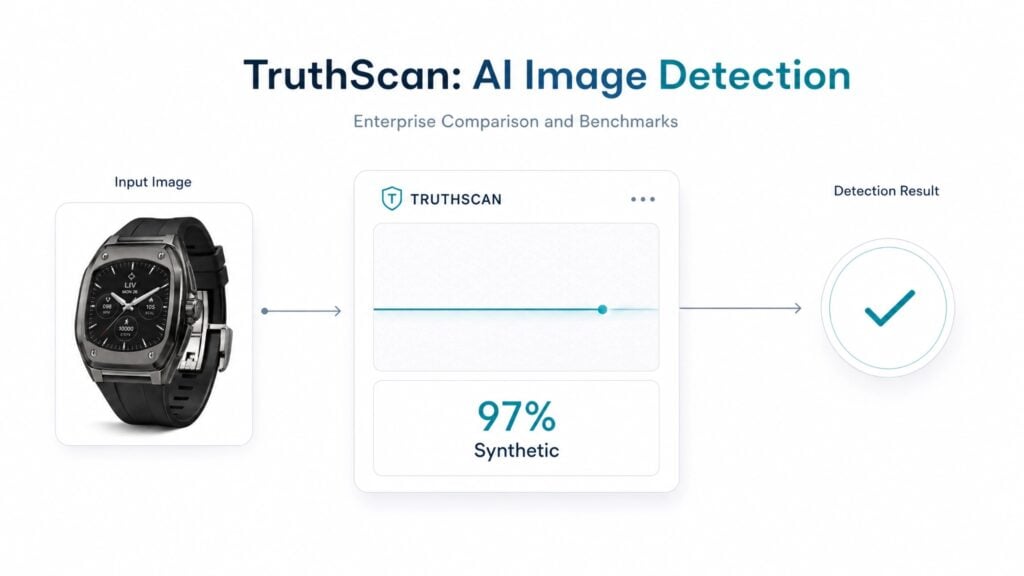
For scanned or image-based documents, image detection adds pixel-level and font-consistency analysis, catching the subtle artifacts of generative models and the micro-misalignments that manual editing introduces.
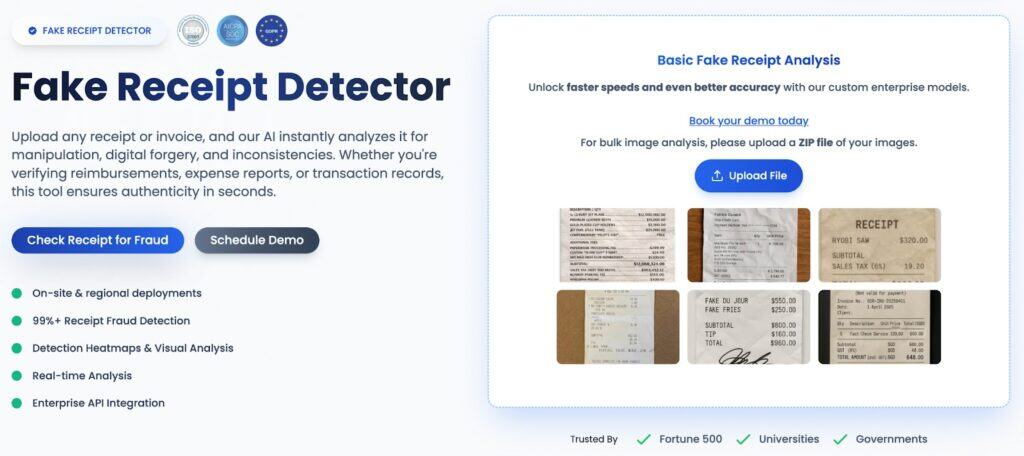
Screenshots of “statements,” a common evasion, are especially exposed here. Where receipts are involved, a dedicated fake receipt detector applies the same forensic lens to expense and proof-of-purchase documents.
Building an AI-Resilient Income Verification Workflow
Detection works best as a forensic layer inside your existing underwriting flow, not a new portal your team has to learn.
A practical rollout looks like this:
- Score at intake. Send every submitted statement, pay stub, and supporting PDF to the detection API at the moment of upload, via document and image endpoints.
- Route by risk. Clean documents continue to underwriting at full speed; flagged files route to a fraud or QC queue with a forensic report attached.
- Keep the evidence. Retain the confidence score and heatmap for every decision, so a declined loan, or an approved one later disputed, has a documented basis.
- Combine signals. Pair document detection with identity checks. Because fabricated documents so often accompany synthetic identities, the two controls reinforce each other, a theme we cover in our guide to KYC deepfake fraud.
Regulatory and Compliance Stakes
The exposure is not only financial. Loans sold to Fannie Mae, Freddie Mac, or the FHA carry representations and warranties about the integrity of the underlying documentation.
Originating a loan on fabricated income can trigger repurchase demands, and supervisors are sharpening their focus, the Financial Action Task Force’s December 2025 Horizon Scan explicitly named deepfakes and synthetic media as threats to customer due diligence, signaling that examiners will expect institutions to have controls that address AI-generated documents.
A documented detection step, with retained forensic evidence, is fast becoming part of a defensible compliance posture.
A Practical Checklist for Underwriting Teams
You do not need to rebuild your stack overnight. Start with the highest-leverage changes:
- Screen every income and asset document at intake, not just the ones that “look off.” AI fakes are engineered specifically to look right.
- Prioritize the riskiest segments first, multi-family and investor loans show materially higher fraud rates than single-family owner-occupied.
- Verify provenance, not just content. Ask whether the file was exported by a bank system or assembled and re-saved by an editor.
- Be suspicious of screenshots submitted in place of original statements, they strip the metadata that detection relies on and are a common evasion.
- Retain forensic evidence for every decision so repurchase reviews and audits have a documented basis.
- Train staff on the new baseline, clean fonts and correct math no longer indicate authenticity.
Frequently Asked Questions
Can AI-generated bank statements really pass underwriting?
Yes. Because they extract cleanly through OCR and carry correct formatting, fabricated statements pass content and format checks that were never designed to verify how a document was created. Detection that examines provenance is what closes that gap.
How common is AI document fraud in lending?
Independent data puts fraud risk at roughly one in 116 mortgage applications overall (higher for multi-family), with income misrepresentation the most common finding, and detected AI-generated document fraud rose nearly fivefold in the back half of 2025.
Does detection slow down loan processing?
No. Documents are scored in one to two seconds at intake; clean files continue straight to underwriting, and only flagged ones are routed for a closer look.
What about borrower privacy and compliance?
Look for SOC 2 Type II, ISO 27001, and GDPR-aligned processing, with regional or on-site deployment for data-resident workloads, the same standards examiners increasingly expect for KYC and lending data.
Can it catch forged tax forms and utility bills too?
Yes. The same document and image forensics apply across pay stubs, tax forms, utility bills, and receipts, all of which show similar baseline fraud rates.
How TruthScan Protects Mortgage Lenders
TruthScan adds a purpose-built verification layer to lending workflows, combining a document detection engine and an image detection engine under one platform.
Submitted files return a verdict, a confidence score, and a region-level heatmap in one to two seconds, fast enough to keep legitimate borrowers moving while flagging the fabrications.
The platform is SOC 2 Type II audited, ISO 27001 certified, and GDPR-aligned, with regional and on-site deployment options for data-resident workloads, exactly the requirements regulated lenders bring to a vendor review. Purpose-built solutions for KYC and financial services and adjacent insurance claims workflows extend the same forensic layer across the institution.
Secure Your Underwriting Pipeline
The economics of fraud have flipped. Fabricating a convincing income document now costs a fraudster almost nothing, while a single wrongfully originated mortgage costs a lender hundreds of thousands of dollars plus compliance exposure.
Restoring trust to the documents at the heart of every loan is no longer optional, and it no longer requires slowing down honest borrowers.
Book a complimentary fraud assessment and see how TruthScan flags AI-generated bank statements and pay stubs before they reach your underwriters, or explore pricing built to scale with your application volume.