
Have you ever looked at a photo submitted for an insurance claim and felt like something was slightly off?
Maybe the lighting on the dented bumper doesn’t match the background, or the water damage on the ceiling looks suspiciously similar to what you saw in a photo last week.
It’s not just you. As technology advances, the insurance industry is facing a massive wave of visual fraud. Fraudsters are no longer relying on crude Photoshop jobs.
Today, they use sophisticated AI generators and deepfake tools to create hyper-realistic images of accidents, property damage, and injuries that never actually happened.
According to the Coalition Against Insurance Fraud, insurance fraud costs Americans over $308 billion every year, and manipulated media is a rapidly growing piece of that puzzle.
When your claims team is processing hundreds of files a day, manually spotting these digital forgeries is nearly impossible.
In this post, we will break down the process of identifying fake damage images in insurance claims, examine the common tactics fraudsters use, and show you how modern detection tools can protect your organization from costly payouts. Let’s get into the details so you can secure your review process.
Let’s dive in.
Key Takeaways
- Fake damage images include AI-generated photos, recycled duplicate submissions, and digitally altered images of real property.
- Insurance fraud costs Americans over $308 billion every year, and manipulated visual evidence is a rapidly growing part of that figure.
- Manual review can’t reliably detect pixel-level manipulation or AI-generated forgeries at scale.
- TruthScan’s AI Image Detector and Deepfake Detector analyze images in milliseconds, flagging suspicious submissions before payouts are approved.
What are Fake Damage Images in Insurance Claim Reviews?
Fake damage images are manipulated or entirely fabricated photos submitted to an insurance company to support a fraudulent claim.
These images are designed to trick adjusters into approving payouts for accidents, property damage, or losses that either didn’t occur or were significantly exaggerated.
In the past, a fraudster might have taken a photo of a pre-existing dent and claimed it happened yesterday. Now, the threat landscape is much more complex.


Never Worry About AI Fraud Again. TruthScan Can Help You:
- Detect AI generated images, text, voice, and video.
- Avoid major AI driven fraud.
- Protect your most sensitive enterprise assets.
Bad actors use generative AI to conjure up realistic images of smashed cars, flooded basements, or broken electronics from thin air.
They might also use advanced editing software to alter genuine photos, adding severe damage to an otherwise pristine vehicle.
The same manipulation techniques used on fake damage photos are also applied to identity documents.
TruthScan’s breakdown of 8 indicators an ID image has been manipulated shows just how sophisticated these edits have become. The goal is always the same: to extract money from your organization using visual evidence that looks completely authentic to the naked eye.
Real Examples of Fraudulent Claim Photos
To understand how to fight back, you need to know what you are looking for. Fraudsters generally rely on a few specific tactics when submitting visual evidence.
Here are the most common types of manipulated photos your team will encounter:
Duplicate claim images
One of the simplest but most effective methods of fraud involves recycling old photos. A claimant might find a picture of a damaged roof online or use a photo from a legitimate claim filed years ago.
They submit this image as proof of a new, unrelated incident. Because claims adjusters review massive volumes of files, a recycled image can easily slip through if the team relies solely on human memory.
Staged damage scenes
Sometimes the photo itself is real, but the context is entirely fabricated. Fraudsters might intentionally damage property or stage a fake car accident simply to take photos for a claim.
While the image hasn’t been digitally altered, the event it depicts is a scam. These staged scenes often lack the chaotic, random details of a genuine accident, but they can be incredibly difficult to spot without specialized analysis.
Misleading accident photos
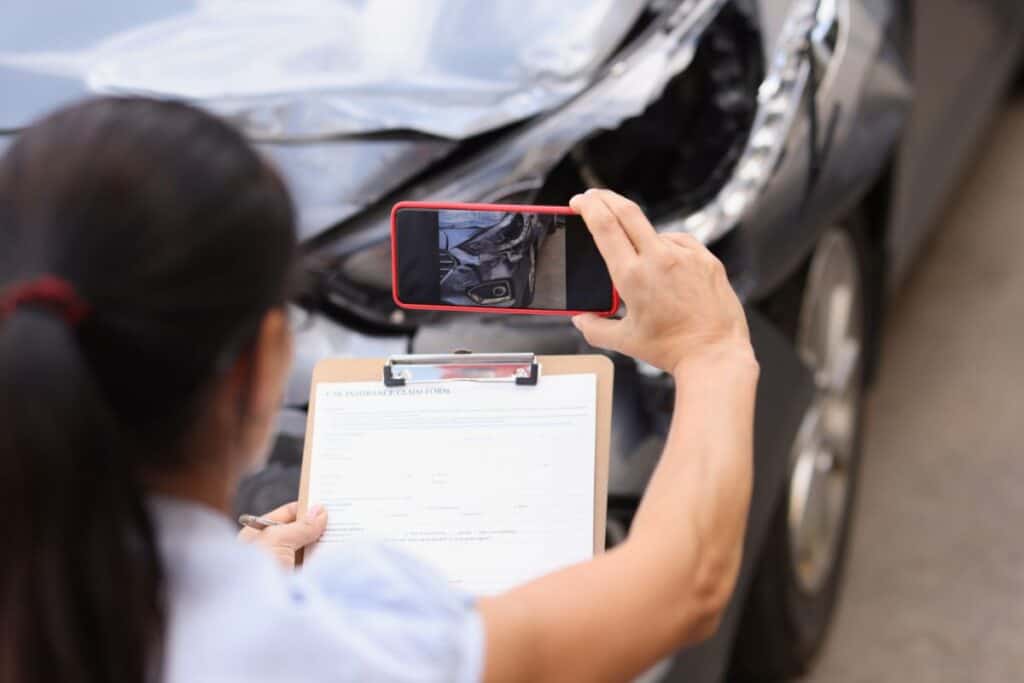
This tactic involves taking a genuine photo of minor damage and using digital tools to make it look much worse. A small scratch on a bumper might be digitally expanded into a massive dent.
Alternatively, fraudsters might use AI to merge two different photos, placing a heavily damaged vehicle into the background of the claimant’s actual driveway.

If you are dealing with a high volume of submissions, the TruthScan’s Deepfake Detector can help you detect repeated or AI-generated duplicates instantly.
Why Fake Damage Images Are Increasing
The surge in visual fraud isn’t a coincidence, but the direct result of powerful technology becoming widely accessible. A few years ago, creating a convincing fake photo required expensive software and hours of skilled labor.
Today, anyone with a smartphone can generate a hyper-realistic image of a car crash in seconds using free AI tools.
Furthermore, the move toward digital claims processing has inadvertently made things easier for scammers. Many insurance companies now allow customers to submit photos through an app for faster payouts.
While this improves the customer experience, it also removes the physical inspection step where an adjuster would normally verify the damage in person.
Fraudsters know that digital-only reviews are vulnerable, and they are exploiting this gap at scale. The same pattern of AI-enabled document fraud is showing up across industries:
TruthScan’s research on detecting fake pharmacy receipts illustrates how the same tools used to fake damage photos are being applied to reimbursement fraud.
You can protect your bottom line and stay ahead of rising fraud trends by integrating TruthScan’s AI Image Detector, an essential tool for detecting trends in manipulated photos.
Using TruthScan to Verify Damage Images

When human eyes are no longer enough to spot a forgery, you need technology that can see beyond the pixels. TruthScan provides an enterprise-grade solution designed specifically to catch visual fraud before a claim is approved.
Instead of relying on guesswork, TruthScan analyzes the underlying data of every image submitted to your system.
The platform looks for microscopic inconsistencies that AI generators leave behind, such as unnatural pixel blending, lighting anomalies, and altered metadata. It can also cross-reference submissions against massive databases to flag recycled images instantly.
By automating the verification process, you can process legitimate claims faster while stopping fraudulent ones in their tracks.
If you want to understand how this type of manipulation works in other document contexts, TruthScan’s guide on detecting medical billing fraud offers a useful parallel.
Training Claims Teams to Spot Fraud
While technology is your strongest defense, your human workforce still plays a vital role. Training your claims adjusters to recognize the subtle signs of manipulation can add an extra layer of security to your review process.
It’s also worth noting that fraud doesn’t stop at images. Teams should be aware of deepfake impersonation in customer support as another vector that can compromise claims integrity.
Your team should know how to look for logical inconsistencies in a photo.
For example, does the weather in the image match the weather report for the day of the alleged accident? Are the shadows falling in the correct direction? Does the damage pattern make sense for the type of collision described?
While they might not catch a perfect deepfake, a well-trained adjuster can often spot the sloppy mistakes that careless fraudsters make.
Combining human intuition with advanced detection tools creates a robust defense system. The same principle applies across other fraud vectors.
For instance, teams reviewing expense submissions can apply similar scrutiny, such as checking for fake hotel receipts.
Strengthening Image Verification in Claims Review
To truly secure your organization, image verification must become a mandatory step in your claims workflow. This means moving away from manual spot-checks and implementing a systematic approach to visual evidence.
Every photo submitted should automatically pass through a verification filter before it reaches an adjuster’s desk.
This system should check for metadata tampering, run reverse image searches for duplicates, and scan for AI-generated artifacts. If an image is flagged, it can be routed to a specialized fraud investigation team for closer review.
By standardizing this process, you remove the burden from your frontline adjusters and create a consistent, scalable barrier against fraud. The same logic applies to video evidence.
TruthScan’s guide on securing surveillance footage against AI-generated tampering is a useful resource for teams looking to extend their verification protocols beyond still images.
How TruthScan Helps Detect Fraudulent Claim Images
TruthScan is built to handle the immense scale and complexity of modern insurance fraud. The platform integrates directly into your existing claims management software via API, meaning your team doesn’t have to master a complicated new system.
When a claimant uploads a photo, TruthScan analyzes it in milliseconds. It provides a clear probability score indicating whether the image is authentic, AI-generated, or digitally altered.
The system also generates visual heatmaps that highlight exactly where an image has been manipulated, giving your investigators concrete evidence to deny a fraudulent claim.
For cases where fraud extends into video submissions or recorded statements, TruthScan’s capability for detecting AI-generated video evidence in legal disputes provides the same level of forensic certainty.
If you’re dealing with fake ID images or fabricated property damage, TruthScan gives you the certainty you need to make confident payout decisions.
Frequently Asked Questions About Fake Damage Images
How do fraudsters create fake damage images?
Fraudsters use a variety of methods. Some rely on simple tactics like recycling old photos from the internet, while others use advanced generative AI tools that can create realistic images of accidents from text prompts.
Can human adjusters spot AI-generated photos?
While adjusters can sometimes spot logical errors in a photo, high-quality AI-generated images are virtually indistinguishable from real photos when viewed by the naked eye. Specialized detection software is required to catch them reliably.
What is metadata, and how does it help detect fraud?
Metadata is the hidden information embedded in a digital photo, such as the time, date, and GPS location of where it was taken.
Analyzing metadata can reveal if a photo was taken long before the claimed incident or downloaded from the web.
How does TruthScan integrate with existing claims software?
TruthScan offers a smooth API integration that connects directly to your current claims management system.
This allows photos to be automatically scanned and scored for authenticity the moment they are uploaded by a claimant.
Is AI image detection expensive to implement?
The cost of implementing detection software is minimal compared to the massive financial losses caused by paying out fraudulent claims.
TruthScan offers scalable enterprise plans designed to provide a strong return on investment.
Talk to TruthScan About Preventing Insurance Claim Fraud
Visual fraud is evolving rapidly, and traditional review methods simply can’t keep up.
If your organization is still relying on manual photo inspections, you are likely losing money to sophisticated scams every single day. You need a proactive defense strategy that scales with your business.
Protect your insurance claims against fraud. Talk to TruthScan today and see how our advanced detection suite can secure your workflows and save your organization millions.