In 2025, the U.S. government recovered a record-breaking $6.8 billion under the False Claims Act.
That is the highest amount in history.
But the concerning part is that a staggering $5.7 billion of that total came directly from medical billing fraud.
We are no longer just dealing with occasional human errors or small-time scams.
In 2026, the game has changed entirely.
The rise of ai document fraud means that healthcare systems are being flooded with perfect fake claims that look, feel, and read like the real thing.
To survive this wave, organizations need a specialized AI image detector and deepfake detector to spot the digital fingerprints that human eyes simply cannot see.
In this blog, we’ll explore how to spot medical billing fraud, the most common types, key warning signs, associated risks, the advantages of automated detection, and much more.
Să intrăm în subiect.
Principalele concluzii
- Healthcare fraud accounted for over $5.7 billion in losses in 2025.
- Scammers now use AI document fraud to create perfect clinical notes and billing codes that look 100% legitimate to the human eye.
- Humans take 14–16 months to catch a single case of medical billing fraud, while AI does it in real-time.
- Effective healthcare fraud detection requires an AI image detector to spot digital fingerprints that standard software misses.
- Switching to automated document verification can increase audit capacity and save nearly billions in revenue.
Why Medical Billing Fraud Is Escalating
Medical billing fraud is exploding in scale. Here are the top three reasons:
Reason 1: Healthcare Is Buried in Digital Records
Healthcare systems have moved to digital records. That’s good for efficiency, but it also means big data lakes of claims, treatments, invoices, and patient files that are impossible for humans to review manually in any meaningful way.
Nu vă mai îngrijorați niciodată de frauda AI. TruthScan Vă poate ajuta:
- Detectarea AI generate imagini, text, voce și video.
- Evitați fraudă majoră generată de IA.
- Protejați-vă cele mai sensibile activele întreprinderii.
Reason 2: Generative AI Is Easy to Use
You don’t need advanced technical skills to generate convincing fake documents. Cheap AI tools can create professional-looking invoices, patient notes, lab reports, and insurance files in seconds.
This lower barrier to fake content is one of the reasons why medical claim fraud is so prevalent.
Reason 3: Billing Farms Have Replaced Big Fake Bills
Older fraud models focused on one giant fake bill that used to get caught.. Modern fraud schemes work differently. Organized groups use scripts and automation to send thousands of small, low-dollar claims.
Each one tiny enough to fall below typical thresholds for human review. These micro-claims are individually easy to miss, but they add up fast.
- Hundreds of low-value claims can evade routine checks.
- Automated billing scripts can run at scale.
- Patterns are too subtle for manual reviewers to spot without advanced analytics.
How AI-Generated Documents Enable Fraud
- Deepfake Documentation
Modern AI can replicate official hospital letterheads and physician signatures with 100% accuracy. These documents are identical to the real thing.
- A human auditor looking at a digital PDF has zero chance of spotting a forgery by eye without a deepfake detector.
- Identități sintetice ale pacienților
Scammers are using Large Language Models (LLMs) to build patients from scratch.
- If the bill is for a heart issue, the AI ensures the patient’s past five years of fake records show high blood pressure and chest pain. The claim looks medically sound, so it sails through the system without raising any eyebrows. To stop this, automated document verification is becoming the industry standard.
- Automated Variations to Avoid Detection
AI beats old-school fraud detection by generating 1,000 unique versions of the same lie.
| Caracteristică | Old School Fraud | AI-Powered Fraud |
| Wording | Same sentence repeated | Every bill is phrased differently |
| Formatting | Exact duplicates | Subtle changes in layout/spacing |
| Detection | Easy to flag as spam | Looks like 1,000 unique cases |
- Perfect Medical Coding
AI knows the ICD-10 and CPT codes better than most humans do. Traditional software looks for coding errors to flag fraud.
- AI ensures the diagnosis matches the procedure perfectly. There are no red flags because the story on the bill is technically flawless.
Common Types of Medical Billing Fraud
Some of the most expensive fraud schemes hide inside very normal-looking claims. Here are two of the most common ones.
Inflated service charges
This happens when a provider bills for a more expensive service than what was actually performed.
Exemplu:
Reality: You see a doctor for 10 minutes for a sore throat.
Scam: The AI writes a fake report claiming the doctor spent an hour doing complex heart and lung tests.
Payoff: The insurance company sees the complex report and sends a $500 check instead of $50.
Duplicate billing claims
This means submitting the same service twice in different words.
Exemplu:
- Monday: MRI bill submitted with one report
- Thursday: The same MRI, but the report is AI-rewritten
- Date changed
- Clinical description slightly altered
- Framed as a necessary follow-up scan
To a human reviewer or basic software, these look like two separate, legitimate claims. They’re not.
Indicators of AI-Generated Billing Documents
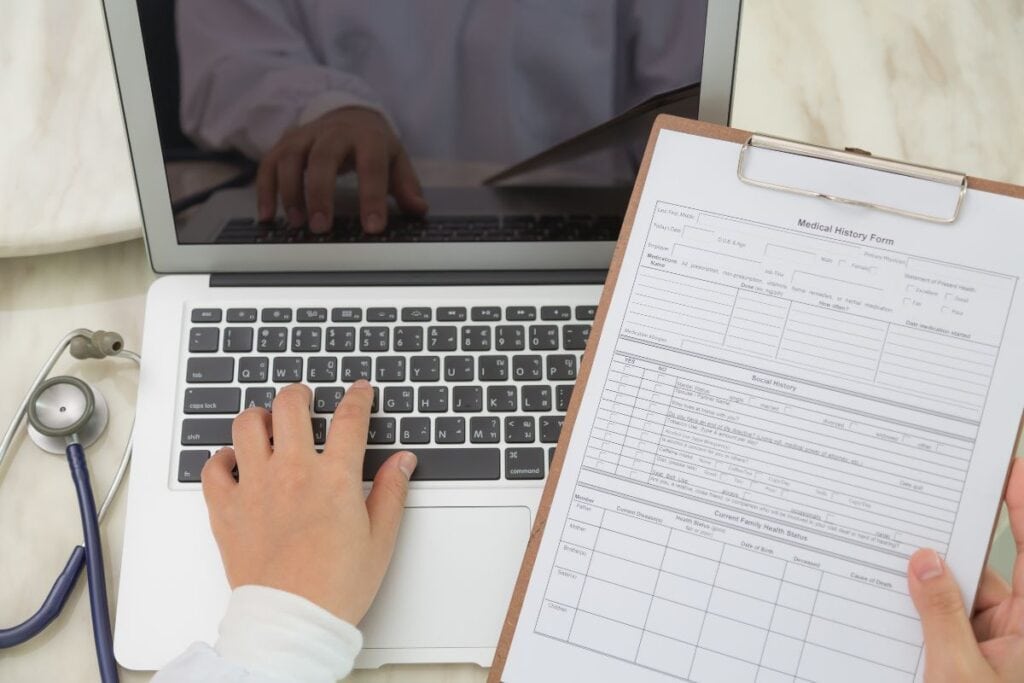
Here is the breakdown of the red flags that can help you spot AI-generated fraud:
- Flawless Grammar: Real medical notes are usually messy and full of abbreviations. AI notes are suspiciously perfect and typo-free.
- Lack of Human Variety: AI often repeats the same structure, whereas real doctors all have their own unique way of writing.
- Medically Incoherent Details:AI might write a logical story that contains medical contradictions or treatment timelines that don’t make sense.
- Template-Like Consistency Across Providers: If bills from different doctors look exactly the same, they likely came from the same AI prompt.
- Suspicious Metadata: Creation dates, editing history, or software info inconsistent with the claimed document origin.
- Identical Rare Phrasing: Repeated unusual terminology across independent documents suggests AI-generated content.
- Mathematical Patterns: Detection tools like an AI image detector can spot robotic sentence structures invisible to humans.
Risks to Enterprises and Healthcare Organizations
AI-driven fraud is a direct hit to the bottom line and patient safety. Here is how these risks break down for organizations:
| The Risk | What Happens | Real-World Cost |
| Money Down the Drain | Billions of dollars go to scammers instead of sick people. | In 2024, Medicare and Medicaid lost over $87 billion to wrong payments. |
| Legal Trouble | Even if you didn’t mean to, bad AI bills can get you sued. | Massive fines and government investigations under the False Claims Act. |
| Ruined Reputation | Once people think you’re a fraud, they won’t trust you. | You lose patients, partners, and your professional street cred. |
| Patient Safety | Doctors might treat patients based on fake medical history. | Someone could get the wrong medicine because a scammer invented a fake illness. |
| Burnt Resources | You spend all your time and money being a detective. | Instead of helping patients, staff are stuck doing paperwork and legal battles. |
| Higher Bills | When scammers steal, your insurance price goes up. | Everyone pays higher monthly premiums to cover the cost of the theft. |
Challenges of Manual Document Review
Here is why the old-school manual way can’t keep up with modern AI fraud:
- Teams can’t handle tens of thousands of fraud reports without errors.
- Detecting a case can take 14–16 months, giving fraudsters time to scale.
- Auditing medical records requires certified experts, limiting reviewer availability.
- Manual audits can miss fraud spread across multiple small claims.
- AI-generated fraud keeps changing, making old detection methods obsolete.
- Reviewing hundreds of documents reduces accuracy as reviewers get tired.
Benefits of Automated Fraud Detection
To fight a high-tech thief, you need high-tech security. Automated document verification is the only way to stay ahead.
- AI flags suspicious claims before payment, unlike manual methods that act after the fact.
- Detects unusual claim volumes, duplicate submissions, or medically unnecessary services quickly.
- AI adapts to new fraud tactics automatically using historical data.
- Works across billing and electronic health record systems to spot cross-system patterns.
- Large insurers can save $380–$970M per $10B revenue by using AI for fraud detection.
How TruthScan Detects AI-Driven Medical Document Fraud at Scale
Ever wondered how some fraudulent claims slip through even the strictest audits? That’s where TruthScan vine în.
It acts like a forensic expert for your documents, covering what traditional billing software simply can’t.
Instead of just reading the words, it looks at the fingerprint of the document. Every AI-generated record leaves subtle patterns behind. TruthScan’s algorithms can spot them all, acting as a powerful AI image detector and deepfake detector for every file you process.
TruthScan’s algorithms can spot them all, whether they come from GPT‑4, Claude, or other AI tools.
But how does it catch the tricky ones? TruthScan examines the look and structure of the document.
If an invoice claims to be from a real clinic but the font or layout is slightly off, TruthScan notices it immediately.
And it doesn’t stop there. It cross-checks the story in the document with the billed codes.
Does the narrative feel too perfect? Does every diagnosis, treatment, and code align exactly? If yes, that’s often a red flag for AI-generated fraud.
Can this work at scale? Absolutely.
TruthScan is designed for enterprise-level operations. It can scan entire databases of past and current claims, uncovering patterns that may have gone unnoticed for years.
How many fraudulent claims are hiding in plain sight in your system?
By combining text analysis, layout checks, and pattern detection, TruthScan helps organizations catch AI-driven fraud quickly and efficiently without exhausting teams or letting subtle tricks slip by.
Talk to TruthScan About Protecting Medical Billing Operations
The rise in medical billing fraud can’t be stopped just by hiring more staff or working longer hours.
Fraudsters are now using AI to create perfect fake documents, and most healthcare organizations are struggling to keep up.
If your healthcare fraud detection still relies on manual spot-checks, it’s like leaving your vault wide open for high-tech fraud rings.
TruthScan fills that gap. It adds a forensic layer with AI-powered image and deepfake detection, plus automated document checks.
This means you can spot the hidden signs of AI-generated fraud and verify that every document entering your system is real.
Stopping medical claim fraud isn’t just about saving money, it’s also about protecting patient care and staying compliant with federal rules.
Waiting for a 16-month audit to reveal problems can cost your organization a lot.
A proactive, AI-driven approach ensures that every dollar you pay goes to real care for real patients.
Talk to TruthScan About Protecting Your Medical Billing Operations