
A normal call from your CFO can be the moment trust works against you. Just imagine the breach begins with;
“Can you send me the admin password before lunch?’
You obey as if obeying was the only way to survive lunch. Sounds reasonable as it’s just a perfectly ordinary workday moment.
But, this routine moment at work is going to be the opening scene of a security incident. Risk now arrives disguised as routine.
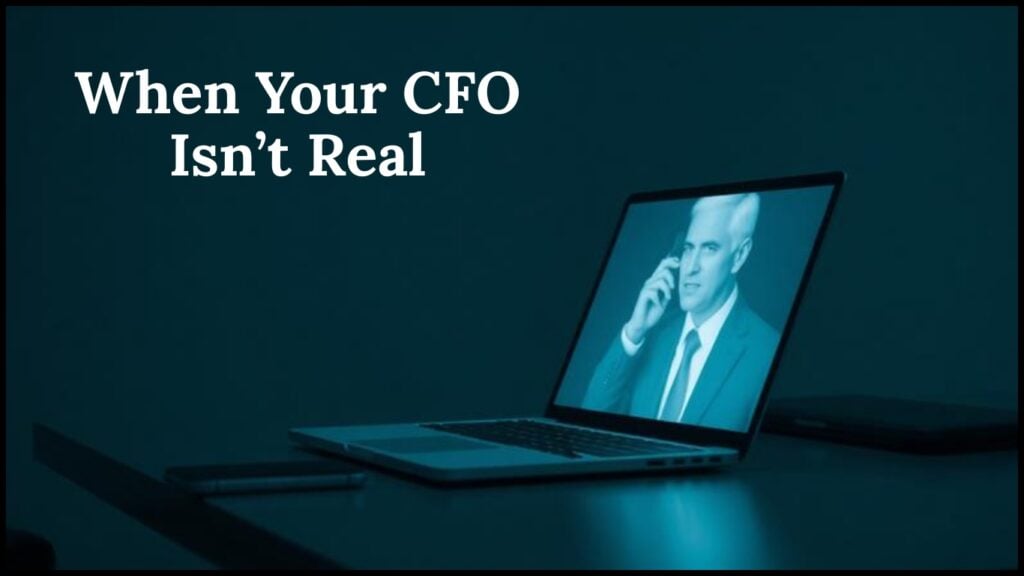
In early 2024, exactly this kind of deception arrived with a familiar voice and a friendly face when a finance worker in Hong Kong cashed out $25 milioane to someone looking exactly like their actual CFO.
Your enterprise can no longer afford to assume good intentions. It’s like we are sitting at the intersection of trust and legal liability.
So, it’s a wake-up call to align your IT protocols with the latest AI deepfake legislation. Because hackers now speak in voices you are used to hearing every day.
Read on and step inside the new AI legal era to see how false sights and sounds can create real legal exposure.
Principalele concluzii
- Trust is no longer safe. The $25 million Hong Kong CFO scam proved that familiarity can be convincingly faked.
- The law is moving faster now. The moment AI is deployed, legal liability follows the enterprise. So, nevermind who pressed “deploy”, the law points at you.
- Synthetic media is so far ahead that trusting human instincts alone is now a gamble. Enterprises need real-time AI detection systems to scan every email, all video/voice calls, shared files for signs of manipulation.
What Is Deepfake Legislation?
Deepfake legislation is no longer abstract, or what we say “belongs only in theory”. It’s a non-negotiable legal necessity that even well-established enterprises are under pressure to adopt.
But, what exactly is this set of rules that are forcing tough choices? Nothing confusing, just a map you need to stay ahead in this AI era.
As every pixel holds a hidden truth (or a lie), global governments are racing to stop AI manipulation from sinking companies. For example, the EU AI Act now forces enterprises to label AI content or risk millions in fines.
Nu vă mai îngrijorați niciodată de frauda AI. TruthScan Vă poate ajuta:
- Detectarea AI generate imagini, text, voce și video.
- Evitați fraudă majoră generată de IA.
- Protejați-vă cele mai sensibile activele întreprinderii.
Because humans need to know when an AI is speaking, not a real person.
How Deepfake Impacts Enterprises
Phishing emails and network breaches? Old news!
The threat now sounds and looks like your CEO (and with AI deepfake legislation, enterprises can’t afford to ignore it). Just a single “yes” can cost millions. It proves, trust is the wildest investment—can be both treasure and trap.
But, what if lies show their hands first? Yes, deepfake lies have met their match: AI detection.
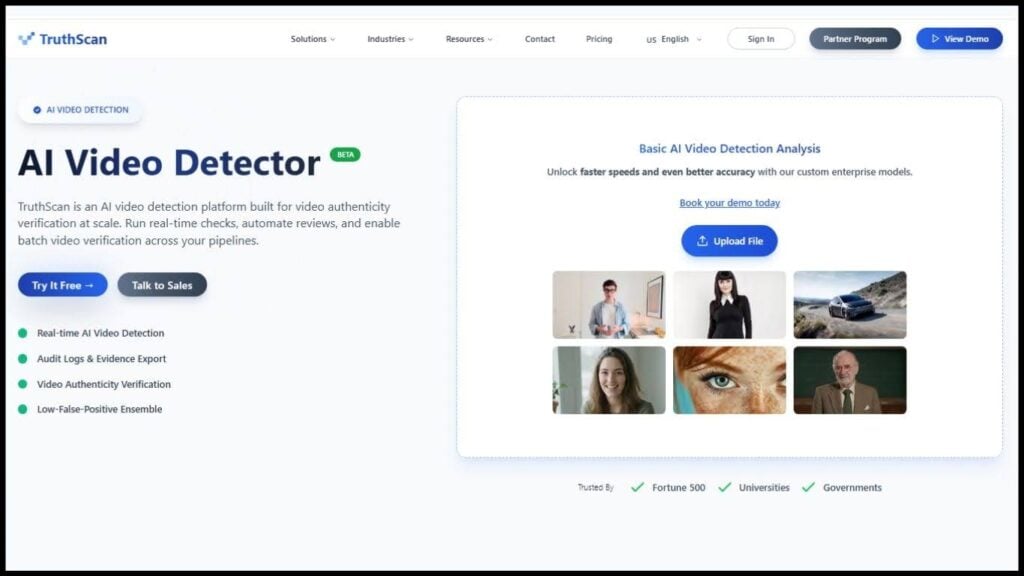
Organizations are now deploying Detectoare AI across internal communication channels because they fear the “CEO” who never actually called.
And honestly waiting for a breach is nothing, but a multi-million dollar gamble.
It’s more like a vulnerability, because deepfake videos these days have just outpaced our natural ability to spot a fake.
The sad reality is, there’s no difference between a BOSS and a pixel ghost anymore unless you use a credible AI video detector that refuses to let a puppet run your payroll.
Legal Risks for Enterprises
“I didn’t know” is not a valid legal defense in 2026 (thanks to new deepfake legislation).
If your enterprise treats AI laws as “suggestions,” a lawsuit is just a matter of time, (A fun fact: It’s just a way to make your lawyers very, very rich.)
Now, in order to shield your C-suite from a $25 million mistake and to stay out of the courtroom, it’s essential to make “Verify” your company’s new favorite word.
Because, realistically, “Verify” is the only internal check that protects a brand.
It ensures your assets don’t become someone else’s ROI by breaking the loop of deception.
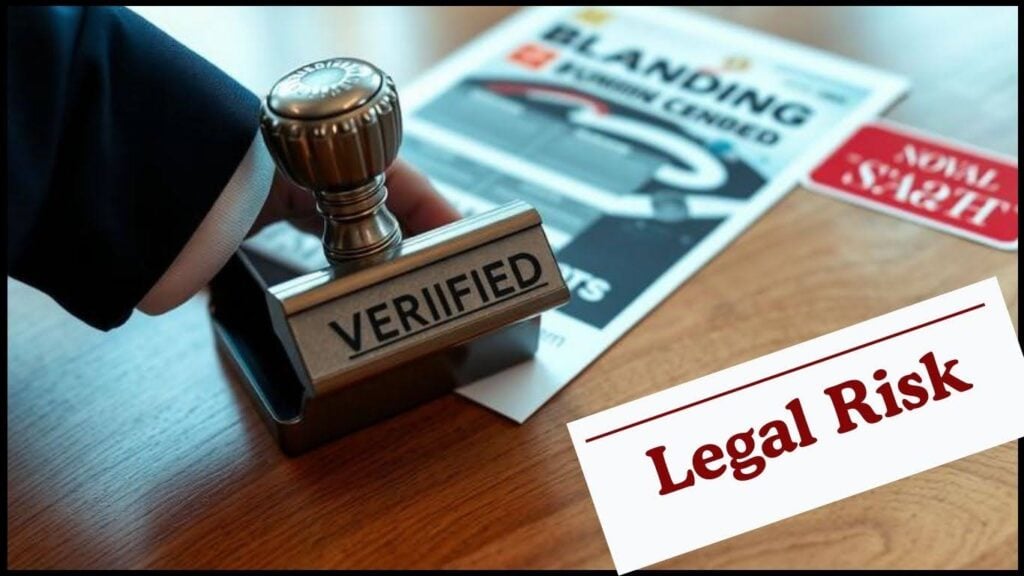
‘Verify’ isn’t a catchphrase; it’s a command!
Gone are the days when vague promises and polite inquiries were effective. Now, it’s all about clear legal receipts and a zero-tolerance policy for error.
The U.S. Executive Order on AI, not just demands goodwill; it commands a cold, hard paper trail—and AI deepfake legislation is only adding more teeth to that accountability.
So, when you’re hiring AI and making it a cornerstone of your strategy, ensuring it’s an ethical one should be the goal.
Because when your autonomous AI agent breaks the law, courts won’t blame the bug, they’ll blame whoever deployed it—which means your Enterprise will be legally on the hook. And that never ends well.
New Era—Legislation Reassigns Responsibility
“Human error can happen, and the victim of a deepfake should not be sued.”
Those are the words of new law, as highlighted in recent deepfake legislation news, that are now turning the spotlight on deception, not the deceived.
Guess it’s the infrastructure taking the fall.
So, if your enterprise is still defenseless, it’s time you take the right precautionary actions, because confronting a judge who doesn’t believe in “oops” will definitely be rough.
Three critical areas of legal exposure:
Enterprises are now exposed to three key legal lines of defense.
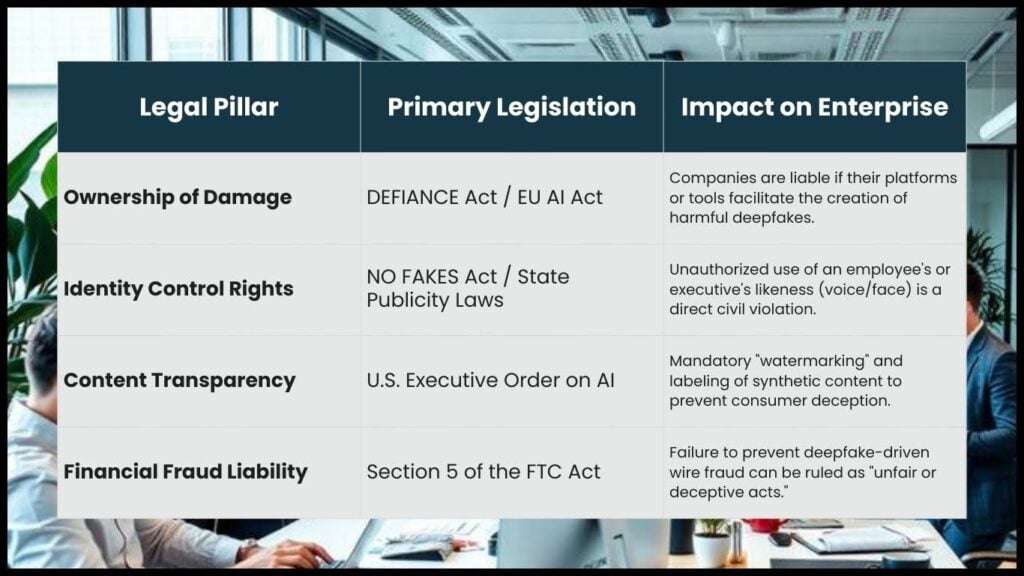
1- Ownership of Damage
The Defiance Act and emerging deepfake legislation clearly holds companies accountable for the downstream impact of their technology. If for instance, your platform enables the creation of a harmful deepfake, responsibility will fall on you.
2- Identity Control Rights
Many U.S. states are redefining who owns a person’s likeness. Identity is no doubt a legally protected asset, but in this age of AI and synthetic media, misuse is no longer a gray area, it’s a direct legal violation.
So, if any enterprise fails to respect identity rights, liability will land squarely on the company in full force.
3-Legal Protection for Words & Works
If anyone violates trademark rights, and uses copyrighted material without licensing rights, consider civil penalties landing where it hurts most—your profits.
Compliance Challenges and Requirements
There’s a fine line between what’s real and what only sounds real.
Compliance exists to keep that line from disappearing—especially with deepfake legislation news highlighting just how quickly AI can skirt the rules.
But, when that line blurs, fraud wears a friendly face. In order to stay ahead, protect assets, and catch subtle lies, vigilance must be your default.
But, why do the compliance watch us fall in the first place? This is because the AI can spin lies so smooth, they feel more real than the truth itself.
Challenge 1: False “Hello.”
We’re not fooled by advanced AI systems and code alone; we’re fooled by manners.
It’s pretty clear that the AI lies come dressed in the smile one recognizes, so employees usually let recognition override reason.
From a friendly greeting in an email to a memo that seems like a usual workday note, no one can blame the staff from letting their guard down.
Because AI has the ability to turn a friendly “Hi” into a high-tech heist without ever raising suspicion.
Challenge 2: Regulatory Lag (Old Laws, New War)
AI evolves faster than the rules meant to control it.
Existing laws surely verify IDs and logins efficiently, but persuasive patterns? Lack digital intuition and traction.
Compliance frameworks and even deepfake legislation can’t keep up with the speed of deception, and this is a huge risk to organizations everywhere.
Because enterprises are held accountable for risks the law lags behind AI evolution.
Challenge 3: Overloaded Human Judgment
No matter how trained, people can’t maintain 24/7 perfection in a 9-to-5 brain.
Surely, staff scrutinize emails, but if volume spikes, burnout lets tiny errors grow.
So, if enterprises keeps relying on human vigilance, even one overlooked email will become a gateway for something deadly, such as:
- Reputation ruin
- Legal headache
- Massive liability
Requirement 1: Layered Security Protocol
Human and automated validation should go through the full spectrum of safeguards.
Ordinary validation usually includes simple form checks and basic cross-references, which is why loopholes remain that can compromise security.
On the other hand, advanced layered security demands multi-step inspections for every action.
For example, when a major wire transfer goes through, each step triggers biometric, automated, and human verification before completion.
This way, nothing slips through unnoticed.
Requirement 2: Cognitive Watch
Who says only human eyes catch fake signals? The best way to spot synthetic faces is to let a sharper AI scan every signal.
This is where TruthScan’s Detector AI în timp real stands as the ultimate compliance guardian against every AI deception.
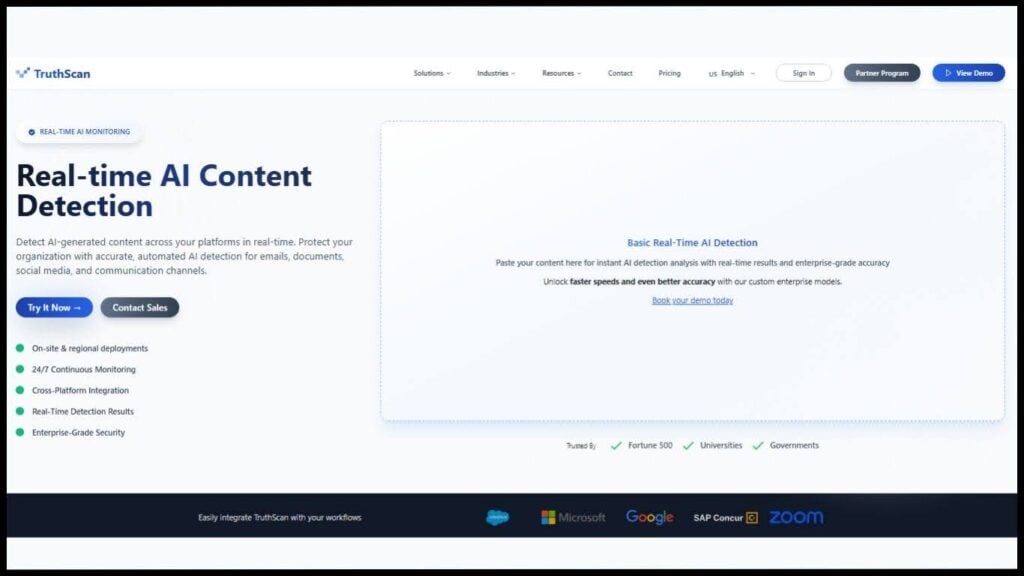
As true compliance isn’t episodic; TruthScan’s Real-Time AI detector runs 24/7, making sure fraud never gets a foothold.
It scans emails, documents, and chat platforms to expose synthetic tricks and unmask fake identities instantly.
Requirement 3: Behavioral Observer
Questioning should be the default.
When doubt becomes a protective habit, enterprises stay two steps ahead of deception.
For example, whenever a high-level executive sends an urgent, out-of-character request for a fund transfer, a moment of doubt can save millions.
Best Practices for Enterprise Preparedness
Preparation is everything–especially with deepfake legislation making accountability unavoidable.
The best defense is a team wired for constant alertness. In an era of rapid digital transformation and constant cyber threats, only the vigilant protect assets and neutralize threats.
The defense should be unbreachable. In 2024, the cost of complacency reached record highs. The $4.88 Million loss shows the real cost of digital negligence.
So, being “prepared” should mean having no weak link in sight, every person trained, and every system tested for failure.
1- Regular audits and risk assessments
If it’s uncharted, it’s unguarded.
Enterprises need to map risks and close every gap before it becomes a headline. High stakes industries like finance and healthcare require audits at least every quarter, because risk doesn’t take a break.
Then those audits will help identify every hidden vulnerability.
Wherever your defenses fall short, quantify how far you are from ISO and NIST standards.
Don’t just stop at auditing, focus on the pattern, and study trends that show exactly where your system is most fragile.
Run “Tabletop Exercises” where leadership simulates regulatory fines and public scrutiny.
2- Developing a crisis response plan
A plan that isn’t acted on is just paper.
A true Crisis Response Plan (CRP) is a roadmap that transforms uncertainty into coordinated moves. It’s like a step-by-step defense against disruption.
You need to define who does what and when the first signal of trouble appears.
Lay out the Crisis Management Team (CMT) structure clearly.
Create ready-to-use templates for every communication scenario. For example, Airbnb’s response during the COVID-19 travel crisis turned a global standstill into a strategic head start.
By utilizing pre-established ‘Newsrooms’ and resource hubs, they ensured every message felt both timely and authentic. This kept stakeholders calm even as the world shifted.
3- Collaborating with legal and IT teams proactively
Isolating the departments does nothing but hurt your enterprise.
Legal and IT are inseparable. In a crisis, both of these departments should move as one, fully aligned to tackle risks flagged under deepfake legislation.
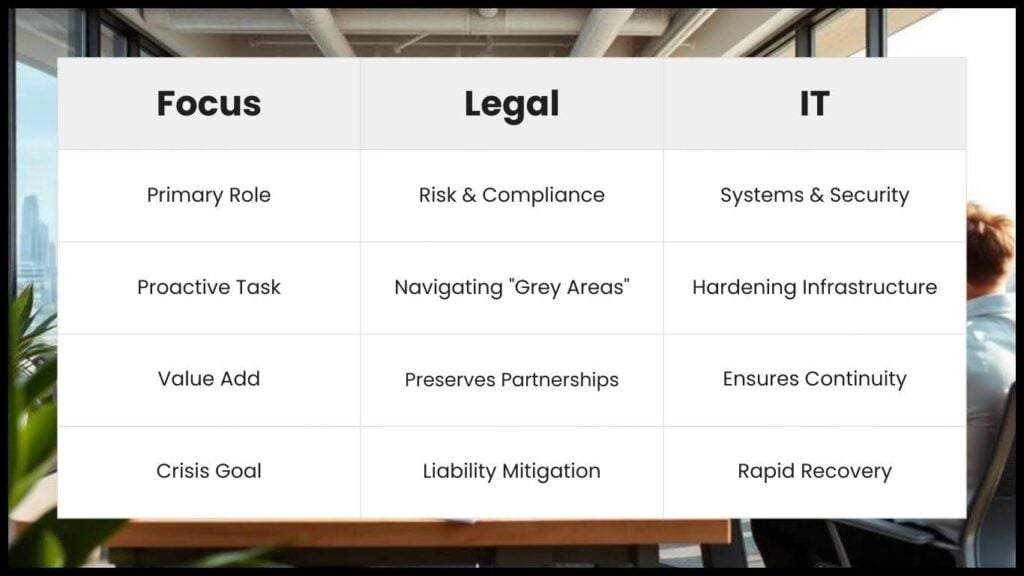
Legal as the business brain
Legal teams should be embedded in every decision, so that your enterprise never learns the hard way.
Law experts show your leadership where every legal grey area could cost relationships with clients and partners.
IT as the Backbone
IT is more than just “tech support”, they are the keepers of operational continuity. The more they scan, the less fraud finds a way in.
Proactive collaboration makes compliance and efficiency partners, which means no digital attack disrupts operations.
Prevention is better than….Cure
Time confirms the saying.
The cost of preventing a crisis is a fraction of what it takes to clean up the aftermath. The price of recovery is always far steeper and more than any budget can bear.
1- Active Defense
Vulnerabilities need to be addressed before damage escalates. Whether it’s the supply chain, cybersecurity, or data integrity, fixing before failure is the smartest strategy.
2- Funding & Force Allocation
Forward-thinking organizations prioritize shielding over paying more to fix crises that preparation could stop.
For example, Maersk, the global shipping giant, suffered a $300 million loss in 2017 due to a single system breach.
Later, the company spent millions to reinstall thousands of machines including 4,000 servers and 45,000 PCs in just ten days to avoid sinking their supply chain into chaos.
Gânduri finale
Enterprise preparedness is the only way to stay two steps ahead of the next AI-fueled deception.
As deepfake technology blurs what’s real and what’s fake, only the prepared survive. Adhering to deepfake legislation like the EU AI Act or the U.S. Executive Order on AI isn’t just a formality, it’s your defense against manipulation.
By integrating credible real-time AI detection tools, video detectors, and continuous employee training, you transform caution into your ultimate shield against deception.