
Healthcare is a prime target for spammers who lure vulnerable people into sharing their sensitive information for malicious purposes.
The Federal Trade Commission (FTC) reported that health insurance-related calls were the highest reported category of spam calls in 2024.
Such calls surge the most during the annual Open Enrollment period, when people expect their insurance companies to call them for policy updates.
That said, scammers’ tactics extend well beyond enrollment windows as well. They will scam people in the name of policy verifications and confirmations throughout the year
Organizations, therefore, have the dual responsibility of protecting their patients from deception and also their own identity from being misused in healthcare phone fraud.
This article discusses what a healthcare phone scam is, how it works, how you can prevent it from happening, and how to use an AI voice detector to enable real-time identification of spoofed calls.
Key Takeaways
- Healthcare phone scams are a major threat, with insurance-related fraud ranking as the most reported category of spam calls in 2024.
- Scammers use spoofing technology to mimic legitimate providers and create a false sense of urgency, often pressuring victims into revealing Social Security or Medicare numbers.
- Legitimate healthcare organizations will never ask for sensitive personal or financial information over an unsolicited phone call.
- Organizations can defend their reputation and their patients by implementing the STIR/SHAKEN authentication framework and using AI voice detectors to identify synthesized cloned voices.
- TruthScan provides a real-time defense against these attacks by analyzing the acoustic properties of a call to distinguish between a live human and an AI-generated deepfake.
What are Healthcare Phone Scams?
Every year, thousands of people become victims of fraudulent phone calls in which criminals act as doctors, hospitals, insurance companies, or government health agencies.
Their aim during the call is to steal money or personal information from their targets. Beyond the immediate financial loss, a victim can end up losing their medical coverage and have their identity used to claim benefits they never asked for.
Such calls are known as healthcare phone scams.


Never Worry About AI Fraud Again. TruthScan Can Help You:
- Detect AI generated images, text, voice, and video.
- Avoid major AI driven fraud.
- Protect your most sensitive enterprise assets.
The FTC’s 2024 Consumer Sentinel Network Data Book reported that healthcare fraud is one of the top 10 types of scams prevalent in the U.S.
In 2024, phone calls were the second most common contact method in scams, with a median individual loss of $1500.
How Healthcare Phone Scams Work
A scammer gathers your personal details (i.e., name, address, date of birth, Social Security number) from a data breach and from the dark web.
Spoofing tech is used to make the call come from a healthcare provider you recognize. So, you are likely to engage with them.
Once you are on the line, they use one of the following tactics:
- Claiming that your Medicare card is expiring and they need your details to keep the insurance plan running
- Creating urgency for your healthcare benefits requires immediate verification
- Making attractive offers of free medical equipment, better insurance, or government refunds in exchange for your insurance details
- Impersonating someone else, e.g., Medicare representatives, hospital billing staff, or insurance adjusters, to directly ask you for details
Almost always, their primary tactic is to push you into acting in their interest within hours before there is any time to think about the call.
You end up sharing your Medicare number or credit card details that get used for fraudulent charges.
Common Signs of Scam Calls
Scammers who target healthcare victims are skilled at making their calls feel legitimate. However, there are only a limited number of ways they can play.
Unexpected phone numbers
The phone number on your screen is manipulated through number spoofing. It is a technique in which the caller ID is altered to display a familiar number that resembles one belonging to a legitimate healthcare facility.
People with active insurance plans or pending medical bills already get calls from the billing departments of their providers. A spoofed number that matches the hospital’s number is likely to be answered.
In addition, a scammer may introduce neighbor spoofing, i.e., displaying a number with the same area code to trigger the assumption that the call is local.
Healthcare-related conversations from insurers begin with verified written correspondence before escalating to phone contact. So, always treat calls requesting personal or insurance information with caution.
Threatening or urgent tone
Once a scammer has you on the line, they want to keep you from thinking clearly by creating urgency as much as they can. Oftentimes, the tone can get threatening, too.
If you get a claim that your Medicare benefits are about to be suspended, it is natural for you to get anxious.
Situations are framed such that you are pushed toward an action before there is any time to think about it and make an informed decision.
Requests for sensitive info
Every healthcare scam phone caller ultimately wants to obtain your personal information that can be used to commit fraud and drain your benefits.
Any caller who repeatedly requests your specific data points is likely operating a scam.
They’d want one or more of the following:
- Medicare number
- Social Security number
- Insurance ID
- Your banking details
They will use easily available info to establish credibility at the start of the call, and then make a subsequent request for sensitive information like a natural next step in a legit process.
However, legitimate healthcare processes never ask you for sensitive information.
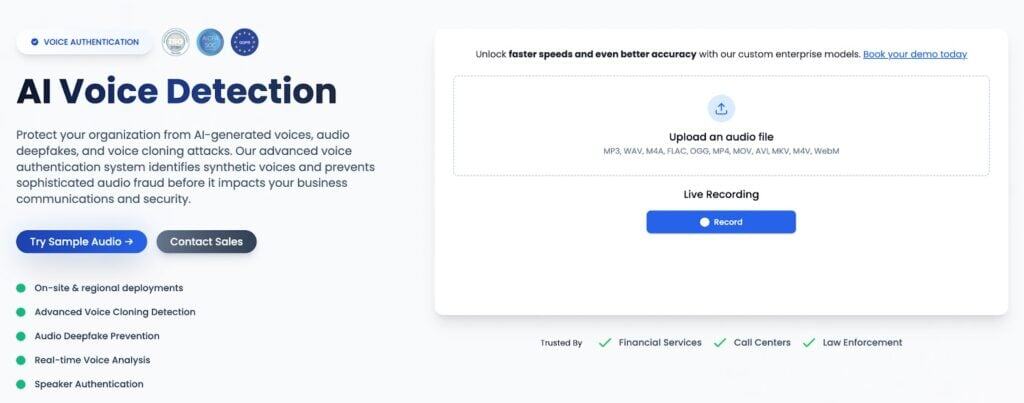
To protect yourself from getting pressured into a scam call before you even realize it, use a TruthScan’s Real-time AI detector.
TruthScan analyzes incoming calls against databases of known scam numbers. It will flag fraudulent callers before you pick up the call.
Real-Life Examples of Healthcare Phone Scams
Recently, some Blue Cross and Blue Shield members in multiple states were targeted by phone scammers.
Scammers used call spoofing technology to make their calls appear to originate from BCBS’s national “Call Blue” customer service number (888-630-2583).
This number is used by the organization exclusively to receive incoming calls from members, not to initiate outbound contact.
The BCBS Association formally issued public warnings after receiving a significant volume of member complaints.
In 2019, the Department of Justice charged 35 individuals with $2.1 billion in fraudulent Medicare claims for medically unnecessary genetic testing. The scam operated through a network of patient recruiters who called Medicare beneficiaries.
The scammers exploited people’s fears about cancer risk to convince them to agree to a “free” cheek swab test. The collected Medicare numbers were passed to physicians who ordered tests for beneficiaries they had never examined.
The labs billed Medicare for those tests while paying kickbacks back through the chain. Many beneficiaries did not receive their results at all.
Using AI to Detect Scam Calls
There are many AI solutions that have been trained on datasets of both legitimate and fraudulent calls to be able to determine if an incoming call matches known fraud signatures.
Such tools, TruthScan being one of them, analyze the conversation in real-time as well. And that includes the tone of the speaker, their phrasing, intent of speech, requests for sensitive data, etc.
The system recognizes such “fraudulent intent” in conversations to trigger live warnings while you’re on the call that prevent any unwanted data sharing.
Certain AI models also run voice biometrics, i.e., they assess the acoustic features of the voice you hear on the call (pitch, cadence, micro-variations in speech, etc.) to distinguish between a genuine caller and a synthesized voice.
TruthScan’s deepfake detection engine is great at identifying artifacts introduced during voice synthesis.
Preventing Healthcare Phone Scams in Organizations
Healthcare fraud consumes between 3-15% of total healthcare spending, which is a loss of billions. As an organization, you have a legal responsibility to prevent the patients you cater to from being scammed by protecting their data.
All healthcare organizations must comply with STIR/SHAKEN, a mandatory caller ID authentication framework to validate their phone calls and prevent them from being spoofed.
You also need to establish strict outbound call policies that include fixed call-back numbers and consistent call windows.
Scammers use some form of publicly available information, which could be your staff names, partial patient data, etc, to gain the trust of naive call recipients. Ensure that you limit the availability of all forms of patient data on the internet that could be used for social engineering.
Organizations must also standardize their patient interactions and make it clear to the patients that no legitimate workflow will ever require them to share sensitive information over a call.
Also, do not sleep on TruthScan’s Real-time AI Voice Detector to protect your organization from audio deepfakes and voice-cloning attacks.
Integrating AI Detection Into Phone Systems
TruthScan brings real-time voice authentication to all your live communication channels, and its integration is pretty simple, too.
We offer a ready-to-use REST API for an AI voice detector that can be embedded into your existing call center infrastructure and authentication workflows.
The API supports real-time streaming for live calls as well as batch processing for recorded interactions. It also includes webhook notifications that trigger patient fraud alerts when suspicious activity is detected.
The point is, you can integrate AI detection at any point in your communication lifecycle.
How TruthScan Protects Against Healthcare Phone Scams

TruthScan has an AI voice clone detection system to analyze the acoustic properties of a synthesized voice that ElevenLabs, Murf, Speechify, Descript, and similar voice synthesis tools create.
It catches convincing cloned voices that would otherwise pass as authentic in a healthcare call scenario.
It has a speaker verification built in that confirms a caller matches a known voice profile. So, healthcare organizations can validate that a caller claiming to be a physician or a policyholder is, in fact, the legitimate individual.
All of that happens in real-time during the interaction itself. Your live audio in phone calls, video conferences, streaming communication, and whatever audio channel you use is always protected.
We’re talking about every audio format, be it MP3, WAV, FLAC, AAC, OGG, M4A, or video formats such as MP4, MOV, AVI, MKV, M4V, and WebM.
Try TruthScan’s AI Voice Detector yourself and check its accuracy.
Talk to TruthScan About Securing Your Organization From Phone Scams
You could protect your organization from healthcare phone scams by securing your communication channels.
TruthScan offers enterprise-grade voice authentication to identify AI-generated speech and voice cloning attempts that could potentially result in a loss of millions.
TruthScan also delivers a suite of AI-driven verification tools consisting of:
- An AI text detector
- AI image detector
- Deepfake detector for multimedia content
The tools used together provide an integrated approach to medical scam prevention since many scammers combine voice, text, and visual elements to establish their credibility.
If you’re interested in reliable prevention against healthcare scams, contact TruthScan’s sales team for a custom consult today!