Abstract: Identity verification providers face an escalating wave of fraud and impersonation attempts driven by generative AI. Synthetic identities with AI-generated faces, deepfake videos for liveness spoofing, and forged documents are challenging traditional KYC/AML defenses. This whitepaper examines the key AI-enabled fraud trends of 2025 – from deepfake-driven onboarding attacks to mass-produced fake IDs – and discusses how emerging AI detection tools (e.g. image forensics, deepfake and document detectors) can fortify verification workflows. Fraud prevention teams, product managers, and security officers will learn how multimodal AI content analysis (such as TruthScan’s detectors for images, documents, and video) can augment existing verification stacks to counter these new threats.
Introduction: A Generative AI-Driven Fraud Surge
The year 2025 has brought a dramatic surge in identity fraud fueled by readily accessible generative AI tools. Fraudsters are now leveraging AI to create convincing fake personas, documents, and live biometric spoofs at a scale and realism that defeats many legacy verification controls. Losses from synthetic identity fraud alone topped $35 milliarder i 2023, a figure that reflects a 50% jump from the prior year and continues to climb. Deepfakes – AI-generated videos or audio impersonations – have likewise exploded in prevalence, with one report noting a 700% increase in deepfake incidents in the fintech sector during 2023. Such AI-generated fakes are increasingly used to bypass onboarding checks, impersonate legitimate customers, and evade liveness detection.
Traditional defenses (manual document inspection, database lookups, simple selfie verifications) are straining under this new onslaught. Generative AI produces synthetic faces and IDs that look “real” to both human staff and automated systems, and can even adapt in real-time to security challenges. Alarmingly, many institutions remain unaware or unprepared – the U.S. Treasury’s FinCEN issued an alert in late 2024 about deepfake media in financial fraud, noting a spike in reports of fraudsters using AI-created fake identity documents to fool KYC processes. In this whitepaper, we delve into the major AI-enabled fraud trends affecting identity verification in 2025 and explore how AI-driven detection tools (like those offered by TruthScan) can help separate truth from fabrication in the identity proofing process.
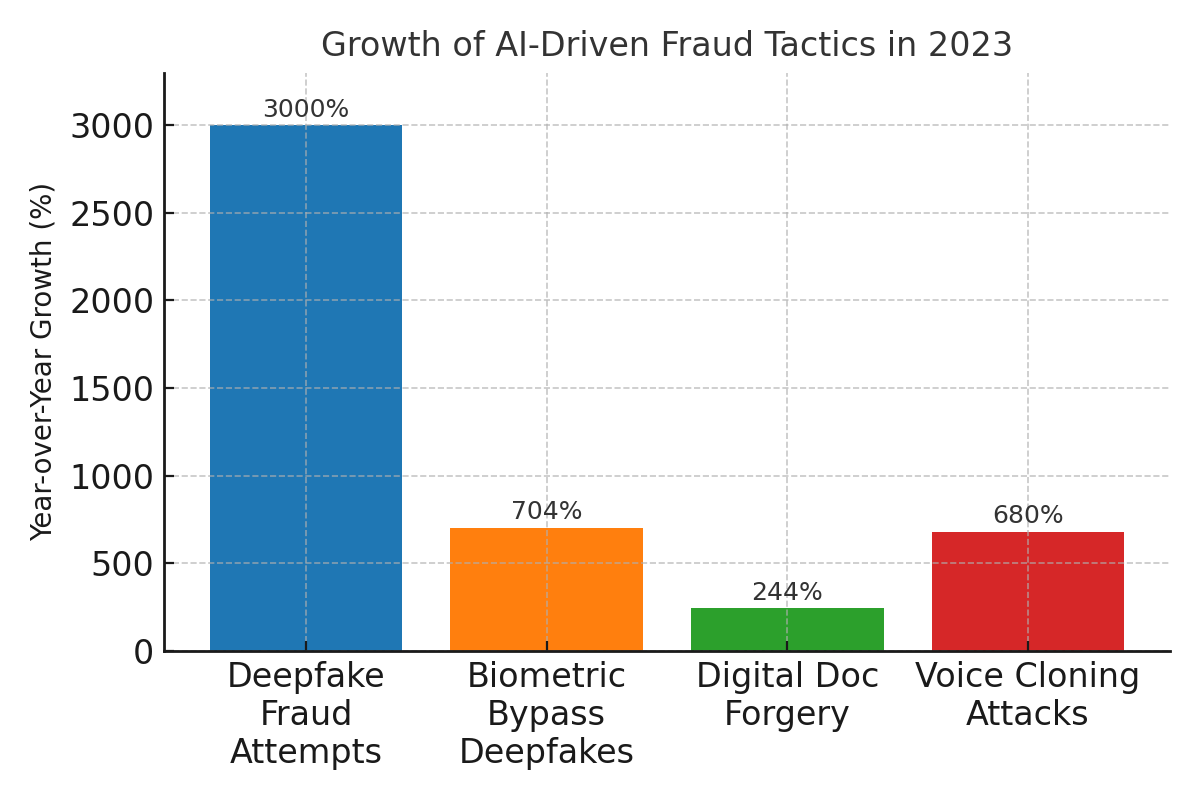
Growth of AI-driven fraud tactics in 2023, showing astonishing year-over-year increases in deepfake, biometric spoofing, and document forgery attempts. Deepfake-related fraud (videos or voice clones) spiked 30× (3000%), while AI-assisted document forgeries rose 244%, and deepfake attacks to bypass liveness checks jumped 704%.
Du skal aldrig bekymre dig om AI-svindel igen. TruthScan Kan hjælpe dig:
- Opdag AI-generering billeder, tekst, stemme og video.
- Undgå at stor AI-drevet svindel.
- Beskyt dine mest følsom virksomhedsaktiver.
AI-Generated Identities and Synthetic Fraud
Synthetic identity fraud – creating a fictitious identity from pieced-together data – is not new, but generative AI has supercharged its scale and realism. Instead of stealing a real person’s identity, fraudsters fabricate one by combining real and fake personal data (e.g. a real Social Security number with a fake name and DOB). Now AI provides the tools to automate and “flesh out” these fake personas like never before.
High-quality fake ID documents and photos can be created in seconds. Using generative adversarial networks and image diffusion models, criminals produce authentic-looking profile photos and ID card images for their synthetic individuals. These AI-generated faces are unique (won’t match any real person) yet are indistinguishable from genuine headshots to the naked eye. Generative AI can even churn out batches of such faces, allowing fraud rings to mass-produce fake identities. According to the Federal Reserve’s fraud toolkit, Gen AI can take personal details (stolen from data breaches or the dark web) and rapidly generate numerous synthetic identities by recombining attributes and inventing new details, learning from failures to improve success rates. For example, if a synthetic applicant born in 1950 is rejected for having too short a credit history, the AI can simply adjust the birth year to 1990 and reapply, evading simple cross-checks.
Crucially, AI now helps create the supporting documents and digital footprints that make a fake identity credible. Fraudsters use tools like DALL·E or Stable Diffusion to generate realistic driver’s licenses, passports, or ID cards with the fake persona’s info and photo. In one demonstration, researchers showed an AI (ChatGPT Vision) modifying a real driver’s license image with a new name, address, and photo – instantly producing a fraudulent but authentic-looking ID. They then generated matching profile photos of the fictitious person (“Kevin”) in different settings via AI image generation, and even an AI-written résumé and social media profile. In minutes, they crafted a complete synthetic identity that could plausibly pass cursory verification checks. This ease of creation means low-skilled attackers can now produce high-quality fake identities at scale, a task that once required expert forgery skills or expensive equipment.
Traditional identity proofing often relies on validating that an ID document looks legitimate and that the selfie photo matches the ID. Generative AI undermines these steps by making the fake look real. As TransUnion noted, AI-generated driver’s licenses and passports are designed to fool document verification tools. Fraudsters have used such fake IDs to successfully open bank accounts, apply for loans, or obtain mobile phones under false identities. Because the identity is synthetic, conventional database checks (like matching name and SSN with the Social Security Administration) might not catch it – especially if parts of the identity are real (e.g. an SSN that is valid but issued to a child or not yet associated with credit files). In the U.S., the SSA’s electronic SSN verification system (eCBSV) requires an exact name match and thus can be sidestepped by minor spelling variations[1], showing the limits of basic cross-checks.
Selv manual review by humans struggles: AI fakes can be so polished that a human verifier might see nothing amiss. In fact, industry data suggests human reviewers spot AI-generated fake documents only about half the time – essentially a coin flip chance of detection. Meanwhile, the synthetic identities sail through onboarding, often treated as just “new thin-file customers.” Fraudsters then nurture these synthetic accounts (making small transactions or on-time payments) to build credibility, before “busting out” with major fraud – e.g. maxing out loans and credit lines and vanishing.
Den bottom-line: Generative AI has made it trivial to manufacture entirely fake but convincing identities, complete with documents and online presence. Synthetic identity fraud losses have mushroomed, with one Federal Reserve analysis estimating over $35 billion lost in 2023. With Gen AI, fraudsters can scale up their attacks in a way that overwhelms one-off manual checks – they can submit dozens or hundreds of applications using varied fake personas, far more than a human crime ring could manage without automation. For identity verification providers, this means the old methods of checking ID documents and basic identity data are no longer sufficient on their own.
Deepfakes and Liveness Spoofing: The Biometric Battleground
When services implemented selfie “liveness” checks and video calls to verify users, it raised the bar for fraud – at least temporarily. Now, generative AI has leveled that playing field too. Deepfakes (AI-generated or altered videos and audio) are being weaponized to spoof biometric verification and remote onboarding procedures. Attackers can effectively “puppet” a fake or stolen identity in real-time video, fooling systems that are only looking for a matching face or a live response.
Deepfake technology has advanced rapidly in recent years, thanks to AI models that can swap faces in video or clone voices with startling realism. By 2024, deepfake attacks were occurring at an estimated one every 5 minutes globally. Entire underground marketplaces now sell user-friendly deepfake creation tools and services (some for as little as $20). The result: even minor criminals can deploy what was once nation-state grade deception. Financial institutions have already seen a wave of deepfake-enabled fraud – from video imposters to voice-scam calls. In one headline case, an employee of a Hong Kong company was tricked into transferring $25 millioner after fraudsters simulated the video appearance of her CEO and colleagues on a conference call. None of the people on the call were real – the attackers used deepfake avatars to issue fraudulent instructions, successfully bypassing the human victim’s trust filters.
In the context of digital onboarding, liveness detection is the primary defense against someone simply holding up a photo or playing a video. However, generative AI has spawned techniques to defeat many liveness checks: – Video Deepfakes: Attackers can generate a real-time video of a person (or synthetic face) that blinks, turns, and speaks on command. Modern deepfake software can take a single photo of a person and animate it with facial movements and lip-syncing to spoken text. This means a fraudster who has a victim’s photo or an AI-generated face can create a live-looking video feed for verification. If the verification asks for actions (like “smile” or “turn your head”), advanced deepfake models can now respond believably, especially if liveness tests are predictable. FinCEN’s 2024 alert warned that criminals are using deepfake videos to bypass selfie verification and facial recognition checks. – Injection Attacks: Some sophisticated fraud rings bypass the camera entirely by injecting a video feed directly into the verification app or browser. In a so-called camera injection attack, the user’s device feed is “hijacked” to stream a pre-recorded deepfake video of a face, rather than the actual person in front of the camera. This tactic was highlighted by biometric security firms in 2025 – attackers feed an AI-crafted video into the data stream, so the verification system thinks it’s seeing a live person. From the system’s perspective, the video is live – but it could be a perfectly rendered deepfake animation. – 3D Masks and Face Swaps: Generative AI can also produce ultra-realistic 3D mask designs or facial replicas. An imposter might wear a prosthetic mask of someone else’s face, but more insidiously, they might use augmented reality to project a synthesized face onto their own in real time. This is akin to a Snapchat filter on steroids – the person moves and speaks, but the system sees the target’s face.
The arms race between deepfakes and liveness detectors is in full swing. Unfortunately, many verification flows still rely on “look-alive” checks that AI can fool. If a service simply matches the selfie video to the ID photo, an AI-generated face that matches the ID will pass. If it asks for a blink or smile, a deepfake can be programmed to do so. Active liveness tests (like asking the user to say random numbers or turn their head in specific ways) provide some friction, but even these can be anticipated by a flexible AI that can respond to prompts. Real-world data from 2023 showed a 704% increase in deepfake attacks that attempted to bypass biometric authentication measures. This reflects how quickly fraudsters are targeting face-based verification.
Compounding the challenge, human operators are ill-equipped to catch deepfakes by sight alone. Studies find that when confronted with high-quality AI-synthesized videos, human observers correctly identify the fake only 24.5% of the time – basically worse than random guessing. People tend to trust what they see, especially in a live video context, so a support agent doing a video call might not notice subtle artifacts. And deepfakes keep improving, with AI models themselves now evaluating and refining the fakes to appear more convincing (an adversarial self-learning loop)[2]. It’s telling that 68% of deepfakes are now “nearly indistinguishable from genuine media,” according to recent threat intelligence.
All of this signals that identity verifiers must augment their liveness and biometric checks. The old paradigm of “match the selfie to the ID photo and ensure the selfie is live” is no longer enough. Without advanced detection, an AI puppet can slip through – for example, a synthetic persona with an AI-generated face can pass a face match (since the same AI face is on the ID and video) og appear live (via deepfake animation), fooling the entire process. As a 2025 KYC report bluntly stated: if your system can verify a face but “can’t determine if that face is a live human being present,” your door is wide open to deepfake intrusion.
Document Forgery at Scale: AI-Modified PDFs and Images
Another dimension of AI-driven fraud is the proliferation of fake and manipulated documents. Beyond IDs and selfies, many verification workflows involve documents like bank statements, utility bills, tax forms, pay stubs, or business invoices to prove address, income, or other claims. Generative AI has made it easier than ever to forge such documents with realism and speed.
Text-to-image models and powerful image editing AI can generate authentic-looking documents from scratch or subtly alter real ones. For instance, an attacker applying for a loan can submit a phony pay stub or bank statement where the numbers (salary, balances) have been inflated – with AI, the tampering leaves little trace. In the past, creating a high-quality fake PDF or scanned document required advanced Photoshop skills; now an AI assistant can do it given a single prompt. Large Language Models (LLMs) can even generate the textual content (like a perfectly formatted bank statement with transactions) while image AI handles logos, signatures, and stamps.
We’re also seeing AI used to modify official IDs or records. A fraudster might take a real government ID template and have an AI change the photo and text to new details (as demonstrated with the driver’s license earlier). Or they might generate fake supporting documents like a birth certificate, credit reference letter, or utility bill to accompany a synthetic ID. These forgeries are often good enough to fool human review and basic automated checks. In fact, fraudulent documents generated with AI have become so convincing that many slip past traditional document verification engines – especially if the system hasn’t been trained on the newest AI outputs. In one sobering statistic, digital document forgery attempts rose 244% year-over-year from 2022 to 2023, reflecting how common AI-assisted document fraud has become.
A particularly pernicious trend is combining multiple fake artifacts for consistency. For example, an identity thief who wants to take over someone’s bank account could use AI to generate a fake email from the bank and a fake customer service phone call recording, in addition to doctored IDs. Deloitte analysts noted that fraudsters are increasingly leveraging “illicit synthetic information like falsified invoices and customer service interactions” to get past controls and even manipulate organizations’ AI models. This means a single verifier might be presented with a whole suite of corroborating evidence – all of it fake but internally consistent, thanks to AI generation.
Den scale problem looms large here as well. AI allows a fraudster not just to make one fake bank statement, but to make hundreds of variants (with different names, addresses, account numbers) for many synthetic identities or many attempts. It becomes impractical for human reviewers to scrutinize every detail of each document, especially when they appear legitimate. Visual giveaways like mismatched fonts, alignment issues, or obvious Photoshop artifacts are becoming rarer as AI improves. In many cases, only a forensic analysis (looking at image noise patterns, metadata, or cryptographic integrity) might reveal the deception.
In summary, AI is enabling a flood of high-quality fake documents and records that can defeat unsophisticated verification checks. Manual cross-checking often fails when the documents look valid and even contain verifiable data (e.g. an address that exists, a company name that is real). Without specialized detection measures, companies have inadvertently accepted falsified documents, leading to downstream fraud losses. As of 2025, over 10% of companies report encountering deepfake or AI-generated documents in fraud attempts, and this number is only expected to grow. The message for verification providers is clear: you need automated AI-aware forensics to inspect documents and media for the subtle fingerprints of fabrication.
Breaking the Trust Barrier: Why Conventional Checks Fail
The above trends highlight a common theme: attacks powered by generative AI exploit the assumptions of traditional identity verification. Legacy KYC and AML programs assumed that if an ID looks real, a selfie video is live, and the personal data doesn’t raise red flags, then the user is likely legitimate. Those assumptions no longer hold. Generative AI allows fraudsters to simulate the signals of authenticity that we’ve relied on for decades:
- Realism at Scale: AI fakes are now highly realistic and can be produced en masse. Traditional systems are tuned to catch anomalies or obvious fakes; they struggle when confronted with hundreds of professionally realistic forgeries. An individual human checker might spot one fake in a batch of ten, but not 50 fakes in a batch of 100 – and certainly not when they all look “normal.” As a result, many AI-generated identities slip through simply because nothing looks amiss at face value.
- Lack of Historical Footprint: Paradoxically, synthetic identities can evade detection because they have no prior history. Credit bureaus and consortium fraud databases flag identities with suspicious patterns, but a brand-new AI-created identity is a blank slate. If it passes document and biometric checks, there’s no immediate data to contradict it. This is why synthetic fraud is often called the “unseen” threat – losses frequently get categorized as credit defaults or bad debt because the victims aren’t real people[3][4]. The fraud isn’t discovered until much later, if at all.
- Cross-Verification Blind Spots: Traditional cross-checks (comparing data to government databases, credit file questions, etc.) can be outmaneuvered. For instance, knowledge-based authentication (KBA) questions can potentially be solved by AI if it has scraped enough info, or bypassed entirely by synthetic IDs. Likewise, checking a selfie against a selfie taken days earlier (to confirm the same person) fails when the “person” never actually existed beyond AI images. Generative AI’s strength is creating internally consistent fake data, which means cross-checking one fake document against another fake document will falsely corroborate the identity.
- Human Limitations: It’s worth underscoring the human element. Many verification steps ultimately rely on human judgment – either directly (manual review queues) or indirectly (setting the rules that automated systems follow). Humans are biased to trust realistic visuals and can be overwhelmed by volume. With deepfakes, our “gut feel” can no longer be trusted. In controlled tests, people detecting deepfake videos did worse than chance, and even trained bank staff fail to spot many forgeries. As one industry infographic put it, manual reviewers catching AI-faked documents only 50% of the time is literally a coin toss. In effect, the use of generative AI by criminals has eroded the reliability of human-based verification steps.
The consequence of these failures is that fraudsters are getting through, and institutions often don’t realize it until damage is done. A synthetic identity might go undetected until it defaults on a large loan. A deepfake might not be identified until after fraudulent transactions occur. A forged document might be trusted, leading to an illicit account opening that facilitates money laundering. Indeed, Deloitte’s Center for Financial Services predicts that AI-enabled fraud could drive losses from $12.3 billion in 2023 to $40 billion by 2027 if defenses don’t improve.
Encouragingly, awareness is spreading. Regulators like FinCEN have put financial institutions on notice about deepfake schemes. Industry surveys show rising concern about generative AI threats, with over three-quarters of consumers expressing fear of AI fraud and demanding stronger protections. Cybersecurity pundits predict that by 2026, 30% of enterprises will no longer trust identity verification results that lack AI analysis for deepfakes and synthetic content. In response, forward-thinking identity verification companies are turning to an arsenal of AI-powered detection tools to restore trust in the verification process.
Building an AI-Resilient Verification Stack
Just as generative AI is being used to attack identity systems, AI can also be deployed as a powerful defense. A new category of solutions is emerging that apply advanced machine learning and forensic analysis to detect when an input (image, video, or document) has been synthesized or manipulated. By integrating these AI-indholdsdetektorer into the verification pipeline, organizations can catch the subtle signs of fraud that humans or legacy tools miss, and do so at scale.
Here are key AI-driven detection capabilities that can enhance identity verification:
AI Image Detectors – Spotting Synthetic Faces and Photos
En AI image detector analyzes a given image (such as a profile photo, selfie, or ID card photo) to determine if it is likely computer-generated. These tools, often based on deep neural networks, look for artifacts and patterns left by generative models. For example, GAN-generated faces might have telltale anomalies in pixel distribution, spectral noise, or inconsistent background details that aren’t obvious to the human eye. Diffusion-generated images may exhibit slight texture patterns or metadata clues.
In practice, an image detector can be run on the selfie a user submits or the face photo on an ID. If the detector reports a high probability of the image being AI-generated, that’s a red flag that either the person is synthetic or someone is using a GAN likeness instead of a real photo. Modern detectors can achieve impressive accuracy – in one internal test, TruthScan’s AI-billeddetektor identified an AI-generated headshot with 99% confidence, even though the image looked perfectly realistic to human observers. By flagging such cases, image forensics tools prevent scenarios where a fake face could otherwise fool facial recognition or go unnoticed in a manual review.
These detectors don’t rely on having seen the particular fake before; rather, they generalize the statistical differences between real photographs and AI images. For instance, human-taken photos have natural variations in lens focus, lighting, and sensor noise, whereas AI images may be too perfect or have subtle quirks (e.g., asymmetry in earrings or background geometry). The detector outputs a score or label (e.g. “AI-Generated Likely”) that the verification workflow can use to trigger additional checks or outright rejection. In essence, AI image detection adds a crucial layer of defense wherever user-provided images are involved – catching synthetic faces, avatars, or cleverly altered photos before they can do harm.
Document Forensics and Fake Document Detection
Another vital component is AI-driven document forensics. A Detektor til falske dokumenter uses a combination of computer vision, text analysis, and metadata checks to identify tampered or fabricated documents. These detectors are trained on both genuine documents and known forgeries to learn what “looks right” versus what signals deception.
Key capabilities of document detectors include: – Visual Consistency Checks: Verifying that fonts, spacing, logos, and layouts match known genuine templates (for IDs, bank statements, utility bills, etc.). AI forgers might get most details correct but could mix up font sizes or positioning that a human might not notice but an algorithm can flag. – Artifact Detection: Scanning for signs of digital editing – for example, odd blurring around text (from erasing and retyping), mismatched resolution between parts of an image, or repetitive noise patterns from generative image synthesis. If an ID photo was swapped or a number changed, tiny artifacts often remain. A detector can highlight regions of an image that likely contain AI-generated or cut-and-paste content. – Cross-Field Validation: Comparing data within the document for logical coherence. Does the age implied by the birth date match the person’s appearance in the photo? Do the ID numbers follow known checksum rules? Was the supposed issuing date of an ID in the future (which could indicate an editing mistake)? By applying rules and AI reasoning, these tools catch inconsistencies that a superficial check would miss. – Metadata and Encoding Analysis: Examining the file properties for traces of manipulation. For example, an unexpected software signature in a PDF’s metadata might indicate it was regenerated by an editing tool. Or discrepancies in EXIF data of an image (like a supposedly scanned document with metadata showing it was created by an AI image generator).
With generative models able to produce very authentic-looking documents, this forensic approach is essential. It moves verification from “does it look real?” to “does it have an authentic digital fingerprint?”. Often, AI-generated documents look fine but fail these deeper checks. For instance, an AI-synthesized utility bill might have perfect logos and text, but the pixel-level noise lacks the typical scanner noise of a real scanned document – a detector trained to spot that difference will flag it. Or the content of a fake pay stub might pass visual muster but the earnings figures and tax withholdings don’t line up mathematically with known formulas – another red flag.
Integrating a fake document detector means that whenever an applicant uploads a file (PDF, image, etc.), the system immediately runs a forensic scan. If the detector outputs a high fraud probability or finds specific issues, the system can escalate the review. Many identity verification providers are adding this step, recognizing that forged documents are a primary vector for AI-powered fraud. It’s far more efficient to automatically screen them than to rely on training humans to catch an ever-expanding variety of AI fakes. By weeding out fake documents, companies can avoid downstream compliance violations (e.g. accepting fraudulent proof of address) and financial losses (e.g. approving loans on false income claims).
Deepfake Video & Audio Detection
When it comes to live video and audio, specialized deepfake detectors are indispensable. These tools use AI to analyze multimedia content for signs of manipulation. For video, a deepfake detector might scrutinize frame-by-frame details: unnatural face movements, warped facial features when the head turns, inconsistent lighting/frame jitter, or discrepancies between lip movement and audio. For audio (voice verification or recorded calls), detectors can look at acoustic features that differ between human speech and AI-synthesized speech (for instance, odd spectral artifacts or lack of expected breathing sounds).
Identity verification providers can employ Deepfake-detektor technology at multiple points: – Selfie Liveness Checks: If users submit video selfies or do live webcam verification, a deepfake detector can run on that feed to ensure the person’s face is real. It can raise an alert if it detects a face swap or digital avatar. Modern detectors, often powered by convolutional neural networks or vision transformers, have been trained on datasets of real vs deepfake videos to recognize subtle giveaways. For example, AI-generated faces sometimes have difficulty with eye reflections or profile angles – a detector picks up on these cues even when the deepfake animates correctly. – Video Interview or KYC Sessions: In video-based KYC calls with an agent, a real-time deepfake detection module can be monitoring the call. If anything indicates the video or voice might be synthetic, the session can be challenged or terminated. This is crucial for preventing the kind of attack that happened in Hong Kong – had a deepfake detector been active, it might have flagged the CEO’s video feed as inauthentic and stopped the fraudulent wire transfer. – Recorded Evidence Checks: Sometimes as part of due diligence, companies accept prerecorded video or audio messages (“video KYC” where a user says a code or reads a statement on camera). Deepfake analysis can be applied to these submissions to verify they haven’t been manipulated. It’s similar to document forensics but for media: checking if the person’s image has been overlayed or if the voice matches the expected user’s known voice.
Given the rapid evolution of deepfake tech, these detectors need continual updates (and often a multi-model approach). Yet, they are improving steadily. They serve as a vital backstop to liveness systems – whereas liveness checks look for human traits (depth, eye motion, challenges etc.), deepfake detectors look for non-human generation traits. The combination is powerful: one ensures there is a live person, the other ensures it’s the right person and not an AI illusion.
Real-Time AI Content Monitoring and Multimodal Checks
Speed is of the essence in fraud prevention. That’s where real-time AI detectors og multimodal analysis come in. A AI-detektor i realtid is designed for instantaneous scanning of content streams. For example, as soon as a user begins a video call or uploads a file, the detector can start evaluating frames or bytes for suspect patterns. This on-the-fly analysis can enable immediate intervention – e.g., if a deepfake is detected 2 seconds into a call, the system could automatically halt the session before any compromise occurs.
Multimodal AI analysis refers to combining data from various sources – images, video, audio, text – to make a holistic fraud decision. In an onboarding scenario, you might have: – An ID document image – A selfie video – OCR-extracted text from the ID (name, DOB, ID number) – Submitted personal data (name, address, etc.)
By analyzing these together, AI can spot mismatches or confirm consistency. For instance, even if an AI-generated photo on an ID fooled a human, an AI image detector flags it; meanwhile a text analysis might notice the ID number format is incorrect, and a cross-check AI might find no evidence this person exists online (no social media or public records footprint). Correlating these signals provides a much stronger assurance of fraud detection than any single check alone.
Cutting-edge platforms are moving toward a unified risk score that incorporates traditional verification results (e.g. document verification, face match score, database checks) og AI detection results (image real/fake score, deepfake likelihood, document integrity score). If the AI detectors raise concerns, the overall risk score would indicate a likely fraudulent application, prompting denial or manual review despite other checks passing. This layered approach was also recommended by TransUnion’s fraud analysts: a “layered approach combining identity verification, device intelligence, and advanced fraud models” to catch synthetics and deepfakes.
Integrating these tools into existing workflows is a key consideration. The good news is that many AI detection solutions offer APIs and can operate in the background of an identity verification flow. For example, TruthScan’s suite can be called upon when a document is uploaded or a selfie taken, returning a result within seconds. This means companies can augment their current processes with minimal friction to users. A genuine customer will barely notice (their onboarding might feel no different, aside from perhaps a slightly longer analysis time or an extra quick capture step), but a fraudster using AI will hit a wall.
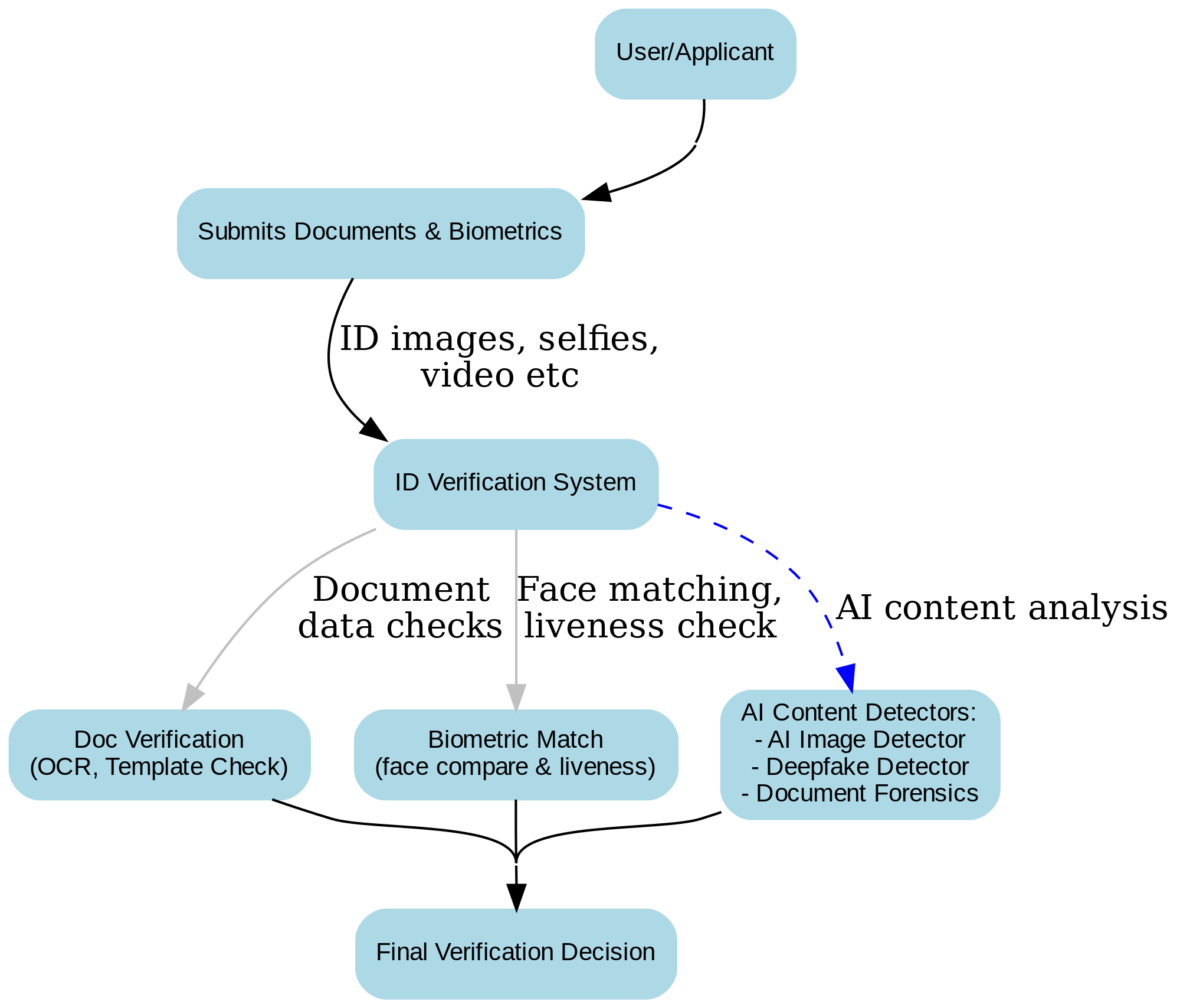
Integration of AI detection tools into a modern identity verification pipeline. As a user submits their ID documents and selfie video, the content is not only subject to standard verification (OCR data extraction, face matching, etc.) but is also scanned by dedicated AI detectors for signs of manipulation. This multilayered defense catches AI-generated forgeries (fake photos, deepfake video, document edits) in parallel, before a final decision is made. Such real-time analysis allows suspicious enrollments to be flagged or stopped instantaneously, strengthening the overall verification process.
Conclusion: Staying Ahead of AI-Empowered Fraudsters
Generative AI is transforming the fraud landscape in ways that demand an equally transformative response from the identity verification industry. In 2025, fraud and impersonation attempts leveraging AI have moved from theoretical to routine – affecting everything from banking and fintech onboarding to e-commerce account creation and online public services. Attackers, armed with deepfakes and synthetic IDs, are breaching defenses that once seemed robust. This whitepaper has detailed how synthetic identity fraud, deepfake liveness spoofing, and document forgery are surging, and why older verification methods alone are struggling to cope.
The encouraging news is that the same technological wave powering fraud also offers new tools for prevention. AI-based detection and forensic tools provide a fighting chance to restore trust in digital identity proofing. By incorporating image, document, and video detectors (such as TruthScans AI-billeddetektor, Detektor til falske dokumenter, Deepfake-detektorog AI-detektor i realtid), companies can identify fake identities and media with a precision and scale that humans alone cannot match. These tools don’t replace existing KYC/AML processes – they fortify them. Just as biometrics added a new layer of security in the last decade, AI content analysis is the emergent layer for the coming decade.
For fraud prevention teams and security officers, the mandate is clear: adapt or be outpaced. This means updating risk models to account for AI-generated content, training staff about these new threat vectors, and investing in technology partnerships to implement advanced detection capabilities. It also means a cultural shift – realizing that seeing is no longer believing when it comes to digital identity data. Verification practices must move from purely evidence-based (e.g. “the ID looks good, the selfie matches”) to integrity-based (e.g. “but is the ID genuine, is the selfie real, has anything been tampered with?”).
The companies that succeed in this new era will likely be those that embrace a multi-layered, AI-enhanced verification stack. They will leverage not just one silver bullet, but a combination of defenses: device intelligence to spot anomalies, behavioral analytics to detect bots, and critically, AI-driven detectors to reveal synthetic content. By doing so, they make life exponentially harder for fraudsters. An attacker can no longer simply download an app and breeze through onboarding with an AI-made identity; instead, they face a gauntlet of smart checks that will flag their ruse.
In closing, generative AI has undeniably upped the stakes for ID verification providers – but it has not made the situation hopeless. On the contrary, it has spurred innovation that can ultimately make digital identity systems more secure than ever, if implemented proactively. Firms in the identity verification and fraud prevention industry should view AI detectors not as optional add-ons, but as essential components of their infrastructure going forward. The threat is already here, as we’ve seen, but so are the tools to counter it. By staying informed of AI-driven fraud trends and integrating solutions like TruthScan’s content detectors, organizations can continue to confidently answer the critical question: “Is this user who they claim to be?” – even when faced with the best tricks that generative AI can throw at them.
Referencer:
- FedPayments Improvement (Federal Reserve) – “Generative Artificial Intelligence Increases Synthetic Identity Fraud Threats”
- Federal Reserve Bank of Boston – Timoney, M., “Gen AI is ramping up the threat of synthetic identity fraud” (Apr 17, 2025)
- TransUnion Blog – “What’s Behind the Rise in Synthetic Identity Fraud” (Money20/20 2025)
- Deloitte Insights – Srinivas, V. et al., “Deepfake banking and AI fraud risk on the rise” (2024)
- DeepStrike.io – Khalil, M., “Deepfake Statistics 2025: AI Fraud Data & Trends” (Sept 8, 2025)[5]
- Veriff – Jolly, G., “Is your user real? Biometric liveness is the new standard in fraud prevention” (Nov 21, 2025)
- Javelin Strategy – Pitt, J., “Deepfake Fraud Alert: How FinCEN’s Guidance Affects Banks” (Nov 18, 2024)
- Keepnet Labs – “Deepfake Statistics & Trends 2025: Key Insights” (2024)
- EWSolutions – “Deepfakes Are Costing Corporations Millions” (2023)
- LinkedIn – TruthScan post, “How AI Fraud Works: Fake Identity in 5 Minutes” (2023)
[1] [3] [4] Money 20/20: What’s Behind the Rise in Synthetic Identity Fraud | TransUnion
https://www.transunion.com/blog/money-2020-whats-behind-rise-synthetic-identity-fraud
[2] Deepfake banking og risiko for AI-svindel | Deloitte Insights
[5] Deepfake Statistics 2025: AI Fraud Data & Trends