
Your employees might be using ChatGPT to book travel. Some might also be using it to ‘invent’ stays that never happened.
In 2023, you could spot a fake receipt from a mile away.
Back in 2023, spotting a fake receipt was easy.
But in 2026, hotel receipt frauds are so advanced and efficient that the human eye alone can’t catch them.
So how do you stop them?
Use AI to catch AI.
In this blog, we’ll cover the damage fake receipts can cause and the common signs to watch for.
We’ll also look at how fraudsters are exploiting AI, the deepfake detector and fake receipt detector tools you can use for fake receipt detection, and how to build travel expense verification into your workflow before the damage is done.
Lad os dykke ned i det.
Det vigtigste at tage med
- Modern fakes are now pixel-perfect thanks to AI, making them almost impossible to spot with just a manual human review.
- Scammers usually fail at city-specific tax rates (like NYC’s 14.75%). If the math is too round or doesn’t add up, it’s a fraud.
- Hotels are obsessed with branding, so blurry, stretched, or outdated logos are immediate dead giveaways.
- If an employee’s flight lands on Tuesday but the receipt claims they stayed Monday night, the timeline is a total bust.
- Digital receipts have metadata that reveals if a file was actually made in Photoshop or on a day that doesn’t match the stay.
- Tools like TruthScan plug into your current apps to auto-approve legit bills and only flag the suspicious ones for a human to check.
What are Fake Hotel Receipts?
In the corporate world, a hotel receipt or folio is supposed to be a boring paper trail.
But lately, these documents have become the go-to tool for a specific kind of white-collar hustle: hotel receipt fraud.
At its core, a fake hotel receipt is a fabricated or digitally altered document submitted for reimbursement for a stay that either never happened or didn’t cost nearly as much as claimed.
Du skal aldrig bekymre dig om AI-svindel igen. TruthScan Kan hjælpe dig:
- Opdag AI-generering billeder, tekst, stemme og video.
- Undgå at stor AI-drevet svindel.
- Beskyt dine mest følsom virksomhedsaktiver.
A Simple Example
Let’s say an employee goes on a business trip. They find a cozy budget spot for $80 a night.
But when it’s time to file the expense report, they submit a receipt (a textbook case of hotel receipt fraud) that looks like a $220-a-night luxury stay.
- A clean-looking folio number
- Detailed tax lines
- The hotel’s branding perfectly replicated
To a busy finance manager, it looks 100% legit. The employee pockets the $140 difference, and the company is none the wiser.
Without proper travel expense verification, this kind of scheme goes undetected for months.
Why Fake Hotel Receipts Are a Risk
The ACFE estimates that companies are losing about 5% of their total revenue to fraud. It’s a massive drain on the bottom line that most businesses can’t afford.
The pros are also feeling the heat, with a huge chunk of financial experts in the US and UK reporting a major uptick in fake paperwork ever since GPT-4o hit the scene.
But it’s not just about the lost cash, it’s the massive headache that comes afterward with taxes and regulations.
If those fake receipts end up on your books, you’re looking at serious tax liabilities, back taxes, and compliance nightmares like material weakness disclosures during an audit.
It tells the world your internal controls are a mess, which kills trust and drives up your audit fees.
This is exactly why reimbursement fraud alerts need to be part of every enterprise’s expense policy.
Et eksempel:
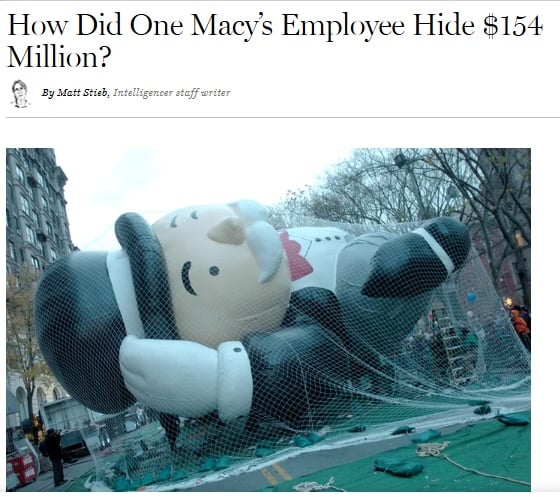
To see how wild this can get, you only have to look at the Macy’s scandal from late 2024.
One employee managed to hide over $154 million in fake expenses over several years just by messing with small-package delivery entries.
Common Signs of Fake Receipts
- Inconsistent hotel logos
If there’s one place fraudsters slip up, it’s the logo. A real receipt starts with branding, and branding follows rules. Fraudsters copy-paste, and that’s where fake receipt detection begins.
If you’re squinting at a receipt, keep these four things in mind:
- Resolution Mismatch: If the text is crisp but the logo looks like a blurry thumbnail from 2005, it was likely ripped from a random Google Image search.
- The Squish Factor: Real hotels are obsessed with their brand guidelines. They don’t send out receipts with logos that look stretched out or squished into a corner.
- Color Fails: Major chains use specific hex codes. If the “Marriott Red” looks more like a “Post-it Pink,” it’s a fake.
- Logo History: Scammers often accidentally use a logo version the hotel retired years ago.
| Funktion | Legit Receipt | The Fraudulent Version |
| Edge Quality | Sharp, vector-based lines | Fuzzy JPEG artifacts (gray pixels) |
| Alignment | Perfectly centered or balanced | Looks tilted |
| Konsistens | Matches the hotel’s current site | Outdated or generic version |
- Irregular dates or times
Dates and times are the most revealing signs in fake receipt detection, and the hardest to cleanly falsify.
- The Weekend Sign: Claims for business stays on weekends when an employee was actually on personal leave.
- The 6:00 AM Checkout: This is a red flag. Most business travelers check out in the late morning.
- Logistical Flaws: If a flight lands on the 6th and leaves on the 7th, a 3-night stay claim (Nov 5–8) is physically impossible.
- The Date Gap: Check-in and check-out dates that don’t match the number of nights billed.
Et eksempel:
An employee claims a 3-night stay at a Chicago hotel from November 5–8.
However, flight records show they arrived in Chicago on the morning of November 6 and departed on the evening of November 7. A 3-night stay is not logistically possible.
Cross-referencing dates with flight records, HR calendars, or payroll is a simple travel expense verification method.
- Mismatched totals and taxes
Every city has a unique tax fingerprint. If a fraudster guesses the percentage, they’re going to leave a trail.
- City-Specific Rates: NYC is 14.75%, San Francisco is 14%, and Vegas is 13.38%. If a New York receipt shows an 8% tax rate, it’s a fake.
- The “.00” Red Flag: Real totals are rarely round numbers. If every line item ends in a perfect .00, be suspicious.
- Phantom Fees: Watch out for resort fees added to budget hotels that don’t actually charge them.
You’d be surprised how many fakes fail simple multiplication. If these three steps don’t add up perfectly, flag it as potential hotel receipt fraud:
- Room Rate × Nights = Room Subtotal
- Room Subtotal × Local Tax Rate = Tax Amount
- Subtotal + Tax + Fees = Final Total
Focus on the timestamps and tax percentages. They are much harder to falsify than the total price, making them the easiest way to spot a fraudulent claim.
How Fraudsters Use AI to Manipulate Receipts
Thanks to the AI upgrades we saw in 2025, the fakes are now perfect. Trying to catch them with the naked eye is a total toss-up.
Back in the day, fakes were easy to spot. Now, generative AI has changed the game:
- New tools study real receipts to copy layouts and even the tiny wrinkles on a scanned page.
- Deepfake fraud jumped 700%. Experts think companies could lose over $11 billion as these tools go mainstream.
- Fraudsters aren’t just faking one receipt anymore. They’re using AI to create matching pay slips and bank statements to make the whole lie look legit.
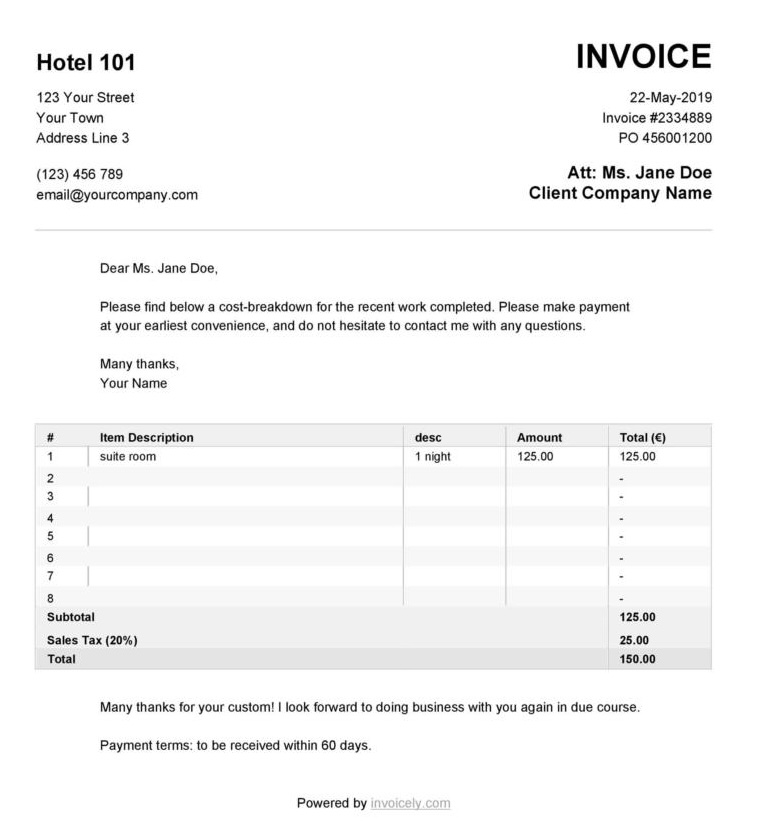
It’s actually easier to fake a receipt now than it is to book a room. Here’s how the modern hustle works:
A scammer tells an AI, “Make a receipt for a 3-night stay at the Hilton for $620 with a realistic tax breakdown.”
The AI spits out a high-res PDF with the right logos, signature lines, and metadata.
The perfect document is uploaded to the expense system in seconds.
These fakes are so realistic that manual review is basically a coin flip. If your company is still relying on a human to spot the difference, you’re already behind, and you need a proper deepfake detector in your stack.
Using AI Tools to Detect Fake Hotel Receipts
You can’t fight 2026 fraud with 2016 controls.
If fake receipts are being generated by smart tools, your fake receipt detection needs to be just as smart.
- Deepfake Detector: Spot synthetic visuals
TruthScan’s Deepfake-detektor is built to identify AI‑generated and digitally manipulated visuals.
- It looks for things a human would miss like weird lighting, smooth gradients that don’t belong on paper, and tiny artifacts left behind by AI tools.
- Even if someone just tries to swap a background or delete an object to hide a personal stay, this tool flags it with over 97% accuracy.
- Every time a new AI image generator drops an update, TruthScan is usually updated within 48 hours to recognize the new patterns.
- Fake Receipt Detector: Identify anomalies automatically
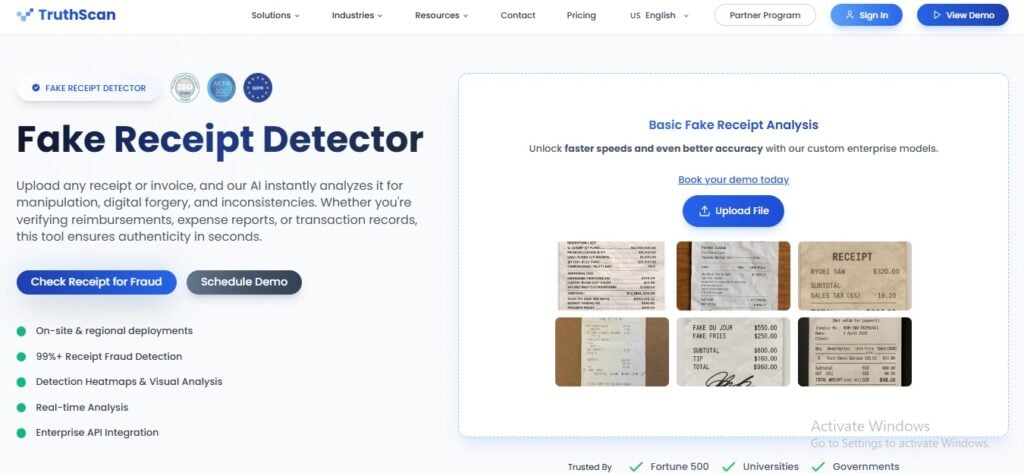
TruthScan’s fake receipt detector is purpose-built for finance teams who need to know if a bill is legit before they hit “Approve.”
- It compares the submitted receipt against thousands of authentic templates from real merchants. If the layout is off by even a fraction, it gets flagged.
- Instead of just saying “Yes” or “No,” it gives your finance team a risk score with actionable insights, so they know exactly why a document looks fishy.
- You can plug this directly into your approval flow. This way, a suspicious document gets caught before the fraud.
- Metadata and format checks
This is the most technical layer of AI expense auditing, and honestly, it’s where most fraudsters get caught red-handed. Every digital file has a hidden story called metadata, which TruthScan reads.
| The Check | Why It’s a Red Flag |
| Creation Date | If the PDF was created in Feb 2026, but the stay happened in 2025, something’s off. |
| Software Stamps | Files made in Photoshop, Canva, or GIMP leave digital fingerprints. Real hotel receipts shouldn’t show editing software in the file data. |
| Locale Mismatch | A hotel receipt from Paris shouldn’t have metadata set to “English (US).” That doesn’t add up. |
| Compression Patterns | AI-generated images have unique noise patterns. Real scanned receipts don’t look like that under the hood. |
Integrating Detection Into Travel Reimbursement Workflows
A detection tool needs to be built into your workflow to stop fraud.
Step 1 — Connect via API
TruthScan integrates with platforms like SAP Concur, Expensify, Ramp, or Zoho Expense. It automatically scans receipts and returns results in real-time, without changing your workflow.
Step 2 — Risk Score Thresholds
Each receipt gets a confidence score:
- Green (90%+) → Auto-approve
- Yellow (60–90%) → Review manually
- Red (<60%) → Auto-hold, request original
This ensures only suspicious receipts need human attention.
Step 3 — Batch Processing & Alerts
Large sets of receipts are reviewed quickly, with confidence scores and metadata. Suspicious ones trigger reimbursement fraud alerts routed immediately to the right people.
Step 4 — Audit Trail
Every scan is logged for compliance, legal, or disciplinary needs.
Best Practices for Enterprises
Here are the best practices to help enterprises prevent hotel receipt fraud:
- Define Policies Clearly: Specify required receipt details like folio number, itemized charges, and check-in/check-out dates.
- Mandate Corporate Cards: Company card charges automatically cross-verify with bank statements; avoid cash reimbursements.
- Require Pre-Trip Approval: Approve trips and submit booking confirmations first to catch inconsistencies easily.
- Do Random Audits: Spot checks and detailed reviews catch subtle issues automated systems may miss.
- Verify High-Value Receipts: Call the hotel’s accounting department to confirm details on large claims.
- Cross-Check Travel Dates: The simplest travel expense verification move: Compare receipt dates with HR/payroll records to spot impossible or overlapping claims.
- Educate Employees: Clear guidelines and awareness reduce risky behavior; detection tech also acts as a deterrent.
- Shift to Proactive Prevention: Build AI expense auditing into pre-approval flows so suspicious documents never get reimbursed in the first place.
How TruthScan Helps Prevent Fake Receipt Fraud
TruthScan uses a multi-layer defense to catch what humans (and basic software) miss:
It’s a purpose-built fraud prevention system, designed to stop hotel receipt fraud at scale.
- Finds pixels or lighting that don’t look right.
- Sees when and how the receipt was made, like if it was edited in Photoshop.
- Compares the receipt to real ones to spot small mistakes, like a logo in the wrong place.
- Notices odd patterns in how employees submit receipts.
TruthScan hits high marks even against the most convincing AI generators:
| AI Tool | Detection Accuracy |
| MidJourney | 97.5% |
| DALL·E | 96.71% |
| Overall Realtime | 99% |
At the end of the day, TruthScan is a purpose-built fraud hunter. It is protecting your revenue from the next generation of AI-fueled scams.
Talk to TruthScan About Securing Travel Reimbursements
Even one fake receipt slipping through can cost your company in culture, audit fees, and regulatory scrutiny.
With TruthScan, you can:
- Integrate a deepfake detector and fake receipt detector into existing expense workflows. No disruption.
- Automatically scan every receipt with AI expense auditing. Humans only review flagged cases.
- Receive real-time reimbursement fraud alerts before approval.
- Keep audit-ready logs for every decision.
- Stay protected against new fraud patterns as they appear.
Schedule a demo with TruthScan and give your team protection that manual review simply can’t.