
Diploma Mills 2.0: How AI Powers Academic Credential Fraud
When I started my research on this topic, I opened Google, and my first page looked something like this:
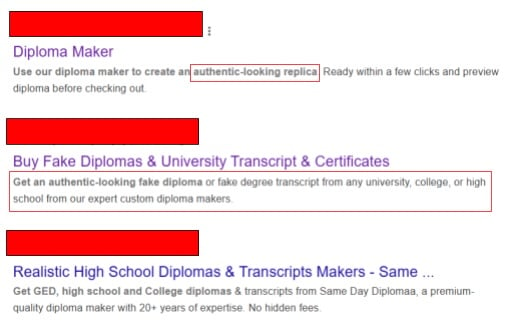
This isn’t the Dark Web or Telegram. All you need is a Google search bar and a credit card to get your job done easily.
The fact that these Diploma mills are ranked on Google is concerning. Because it’s a legal grey area. If you lost your certificate or diploma and you buy a replacement diploma, that is not illegal, but actually securing a job through it is credential fraud.


Never Worry About AI Fraud Again. TruthScan Can Help You:
- Detect AI generated images, text, voice, and video.
- Avoid major AI driven fraud.
- Protect your most sensitive enterprise assets.
This is where it all begins. The props created with Photoshop have their flaws, but now with Generative AI, the documents look too real.
In this blog, we’ll talk about how Generative AI fraud happens, what factors can help us catch that, what an actual legal procedure is, and how TruthScan can help you stop it.
What Are AI-Powered Diploma Mills?
You typically need a solid operation behind it to run a traditional diploma. We’re talking about things like:
- phoney documents
- AI-generated transcripts
- Synthetic student records
- Fake diploma or certificate
- Verification letters
- Enrollment proof documents with proper seals
And a whole ton of people work on the scheme.
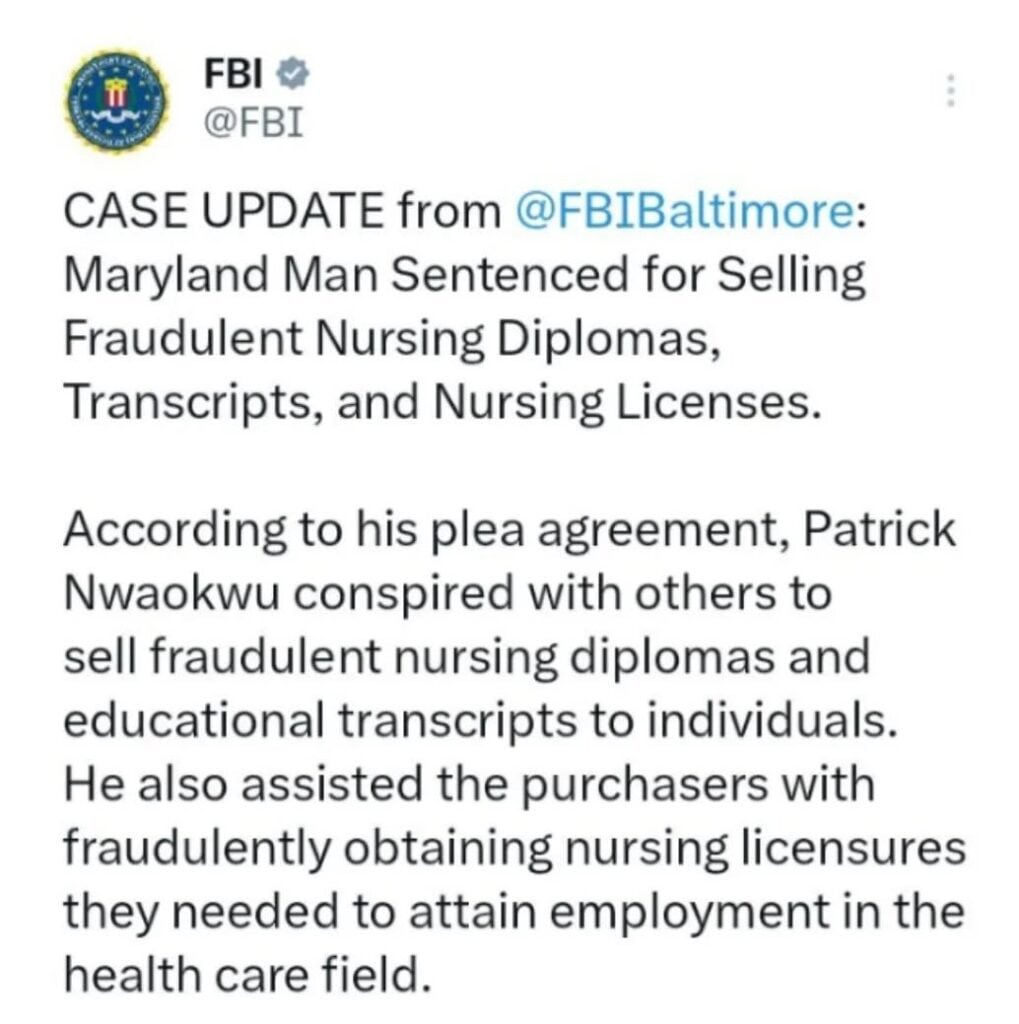
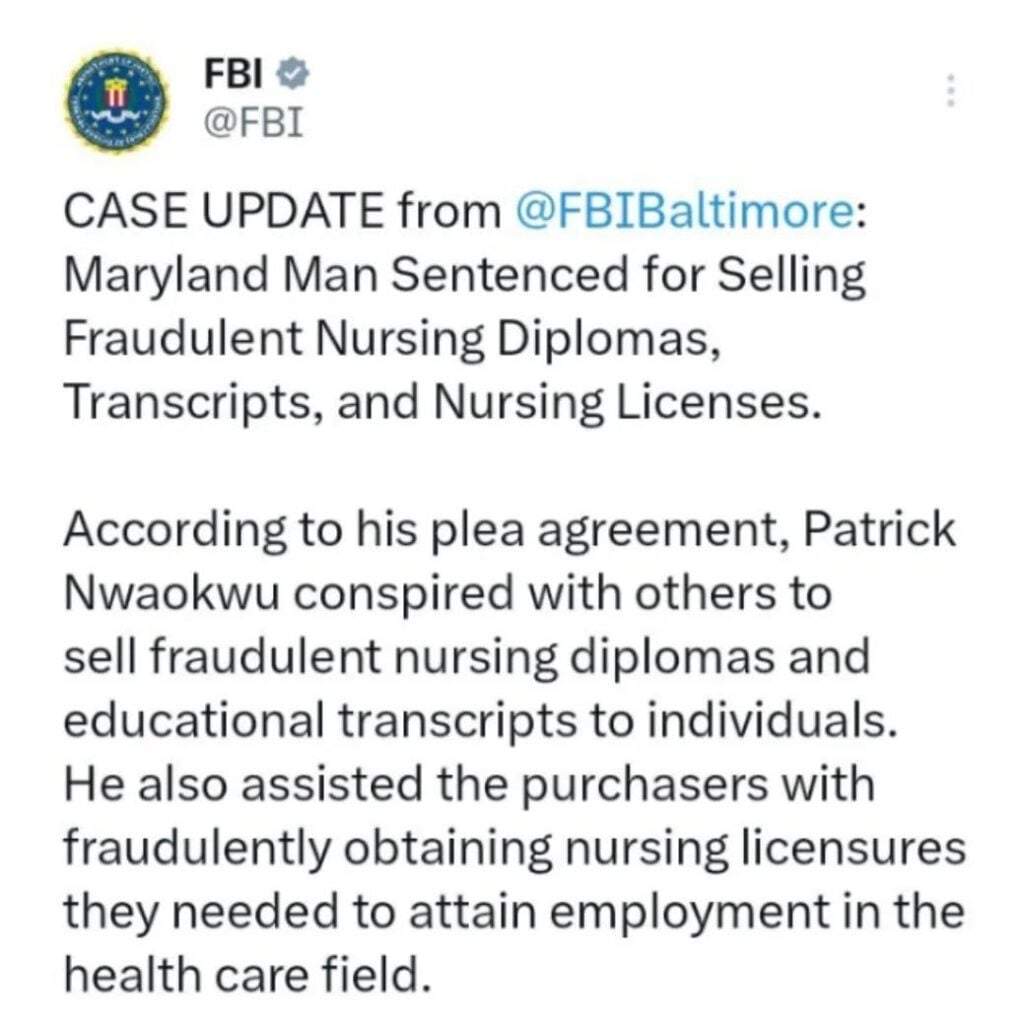
That’s the main reason it took five years for Operation Nightingale, the biggest nursing credential fraud in U.S. history, to be built from scratch, and that ended up 12 defendants were charged with conspiracy to commit wire fraud for selling fraudulent nursing diplomas and transcripts to aspiring nurses across Florida, according to the U.S. Department of Justice.
AI-powered diploma mills don’t have the same costs. They usually operate like online shops, mostly found on public sites, still sometimes they’re hidden away on Telegram or in private marketplaces, and since it’s fully automated, people can simply get their deliverables as a file.
| In some cases, what appears to be first-party fraud is actually synthetic fraud. And a lot of that is also hybrid. Some details may be real, some details may be fake. The AI makes this faster and easier to do at scale. Laura Spiekerman — Co-Founder & President, Alloy |
Traditional vs AI Credential Factories
Here’s the difference between the two of them based on the following factors.
| Factors | Traditional Diploma Mill | AI-Powered Diploma Mill |
|---|---|---|
| Physical infrastructure required | Yes: premises, staff, printing, mailing | No: fully digital, no fixed footprint |
| Document quality | Detectable on close inspection | Visually indistinguishable from real documents |
| Customization | Fixed templates per school | Any institution, any degree, any graduation date on demand |
| Verification weakness exploited | Institutions that don’t respond | AI-generated confirmation letters sent in real time to verification requests |
| Operational risk | High: paper trails, co-conspirators | Low: no human network to investigate |
How AI Lowers the Fraud Barrier
The real question that should come into your mind is: how did everything work before generative AI?
Well, creating convincing fake documents used to take some serious Photoshop skills, high-quality scans from institutions, and definitely a good eye for design. (which some people are born with)
But most of the time, if you looked closely, you could spot the fakes back then.
According to Inscribe’s 2026 State of Document Fraud Report, you can easily find editable diploma templates for less than $50 in open marketplaces.
Plus, they noticed that the number of detected AI-generated transcripts and credential fraud cases increased nearly five times from April to December 2025.
How AI Fake Credentials Are Made
Every phase of the production process clearly clarifies why a particular verification check fails to catch fake AI credentials.
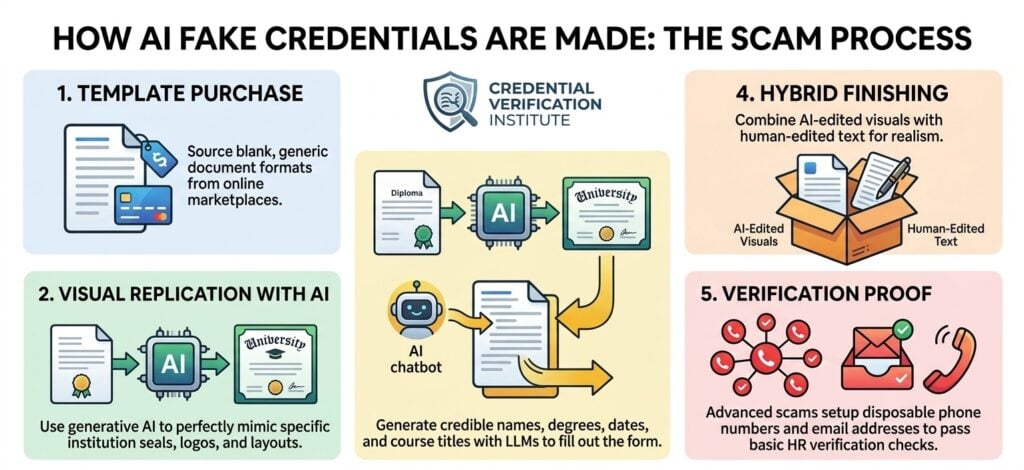
Step 1: Template purchase. They start the process by purchasing an editable diploma file for a specific institution from an online marketplace, since large number of universities have versions of their docs, including matching designs for transcripts and enrollment design confirmations.
Step 2: Visual Replication with AI. If there’s no template available, generative AI can easily recreate the visual aspects using a reference image, like seals, signatures, letterheads, and watermarks, by using just a simple prompt.
Step 3: Supporting text using AI. A full package of fraud for an academic document requires more than just a visual credential. AI helps create enrollment letters and grade reports, along with reference responses that mimic the style and formatting of actual communications from institutions.
(This detail makes it difficult to keep things consistent when an employer asks for multiple supporting documents.)
Step 4: Hybrid finishing. The end result isn’t just a template that was bought online or generated by AI. Instead, it’s a box containing two products:
- Purchased template with AI-edited visuals
- Human-edited text.
Spotting it requires a verification process that analyzes both images and text at the same time.
Step 5: Verification proof. Advanced operations can create phone numbers and email addresses that can easily respond to HR verification calls.
So, when a hiring manager calls to verify a degree, someone is on the other end to confirm the verification. Here, at the end of the story, the check is logged as a success!
Scale of Credential Fraud in 2026
The data from tons of independent sources now tell the same story.
VerifyED’s 2026 diploma mill database tracks 3,298 fraudulent institutions tracked across 233 countries.
According to a springer study, the academic fraud industry, which includes:
- Diploma mills
- Fake degrees
- Fraudulent credentials
It is worth $21 billion USD at least.
According to HireRight’s 2025 Global Benchmark Report, which involved more than 1000 HR and risk professionals from North America, EMEA, and APAC, more than 75% of businesses found at least one candidate scam in the last year.
Especially in EMEA (Europe, the Middle East and Africa), around 47% reported problems with education credentials. Surprisingly, if you got to know that, only about 60% of companies worldwide perform identity checks during their hiring processes.
Why Verification Methods Are Failing
Old Verification methods are failing against AI credential fraud due to the following gaps:
OCR (Optical Character Recognition) checks the raw text, and document parsing checks the layout and structure of the document.
AI-generated transcripts can pass them in many cases because they provide the actual text in actual fields.
Visual inspection, human receivers looking at the inconsistencies, doesn’t work any more. Which means people are still checking for mistakes that AI no longer makes.
PDFs are still trusted by universities. But the issue is AI can now embed layouts, realistic metadata and fake layouts, making fake PDFs look like it was printed, signed and scanned back to the computer. (humans can’t identify it with just one look.)
The gap that is worth noticing:
Before AI, Real and fake documents were pretty easy to spot:
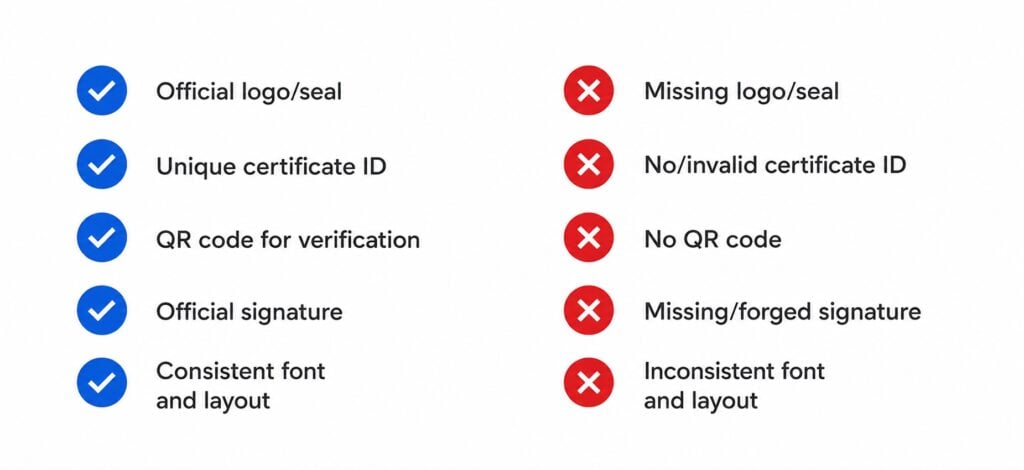
Document forgery is shifting because AI tools have been turned into:
- synthetic documents
- Embedded fonts & structural layout
- fake verification systems
- Realistic Codes
Detecting AI-Generated Credentials
In 2026, detecting educational fraud is a whole different process, rather than just looking out for visuals or formats.
- Testing pixe- level artefacts helps you reveal how AI image generation is impacting data reduction and the structures of the data being generated.
- Text-layer AI analysis mainly uses linguistic fingerprinting to check through the documents that support the main one.
- Cross-reference verification compares the schools in question against the database and known diploma mills, including those that have already been flagged.
- Forensic analysis of metadata looks into the file creation history, like what software created it, when it was edited, and the information about the device that was used for it.
So, if an AI-generated diploma has a graduation year that’s backdated, the metadata will definitely tell us a different story.
TruthScan’s enterprise feature processes all four types for every document submitted before any human gets involved. Then it generates a forensic report that includes pixel-level evidence, and above all, a detailed look at the metadata history, and a confidence score for each part.
Book a demo and see for yourself how TruthScan works
Legal Risks of Credential Fraud
For individuals, using fake academic credentials can cause:
- Employment contract violation and termination
- Civil serious penalties
- Fraud investigations & regulatory action
- Immigration
The organization that hired them can face:
- Compliance failures
- License violation
- Negligent hiring claims
- Security risks & audit failures
In the US, the Immigration Reform and Control Act (IRCA) of 1986 requires all U.S. organizations to check the certificate and identity documents of newly hired workers to avoid hiring unauthorized persons (people with fake credentials)
This applies to all the industries that require certifications:
- Healthcare
- Aviation
- banks
- Finance
- Engineering
- Law enforcement & Government contracting
What is being verified:
- Passport
- Social security number
- Birth Certificates or green card
Modern Credential Verification Workflow
The truth is, what worked back in the day isn’t going to work anymore. Here are the current best options you can use instead:
- Document forensics when submitted.
Every credential that is uploaded should be checked by AI-generated artifacts like metadata and fraud detection cues before it reaches human hands. All automated and gives you a result within a few seconds.
- Text analysis on supporting materials.
It includes cover letters as well as personal statements, and reference letters that are submitted with the documents submitted to check generative AI diploma fraud patterns. A big RED FLAG to look for is the presence of visually authentic documents that come with AI-written support materials.
- Primary source verification.
If the information provided by the candidate appears suspicious, it can be checked through a verified channel like the National Student Clearinghouse or equivalent registries. Verification done by automation is way faster and more reliable.
- Double-check Accreditation.
Search the U.S. Department of Education Database and CHEA Directory of Institutions and Programs to verify if an institution/organization or program holds recognized federal accreditation.
- Ongoing monitoring for licensed roles.
If we’re discussing healthcare, finance, legal, and educational professionals, the initial stage of verification is not going to be a one-time thing.
Certification withdrawals and ethics violations definitely need continuous check-ins, not just a single process.
How TruthScan Detects Fake Credentials
TruthScan is the enterprise AI detection platform built by Undetectable AI. SOC 2 and ISO 27001-compliant, and offers a single API covering image, text, video, and voice detection.
Instead of talking about its features, let me walk you through how it detected the Academic certificates and documents that I created using AI.
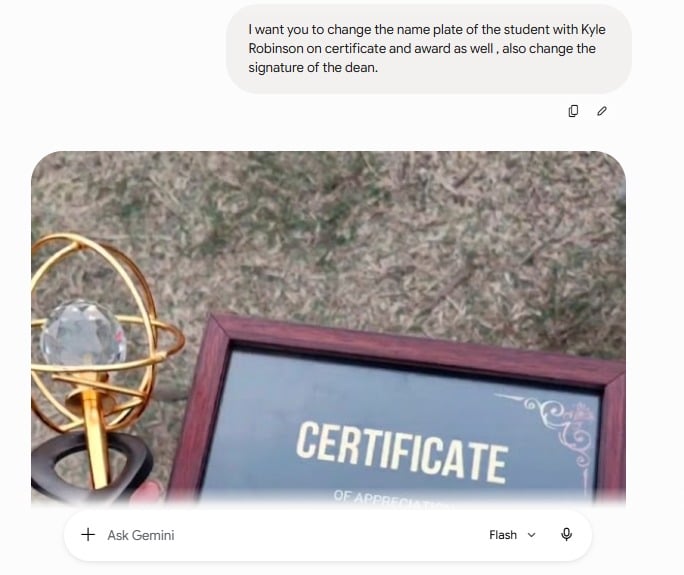
I downloaded a real certificate image from Google and manipulated it with AI to test it against TruthScan’s Enterprise AI Detection Analysis platform.
AI image tools can easily replicate the official fonts, seal designs, and signatures, all of that with just one reference photo.
Here’s the prompt I used.
Here’s the before and after:
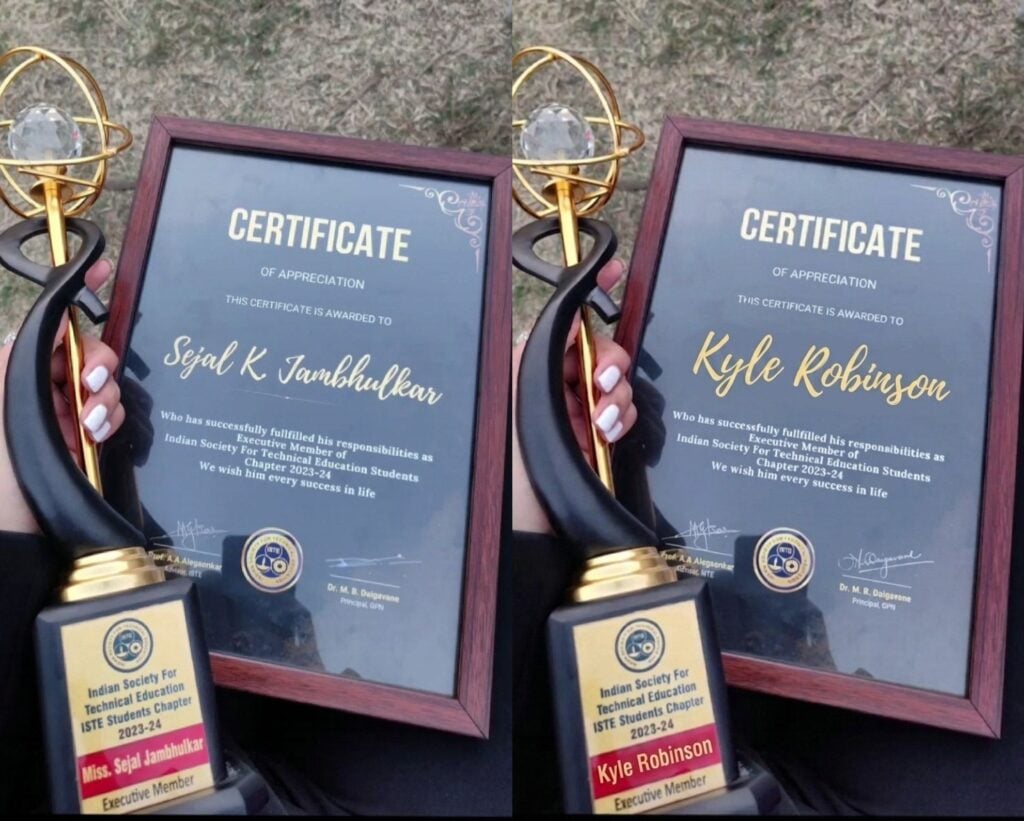
Now let’s check both.
The result from the real image tells us about the false positive rate of this tool, while the manipulated image shows whether TruthScan can detect the minor changes or not.
Results of the certificate:
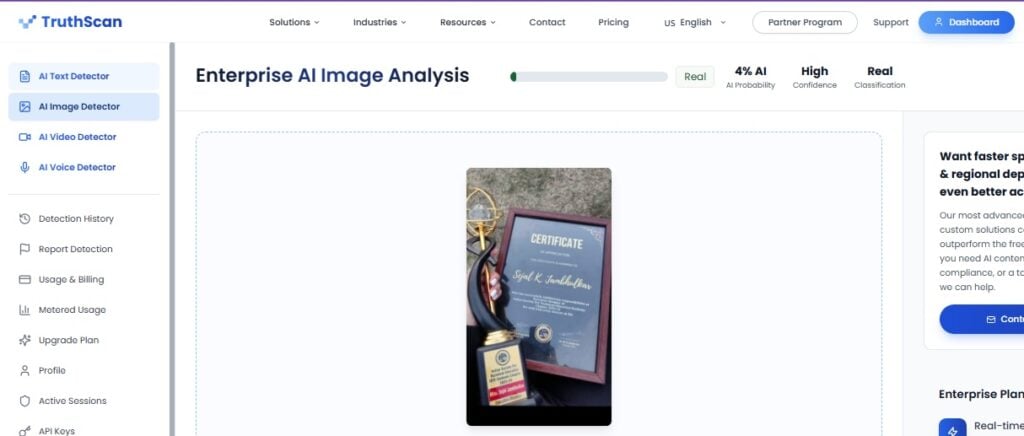
And the AI-Manipulated one:
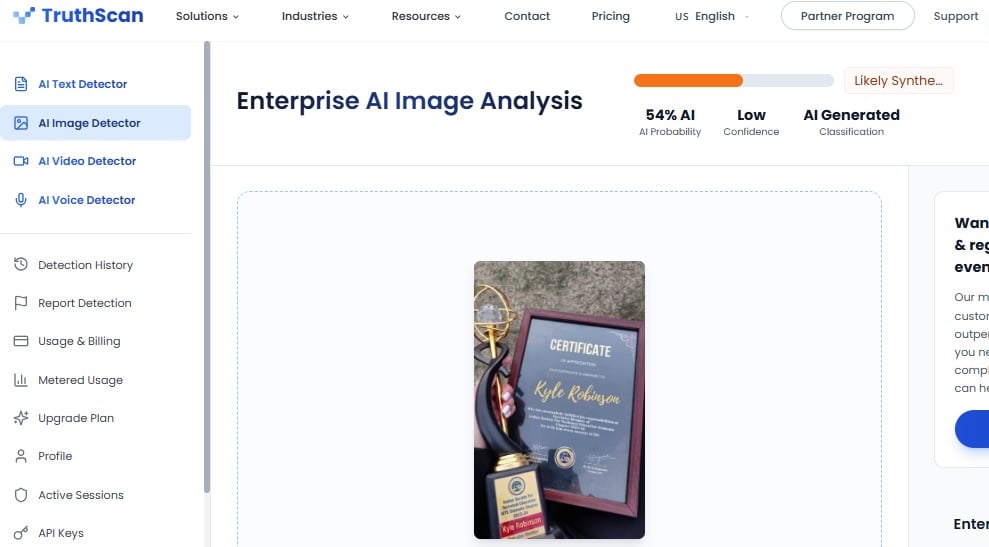
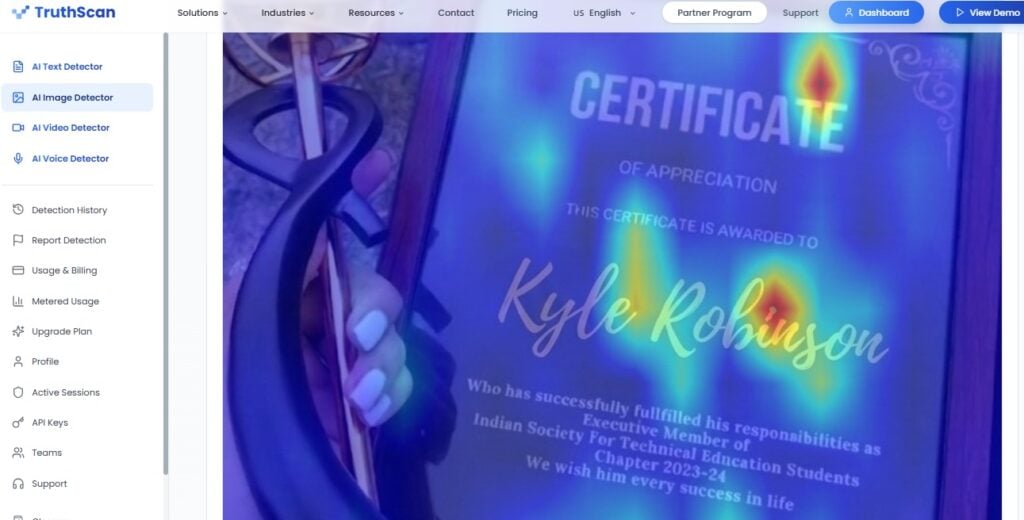
Heatmap and the AI probability are on point.
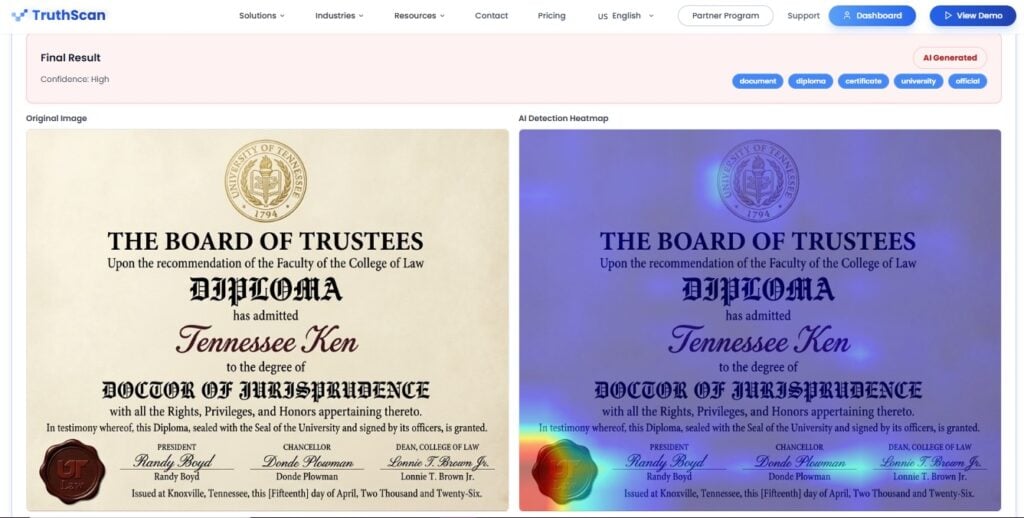
How about we create a FAKE certificate from scratch using AI?
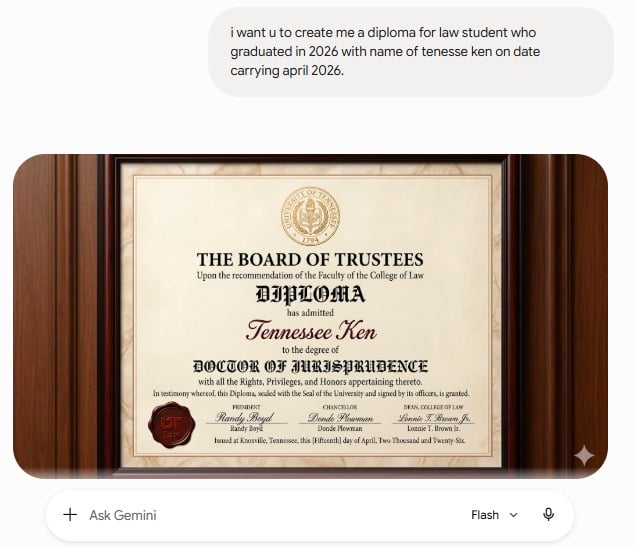
I even removed the side parts (to hide Gemini logo) to trick the tool, but it still detected the fake diploma.
Stop AI Credential Fraud Today
Those fake certification platforms that come up on Google’s first page aren’t just a monitoring process anymore; they’re a big part of a well-organized supply chain delivering directly into
- hiring processes
- Screening systems
- licensed workforces
It tells us what we are missing here.
What sets 2026 apart from every year prior is the newly issued credentials from this supply chain that are now able to pass the verification checks (that they failed before).
This isn’t due to a decline in due diligence from verification teams; rather, it’s simply because the fraud has been mapped to align only with what your system expects to see.