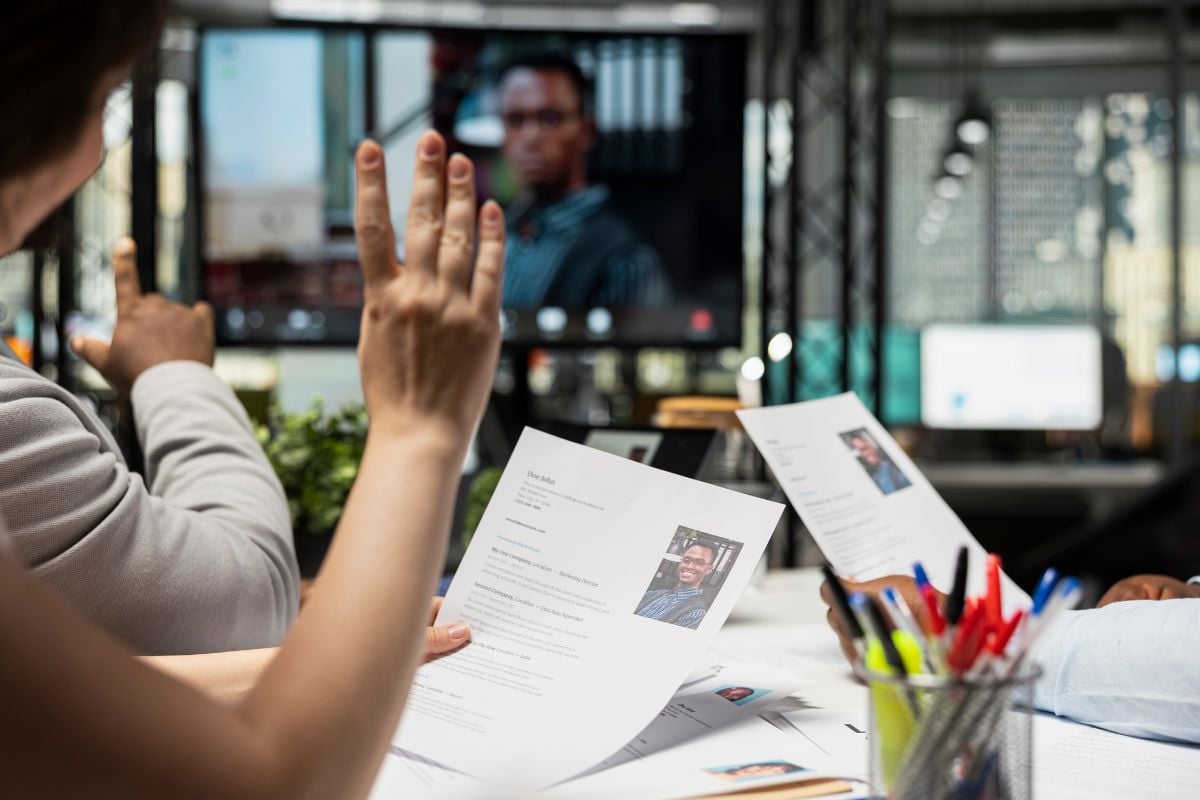
A potential candidate may tick all the boxes on your checklist during an interview. However, with the influx of AI tools, there is a possibility that the candidate might not even exist in the first place, thanks to deepfakes.
Deepfake technology has become so good that fraudsters have taken it upon themselves to use it to impersonate candidates during live video job interviews.
That is why you need to educate yourself on deepfakes and the dangers that come with a fraudulent hiring process before you hire the wrong person.
Let’s dive in.
Key Takeaways
- Enterprises are at risk of candidate identity fraud
- It is important to invest in deepfake detection tools
- AI interview verification deepfake alerts helps decision making without slowing down recruitment
What are Deepfake Job Interviews?
A deepfake job interview is when an individual makes use of an artificial intelligence-created video or audio to impersonate a different individual during a job interview.
It occurs when a candidate employs a doctored video or even invents a totally fake individual in the course of hiring.
So, instead of the real applicant showing up on screen, you might see:


Never Worry About AI Fraud Again. TruthScan Can Help You:
- Detect AI generated images, text, voice, and video.
- Avoid major AI driven fraud.
- Protect your most sensitive enterprise assets.
- A manipulated or entirely synthetic face.
- Pre-recorded answers triggered live
- AI-generated voice cloning
- A completely different person pretending to be the resume owner
Scammers who use deepfakes do so to let a more “qualified” person handle the Interview on behalf of someone else. It lets them deceive the recruiter and land a job under false pretenses.
With an increase in remote hiring, candidate identity fraud has become much easier for individuals to commit. There are times when you do not know whether you are talking with a real person.
It is no longer about the counterfeit resumes, it has now turned towards live time deception in video interviews, making deepfake interview detection very important.
Why Enterprises Should Care
You are probably thinking, “Yes, deepfake interviews are real, but how big of a deal is it really?”
Deepfake interviews are getting more serious than you would expect, and that is why you and every enterprise owner should pay attention.
For starters, these fake interviews do not end with just impersonating someone else, it has gradually moved to trying to fraudulently gain access to a company.
Scammers are now trying to use deepfakes to get employed, especially in roles that involve sensitive data, financial systems, or intellectual property.
It has become a case of potential data breaches, insider threats, and legal liability.
With deepfakes, industries like fintech, healthcare, defense, and basically any company with proprietary systems are at risk. Hiring scammers with the right level of access could cause damage that takes years to undo.
Outside of potential security breaches, there is also the cost incurred by a bad hire. That is, the amount it costs to onboard and train a new staff member.
So, enterprises can no longer afford not to care; there is a need for immediate deepfake interview detection and hiring fraud prevention.
Techniques Used in Deepfake Interviews
The question everyone is asking is “How do these fraudsters actually pull it off?”
The following are the techniques used in deepfake interviews:
- Face-Swapping Technology: This is actually the most popular way. It involves using tools that allow scammers to overlay a different face on a live video in real-time. The technology uses AI to map another person’s facial expressions and movements over the interviewee so the scam appears natural during the call.
- Voice Cloning: This technique uses artificial intelligence to replicate a person’s voice. The scary thing about this is that the technology does not need a long recording of the person’s voice. All it needs is just a few minutes of audio. With this tech, you might be watching a real video, but the voice you are hearing might not belong to the person on the screen.
- Synthetic Filter or Avatars: Scammers also use AI-generated people that do not exist at all. The method is often used alongside fake documents and online profiles that look legit at a glance.
- Pre-recorded Interview Response: Fraudsters use pre-recorded interview answers synced to appear live. They record these answers with slight delays to make it look real.
While these techniques sound complex, recruitment deepfake alerts are catching these patterns and much more.
Red Flags During Candidate Screening
Before we address the tech solution to this problem, it is important to know the red flags to look out for during candidate screening.
Here are some of the signs that may point to a candidate identity fraud:
- Unnatural Facial Movements: One thing deep fakes struggle with is facial movements. You would always see things like irregular blinking patterns and eye movements with deepfakes. If the person on the screen looks too stiff or off sync for a regular person, it is most likely a fake.
- Delay in Audio and Video: Even with good deepfake tech, there is a probability that the audio and video will feel slightly out of sync. You would probably notice that what you are hearing and how the lips are moving is different. That should tell you that something is not right.
- Inconsistencies with Lighting and Skin Texture: Real human faces have depth, shadow, and texture that AI struggles with. So if you see that the face on the video seems too smooth and lacks texture, then it is probably fake.
- Blurry Edges: The appearance of blurs around a person’s face are obvious sign of a composited image. This is more obvious when the person moves.
- Rigid Head Movements: In a deepfake video, it is possible that the candidate refuses to turn their head or face the camera directly. So if you notice this, it should tell you the fraudster is working around the limitations of their deepfake setup.
Other red flags you should watch out for outside of video interviews include resumes that look impressive but lack depth, scripted technical responses, and refusal of the candidate to go through identity verification steps.
Challenges of Manual Verification
The truth is, even with all the knowledge on how to spot deepfake fraud on the internet, you can never be 100% correct.
This does not mean that you are doing something wrong; it is just that deepfake technology has evolved and become difficult for mere human eyes to detect.
Here are the challenges of manual verification:
- Human eyes often miss subtle frame distortion
- Tiredness reduces attention to detail
- Virtual interviews lower natural suspicion
- Personal bias may affect judgment
- High hiring volumes may reduce the time spent on closely analyzing each video
With artificial intelligence, deepfake videos have become incredibly convincing, and studies have shown that even trained observers struggle to identify fake videos with just their eyes.
Apart from the videos being too advanced, recruiters with multiple interviews to run barely have time to review each video for signs of manipulation.
This is why AI interview verification tools are not just nice to have; they are a necessity for hiring teams.
How AI Detects Deepfake Interviews
So, how does AI detect deepfake interviews? AI-powered deepfake interview detection works by looking at patterns and signals that are consistent with manipulated videos.
It looks for signs that are invisible to human eyes and don’t match natural human behavior.
Deepfake detectors analyze tiny differences in how the face moves. They also check out pixel-level artifacts that appear when AI generates or manipulates video frames.
You can use these detectors to check audio frequency patterns that reveal voice synthesis. They can even examine the metadata that is common with specific deepfake tools.
What makes an AI Video detector better than human effort is that you can analyze interview videos while the interview is actually happening.
That way, you can discover suspicious activity as it happens rather than when it might be too late.
An AI video detector scans frame-by-frame distortion, face morphing inconsistencies, and background movement mismatch.
Integrating Detection Into Hiring Workflows
At this stage, where technologies continue to advance, it is important that every company starts to integrate detection into workflows.
Don’t get it wrong, though; integration doesn’t need you to change your whole system. All you need to do is find the best deepfake detection software that fits into your existing workflow.
Here is how companies are integrating deepfake interview detection:
- Using a Real-time AI detector: Companies are now starting to use live video AI detectors that run in the background during interviews. These tools analyze a candidate’s video as the interview is happening, and when someone looks off, the system flags it and reports to the recruiter.
- Using AI Video Detector: An AI video detector can process footage after the fact, especially for recorded interviews or video submissions. It checks for authenticity before it reaches the last stage of the hiring process.
The whole integration process happens through API connections with your video interviewing platform. These detectors already come with flexibility in mind, so you don’t have to do much technical work on your end.
All you need to do is have detection checkpoints from the initial screening stage to the final-round interviews.
That way, you have a layered hiring fraud prevention effort and multiple opportunities to catch something before it becomes a big problem.
Benefits of Using AI in Recruitment
There are many benefits of using AI in your recruitment process, and they include:
- Building trust in your hiring process
- It protects the reputation of the company in public
- It frees up recruiters to focus on other parts of the recruitment process
- It creates a more equitable process
- It reduces the risk of candidate identity fraud.
TruthScan Tools for Deepfake Job Interviews
For practical solutions to deepfake job interviews, TruthScan offers a range of tools that make the hiring process easy.
These tools include:
Deepfake Detector
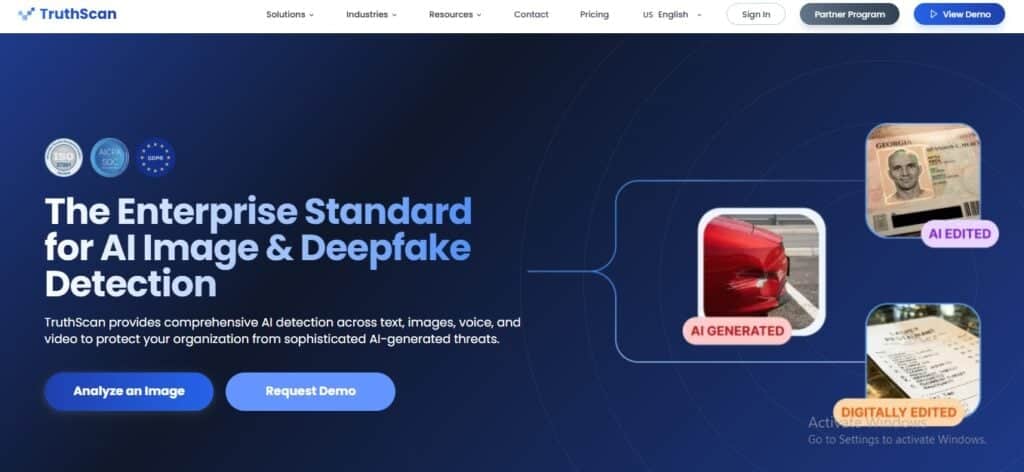
TruthScan’s deepfake detector uses advanced computer vision and machine learning algorithms to identify signs of manipulation.
It analyzes facial movements, blinking patterns, and pixel-level inconsistencies that are known with AI-generated videos.
The TruthScan deepfake detector does the following:
- Face swap detection
- Facial authentication
- Video forensics
- Live stream analysis
- Automated authentication
- API integration via Rest API
The tool identifies deepfake content with 99% accuracy, and that means that you get clear, actionable outputs no matter what you are looking for.
Real-time AI Detector
The TruthScan real-time AI detector is like an assistant interviewer. It monitors the video stream as the interview is going on, flagging suspicious patterns the moment they appear.
The tool is trained to notice what you cannot. Once it detects that a candidate is using a deepfake, recruitment deepfake alerts are triggered immediately. It works without letting the fraudster know that they’ve been caught.
The TruthScan real-time AI detector also ensures that detection happens fast enough to be useful in real-time and not five minutes after the fraud has occurred.
AI Video Detector
In the case of those companies that use asynchronous video interviews, where the applicants record their answers themselves, TruthScan provides an AI Video Detector that analyzes such videos to detect evidence of manipulation.
This tool ensures that each video submission is checked for signatures of AI generation and manipulation before they reach your hiring team.
It guarantees that the outcomes of each test are provided in a short time hence there is no stalling of the recruitment process.
TruthScan’s AI video detection platform is also built for video authenticity verification at scale. This is valuable for high-volume recruiting scenarios, where manual review would slow things down.
It can work as a first pass filter, separating videos that need a closer review from those that pass the test.
The AI Video Detector that TruthScan has can detect videos generated by over 20+ AI models, and it continues to adapt to new models as they emerge.
How TruthScan Protects Enterprise Hiring
TruthScan is built to protect enterprise hiring from falling victim to deepfake interview fraud. It helps companies that have a high influx of candidates and need to do AI interview verification on a large scale.
The platform goes through each video to find signs of manipulation and fraud before they cause harm to any company’s data.
Enterprises do not have to change their existing workflow before using TruthScan tools. Companies can always connect TruthScan to their hiring process setup and automatically verify videos in real-time.
The most interesting part? TruthScan evolves. The platform adapts as fraud techniques change. So you don’t have to worry about any new fraudulent AI model causing damage before you can stop it.
Talk to TruthScan About Securing Your Recruitment Process
With the different technological changes happening in the hiring environment, candidate identity fraud is not something that should be handled with levity.
Some companies are already dealing with the effect now and are taking steps to protect themselves.
To prevent fraud in your hiring process, you need to stop relying on gut instincts alone and start using real, AI-powered protection.
TruthScan offers the level of protection you need to prevent fraudsters from gaining entry into your enterprise. It helps provide AI interview verification that works at the scale and speed your organization requires.
Talk to TruthScan now to find out how our deepfake detector, real-time AI detector, and AI videos detector can become a part of a smarter and safer recruitment process.
The best time to catch a deepfake is before they get hired.